Christians and culture: Where do we draw the line?

Neil Robbie  |  Comment
Date posted:  3 Jul 2026
Share Add       
Christians and culture: Where do we draw the line?

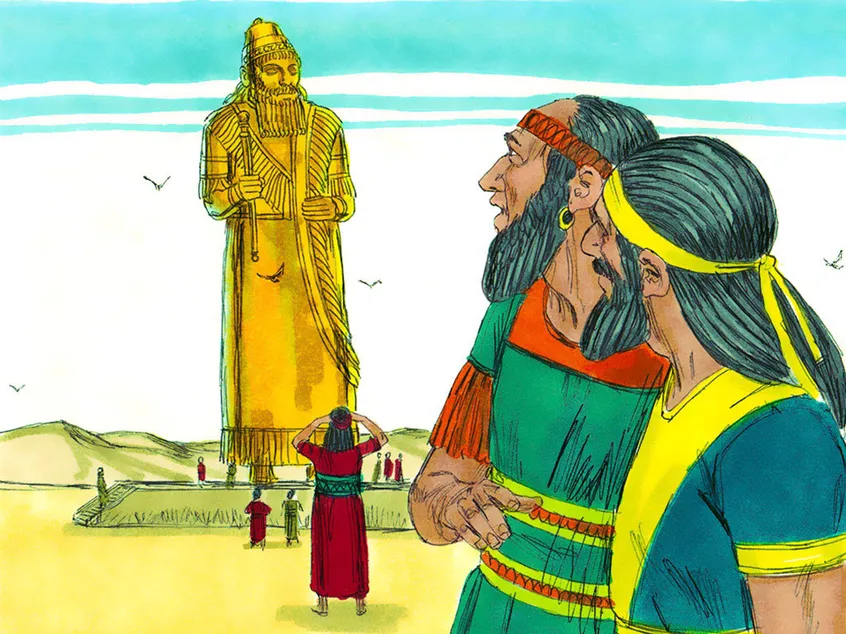
"King Nebuchadnezzar made an image of gold, sixty cubits high and six cubits wide..." (Daniel 3). Image: Sweet Publishing / FreeBibleimages.org

Four young exiled Hebrew men, Daniel, Hanniah, Mishael and Azariah, had been transported from their homeland of Israel into exile in Babylon, where they were prepared by the powerful ruler to serve the Government of the empire.

King Nebuchadnezzar wanted to fully acculturate the four young Hebrews. So he imposed Babylonian names on them: Belteshazzar, Shadrach, Meshach and Abednego. He educated them with Babylonian literature and told them they would now eat from his table.

The four friends accepted their new nicknames. Like all nicknames, they had no choice. They willingly engaged in education, and excelled, with God's help. But they drew a line at the food. They refused to consume the produce of The King’s table. It was a step too far in their acculturation. Although small, it was important to them to remain faithful to God.

Daniel and his friends drew boundaries which got progressively harder not to cross. They started small and grew in boldness. Much later, they refused to bow down to the statue of Nebuchadnezzar; and Daniel, towards the end of his life, broke the law of the land by refusing to give up personal prayer. The seeds for those bold decisions were sown early, in the small choices they made.

Daniel and his friends drew three kinds of lines against acculturation or assimilation.

These are lines which we can learn to draw when in cultural exile. We may need to start small and grow in confidence.

  1. Choose what to consume. Christians have no choice about what people call us, or what we need to learn to work in a hostile culture, but we can choose what we feed ourselves. A hostile host culture may expect believers to consume the same as they consume, but we have a choice about what we put in our mouths, watch with our eyes and listen to with our ears. Small choices not to consume the same as the culture around us build our confidence in the Lord.
  2. Refuse to bow down to cultural idols. The host culture may demand believers to bow down to idols, to wear that lanyard or sign that contract which requires adherence to a worldview which is not Christian, but we can choose not to bow down. Christians can choose not to serve the same idols as the pagan culture around us.
  3. Ignore prohibitions on worship and prayer. Finally, the host culture may introduce prohibitions to worship and practice, but, like Daniel, believers should seek to be obedient to God not man, even if, like Daniel, worship and prayer is done at home, in house churches.

It is worth reflecting on these three boundaries. How are we living in exile? Are we in the habit of consuming the things of the culture and so undermining our determination to stand for the Lord?

Has our boldness increased or decreased?

When I am asked to bow down to a cultural idol, has my habit of choosing what not to consume in the culture strengthened my will to be faithful to the Lord?

And will I remain faithful to Him, as He is faithful to me, even if I am compelled by law to stop following Him?

In my last article, I considered the comforting doctrine of the necessity of affliction. Daniel, Hanniah, Mishael and Azariah grew through the affliction of exile, the fiery furnace and the lion’s den. They were very well prepared to serve the Lord in exile and with joy and obedience in eternity.

May our exile, however painful, serve the same end.

Share
< Previous article| Comment| Next article >
Read more articles on:   culture  /  discipleship
Read more articles by Neil Robbie >>
Comment
Why I took a stuffed parrot to CofE Synod

Why I took a stuffed parrot to CofE Synod

The General Synod of the Church of England has engaged over decades in a cycle of groundhog-day debates about human …

Comment
The comforting doctrine of the necessity of affliction — part two

The comforting doctrine of the necessity of affliction — part two

This article is a "part two" to the piece of the same title (en online, 13 Sept. 2025) …

Need to advertise?

We can help you reach Christians across the country

Find out more

Looking for a job?

Browse all our current job adverts

Search