Historical lessons for exiled evangelicals

Neil Robbie  |  Comment  |  migration & the Bible
Date posted:  13 May 2026
Share Add       
Historical lessons for exiled evangelicals

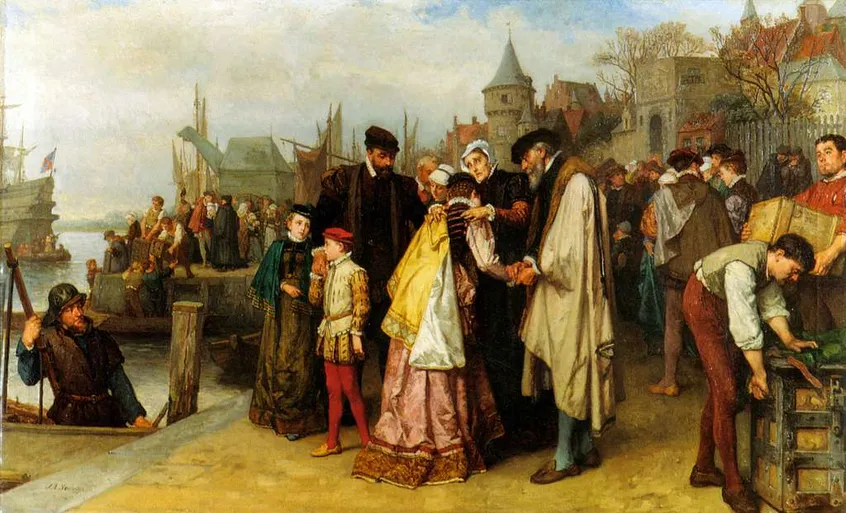
'Emigration of the Huguenots' 1566 by Jan Antoon Neuhuys. Source: picryl

The mass, inward, multinational migration experienced in the UK today is not a novel phenomenon.

Four hundred years ago, the Reformation caused large-scale, trans-European migration. The Calvinist Dutch Republic became an ark for refugees from all over the continent.

The result was that, by the close of the 17th century, a significant percentage of the population of the Dutch Republic was not Dutch.

History repeating itself?

Exiles clustered, understandably, into homogeneous, single-language-based congregations for a few generations before integrating with one another and the Dutch. These patterns may be repeating themselves in the UK today.

The Boomer and Windrush generation of the 1960s saw the start of the homogeneous Church Growth movement, which once dominated approaches to mission in the UK and elsewhere. There were notable exceptions; the churches I have served in Wolverhampton and West Bromwich welcomed Jamaican brothers and sisters in the sixties, our first Jamaican choir members in 1971 and our first Jamaican church warden in 1976. This history has shaped me as a minister.

The churches which previously put culture and language before unity in Jesus may now be making an 180-degree turn in their thinking; churches now actively seek to be multicultural or intercultural. This is partly due to a generational shift, as urban Gen Z grew up in a multi-ethnic society and so have little desire to segregate on a Sunday.

William Bridge and other 'exiles'

The history of the tolerant Dutch Republic can help us today. The Huguenots fled from Louis XIV’s France and joined other exiles, including Calvinists from the Southern Netherlands and Puritans from England - like William Bridge, who was excommunicated from his church in Norwich in 1636.

A warrant for his arrest was issued, so Bridge fled from England and went to the Netherlands, where he became co-pastor of a congregation of English-speaking exiles in Rotterdam. When Archbishop Laud gave his annual report to Charles I, he said, “Mr. Bridge of Norwich rather than He will conform, hath left his lecture and two cures, and is gone into Holland.” Charles I wrote in the margin: “Let him go: we are well rid of him.”

Other exiles in Holland included Scottish Covenanters, Jews from the Iberian Peninsula and Lutherans from Bohemia and Austria. These multinational exiles arrived with their different languages, cultures, economic realities and theological positions.

The Huguenots

The Huguenots were French Protestants in the 16th and 17th centuries who followed the teachings of John Calvin, a key figure in the Protestant Reformation. They were essentially the French branch of Calvinism.

The Huguenots initially gathered in French-speaking, so-called Walloon churches. They wrote about their exile from their own interpretive location (see my earlier article on Esau Mccaulley's work on "interpretive location").

French Huguenot minister, Elie Benoist, author of Histoire de l’Edit de Nantes (1693–1695), describes the tyranny of Louis XIV and compares that abuse of power to the benign treatment of Huguenots in The Dutch Refuge. The Dutch Refuge refers to waves of Protestant refugees – especially in the late 16th and 17th centuries – who fled persecution in Catholic-controlled regions (like France and the Spanish Netherlands) and settled in more tolerant places, particularly the Dutch Republic.

Most of what we know about Huguenot history in exile is contained in the Walloon library.

Benoist's history paints himself and the other Huguenots as suffering martyrs who positively influenced the economic, political and cultural realms of Dutch society. But a more careful reading of Huguenot history has given rise to an understanding of the complexities of exile in the Dutch Republic.

Over the past 30 years, a new approach to historical and biographical accounts has led scholars to acknowledge that the Huguenot diaspora should be studied from a transnational, even global, angle. There was no single national boundary or even a one-way street along which exiles travelled. Refugees came and went, interacting with each other and those who remained in their homelands.

Huguenots were not a homogeneous, isolated group, as portrayed in Benoist’s history. Rather, the French, English, Scottish, Spanish, Bohemian and Austrian Christians met and had cross-cultural interactions, eventually, if they chose to stay, dissolving national identities and becoming a Dutch church.

Does this not sound somewhat contemporary?

Migration in our modern day

Secular Britain mirrors the Calvinist Dutch Republic as a multi-confessional and tolerant society. The UK is a great ark for refugees and exiles of all kinds. The major difference today is that Protestant Christians, including indigenous Christians, are not at home in a Calvinistic state but are amongst the political and cultural exiles in a sometimes hostile secular society.

For the church in the UK, history could be repeating itself as exiles mingle and mix in the land today.

There are positive and negative lessons to learn from the Huguenots.

Positively, they were model citizens who moved towards the politics and business enterprise of their day, making a difference to the religious, theological, cultural, economic and social fabric of the Dutch Republic.

Negatively, they segregated for worship and interpreted life in exile from only one social location – their own. There is little contemporaneous evidence of an awareness amongst the Huguenots and the indigenous Dutch of the need to integrate with others who arrived in the Dutch Republic from various cultures and languages. The Walloon churches remained culturally French until their children and grandchildren lost their French identity and became Dutch.

Looking to Scripture

Peter’s first letter is addressed to “God’s elect, exiles scattered throughout the provinces of Pontus, Galatia, Cappadocia, Asia and Bithynia”. Peter is described as the Apostle to the Jews and so it has been assumed that the exiles to which he wrote were only exiled Jews in the church of Christ. But, as Peter was writing a decade or more after Paul rebuked him for segregating from the Gentiles (Galatians 2v11-14), the exiles who he addresses are more likely to be a mixture of physical, cultural, political and economic exiles, who were “once not a people” but are now “a people, a holy nation” (1 Peter 2v8-9).

This people, this holy nation, made up of different kinds of exiles, was called by God to live such godly lives together amongst the pagans, without nationalistic or sectarian malice, envy or slander (1 Peter 2v1), to the glory of Christ.

We, like those exiles and the Huguenots, are to engage in the political, economic, religious and cultural life of the UK, to be model citizens, making a difference by being salt and light.

And, avoiding Peter’s initial error of segregation, we move across cultural boundaries and find a home together in the church of Christ, becoming a people, a holy nation.

This movement toward one another enriches our understanding of Scripture, which is no longer bound too tightly with our own cultures. We shine the gospel light in fragmented British society by being a witness to the true gospel of Christ who unites all people in Himself. And the gospel spreads back and forth along transnational routes as the church at home and in each homeland benefits from being a people.

I am glad the homogeneous church growth principle is hardly mentioned these days. The church in this transnational ark, the modern UK, is repeating history as Christ breaks down dividing walls of hostility and unites His people in His truth, His love, His death for our sin, (which includes the sin of segregation), His resurrection and His multi-ethnic mission to all nations, to the glory of His name.

Share
< Previous article| Comment| Next article >
Read more articles on:   history  /  migration
Read more articles by Neil Robbie >>
Comment
Why I took a stuffed parrot to CofE Synod

Why I took a stuffed parrot to CofE Synod

The General Synod of the Church of England has engaged over decades in a cycle of groundhog-day debates about human …

Comment
Christians and culture: Where do we draw the line?

Christians and culture: Where do we draw the line?

Four young exiled Hebrew men, Daniel, Hanniah, Mishael and Azariah, had been transported from their homeland of Israel into exile …

Looking for a job?

Browse all our current job adverts

Search

Need to advertise?

We can help you reach Christians across the country

Find out more