As bombs fall and a dangerous regime plunges the region into chaos, it might seem trivial to write an article about the archaeology of Iran. But doing so helps us not only to see the historical reliability of the Bible, but to understand and appreciate more of the context of this beautiful land.
Iran is an enormous country, nearly seven times the size of the United Kingdom. It includes the lands which in Bible times were Persia, Elam and Media. The later Old Testament books are often interwoven with the history of these places. Elam is frequently mentioned in prophecies of Jeremiah and Ezekiel. Elamites appear in Genesis 14 but also, remarkably, in Acts 2v9. Alongside Media and Parthia, also in Iran, Jews from Elam were listening to Peter’s sermon on the day of Pentecost. The seed sown for the gospel in Iran began a long time ago!
Media is the region where many from the northern kingdom of Israel were exiled (2 Kings 18v11). No doubt their Hebrew traditions and teachings settled with them. Daniel and Esther both arrive in ancient lands within the modern borders of Iran. Susa is both the capital of Persia at the time of Esther, but also the place where Daniel received his visions from God. Tradition places his tomb in this city to this very day. Esther and Mordecai have traditional tombs at Ecbatana in Iran.
Unearthing the Bible
With this Biblical background in mind, we might expect archaeological discoveries from Iran that will confirm these historical people and places. That’s exactly what we find. Many of the most important artefacts for Biblical history are safely housed in the British Museum in London. Though there is a modern-day concern to keep artefacts in the land of their discovery, many of us would thank God that they were removed and stored in a Western country that could protect and preserve them against the destruction wrought by certain religious groups.
Here are my top five archaeological discoveries from the land of Iran.
1. The Cyrus Cylinder. Dating from 539 BC, this clay cylinder documents the decree of the Persian ruler, Cyrus, permitting the return of exiles to their native lands. The impact on the Jews, as an end to their period of exile, is recorded in Ezra 1v2-4. The cylinder has global significance as some consider it the first human-rights decree. The United Nations in New York has a perfect replica on display in their headquarters. You can see the original in the British Museum.
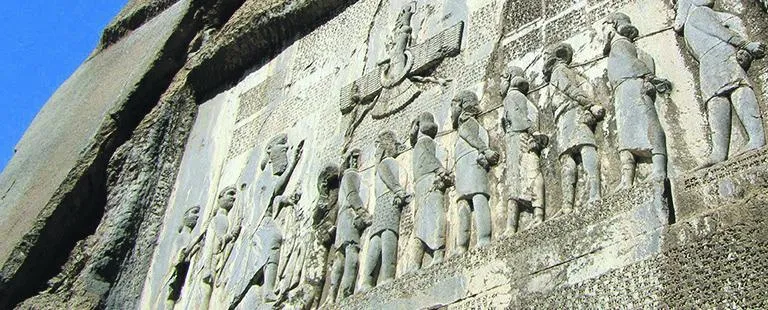
2. The Behistun Inscription. Dating back to 520 BC, this is a carving high on a rock wall that would require a trip to Iran (and a dangerous climb) to see for real. Like the more famous Rosetta Stone, it is an inscription recorded in three different languages using different scripts. Carved by Darius the Great (Ezra 4-6) and recording his rise to power, it included the ancient cuneiform script. Just as the Rosetta Stone helped scholars to read ancient Egyptian hieroglyphs, the Behistun inscription would unlock the literature of Babylon and Assyria. Many Biblical references and parallels would be brought to light because of this discovery.
3. Foundation Charter from Susa. The Book of Esther records the importance of the palace at Susa (Esther 1v5-6). A similar description appears on a foundation tablet, known by unimaginative scholars as “DSf”, that had been buried at Susa from the time of Darius. It helps to confirm that whoever wrote the book of Esther knew what they were talking about in their descriptions.
4. Monumental depiction of Xerxes. I never know how to pronounce this unusual name (you will be told it is “zurk-seez”). But we know from Iranian inscriptions it is closer to the Hebrew “Ahasuerus” (Esther 1v1). The British Museum has a cast of the image of this king from Persepolis.
5. A silver drinking bowl from the palace of Artaxerxes I. When Nehemiah was in Persia we read that he was “cupbearer” to this King (Neh.2v1). The bowl, displayed at the British Museum, is inscribed with the name of Artaxerxes. From such a bowl wine would have been tasted by a cupbearer to check for any poisons planned for the King. Could this have been the very bowl Nehemiah drank from?
These are just a selection of the more notable artefacts from Iran. Other Persian inscriptions have been found elsewhere in the region, and objects such as the early “Daric” coins first minted in Iran and mentioned in the Bible (1 Chron.29v7) all help to confirm the historical witness of these Biblical books. What a magnificent land – who knows what else lies in wait for future discovery? In the meantime, we can only pray for peace and opportunity for the Iranian church to grow, thrive and be a light in the darkness during these times of upheaval.