Bayeux and the Bible

Chris Sinkinson  |  Features  |  defending our faith
Date posted:  8 Sep 2026
Share Add       
Bayeux and the Bible

Image: iStock

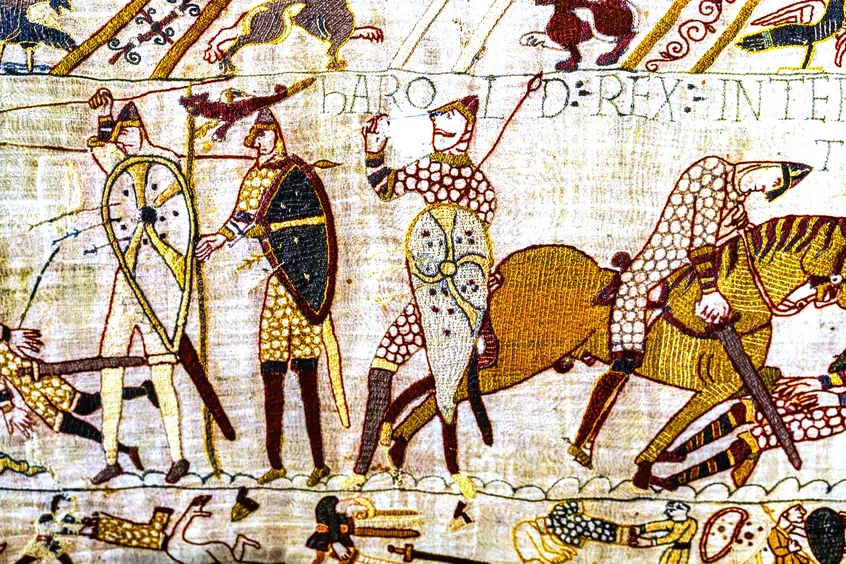
The Bayeux Tapestry has come home. We know that the embroidery was created somewhere in England nearly 1,000 years ago, following the Norman conquest.

It disappeared into obscurity for many centuries in France. Once a year it was displayed in Bayeux Cathedral before being folded away again. It only really came to prominence in the 18th century, when scholars took interest and published engravings bringing it to a wider public. Napoleon, with his own imperial French ambitions for conquest, used it for his own propaganda purposes. Since then, the 70-metre-long embroidery has continued to capture the popular imagination.

A time at the museum

The temporary exhibition at the British Museum is truly historic. The record of a pivotal moment in history that is captured in this iconic artefact is likely to attract 7.5 million visitors. Despite ticketing, it will certainly be the most viewed object in the British Museum, and likely a topic of discussion throughout 2027.

So what is it? The easiest answer is that it records the AD 1066 Norman conquest of England. But it is so much more than that.

The tapestry (yes, technically it isn’t a tapestry, but the word has stuck!) is like a comic book or even a film strip. It starts in AD 1064 with King Edward at the recently built Westminster Abbey sending Harold Godwinson on a trip to France. Harold meets William Duke of Normandy, and having fought alongside him, pledges an oath of allegiance. But back in England after the death of King Edward, Harold takes the throne, which William considers the breaking of his oath. William’s invasion brings the older Anglo-Saxon dynasty to an end.

Faith and history

The tapestry includes an incredible array of details that illustrate the Medieval world. It provides a great opportunity for conversations about faith.

The tapestry is saturated with the Christian worldview. Harold swears his oath on religious relics and big decisions are made in the context of churches and bishops. The tapestry strongly suggests that the fall of the Anglo-Saxons to the Normans was God’s judgement on Harold’s broken oath.

The depiction of Halley’s comet provides an independently verifiable astronomical date for the events (AD 1066). While this was also taken as having supernatural significance it also reminds us that people of the past did think about historical context and references that help date when something happened. We might be reminded of examples in the Bible where astronomical references are given even if we can’t pinpoint when they happened (Josh.10v12-14; Joel 2v31; Amos 8v9; Matt.2v2).

Embroidery matters

The tapestry provides a useful comparison with the New Testament. It is true that the creators had an agenda (don’t we all?) but we can test much of its accuracy. Even if we don’t share the creators’ agenda (“three cheers for Harold!”) we can acknowledge the historical veracity of the story being told.

Many incidental details underline its accuracy – buildings, boats, recognisable people, military equipment and locations. The work can itself be compared with what we know from archaeological discoveries and other writings from the ancient world to be satisfied that, whatever their agenda in the embroidery, they intended to create a contemporary account based upon the testimony of those who were there. It is a parallel to Luke’s intentions in his Gospel (Luke 1v1-4).

Any trip to a museum can kindle an interest in history. The exhibition of the Bayeux Tapestry is likely to be a significant one. We can use this to draw people to the real history of Jesus. Christianity is not rooted in myths and legends. If a 1,000-year-old embroidery can help us understand an event that changed England for a millennium, then how much more can the Bible help us understand an event that changed the world forever?

Share
< Previous article| Features| Next article >
Read more articles on:   history
Read more articles by Chris Sinkinson >>
Features
Opening the Bible G.A.T.E.

Opening the Bible G.A.T.E.

There is clear evidence of an upsurge in Bible purchases. More people want Bibles. Younger people are buying Bibles. Bibles …

Features
The New Testament’s P45

The New Testament’s P45

Have you ever held a P45 in your hand? Most likely you have, and it is the document you were …

Looking for a job?

Browse all our current job adverts

Search

New here?

Register and get three free articles each month!

Register