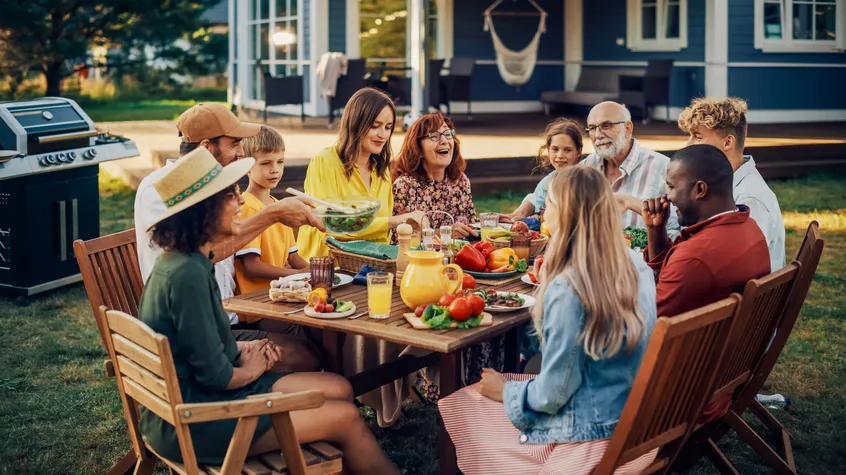
There is a front door in almost every Christian’s life that is far more strategic than we realise.
We pray for revival in our nation. We long for gospel advance in our towns. We want deeper discipleship in our churches. And all the while, God has given many of us a dining table.
In an age of church programmes, conferences and digital platforms, we must not overlook one of the most powerful missional tools in the New Testament: the Christian home.
Hospitality is not entertaining. It is not performance. It is not middle-class impressiveness. It is mission. It is opening our homes in such a way that hearts are opened to Christ.
Hospitality is not optional – it is commanded
The apostle Paul writes in Romans 12v13, "Contribute to the needs of the saints and seek to show hospitality." The word "seek" carries the sense of pursuing. We are to chase opportunities to open our homes.
In Hebrews 13v2 we are told "Do not neglect to show hospitality to strangers…" In 1 Peter 4v9: "Show hospitality to one another without grumbling." And remarkably, in 1 Timothy chapter three and Titus chapter one, hospitality is a qualification for eldership. Hospitality is not a niche gift for extroverts. It is a baseline Christian instinct.
Why? Because hospitality reflects the gospel.
The gospel is the ultimate act of hospitality
Before we ever opened our homes to God, He opened heaven to us.
We were strangers and aliens (Ephesians chapter two). We were outside the covenant promises. We were spiritually homeless. Yet in Christ, God welcomes us to His table.
Jesus says in John 14v2, "In my Father’s house are many rooms… I go to prepare a place for you." The gospel is divine hospitality. Through the cross, sinners are not merely pardoned, we are adopted. Not merely tolerated but welcomed as children.
When we open our homes, we are enacting a parable of salvation. Our dining tables can become small foretastes of the marriage supper of the Lamb. Hospitality, then, is not social strategy. It is theological imitation.
The home as a missional outpost
In the New Testament, the gospel often travelled along the pathways of meals.
Jesus was frequently at a table with tax collectors, Pharisees, sinners and with His disciples. Early churches met in homes (see Acts 2v46; 20v20). Your home is not merely where you rest from mission, it is where mission can happen.
The table as evangelistic space
Many unbelievers will not attend church, but they may accept dinner or even a cup of tea. In a secular UK context increasingly suspicious of institutional religion, the home can disarm hostility. Around a meal walls lower, questions surface and stereotypes weaken. Evangelism does not always begin with a tract, sometimes it begins with roast chicken. Hospitality creates space for spiritual conversations that rarely happen in hurried public settings.
The table as discipleship space
Some of the most formative discipleship in church life happens not in formal classes but in living rooms. Younger believers learn how Christians speak to one another, how husbands and wives interact, how parents shepherd children, how conflict is handled and how prayer sounds in ordinary life.
Paul tells the Thessalonians in 1 Thessalonians 2v8 "We were ready to share with you not only the gospel of God but also our own selves." That is hospitality. Discipleship is not merely information transfer, it is shared life.
The home as a spiritual hospital
Church members carry hidden grief, quiet depression, marital strain and doubts they are afraid to voice. A home can become a safe place for weary saints. Sometimes pastoral care happens best over tea and cake rather than across a desk. In a culture of isolation, loneliness and fragmentation, the Christian home can be a sanctuary of warmth.
Ultimately, Christian hospitality is doxological. When unbelievers encounter genuine love, sincere prayer, peace in suffering and joy in ordinary life, they glimpse something of Christ. Our homes become signposts.
One day there will be a final feast – the marriage supper of the Lamb. Every faithful, Christ-centred meal offered now can point forward to that day. And perhaps, by God’s grace, someone who first heard the gospel across your kitchen table will sit beside you at that eternal banquet.
Your home is not an accident
The square footage. The postcode. The kitchen table. None of it is accidental. God has entrusted you with space.
That space can become a discipleship engine, a missional outpost and a spiritual hospital. You may never preach to hundreds. You may never write books. You may never lead a conference. But you can set a table.
And in God’s sovereign kindness, that table can be a useful instrument in His hands. Open your door, open your life, and trust that as hearts open in your home, Christ will be glorified.
Faithfulness in a 'post-Christian' Britain
There was a time when much of British public life at least assumed a broadly Christian moral framework. That did …