The New Testament’s P45

Chris Sinkinson  |  Features  |  defending our faith
Date posted:  22 Jul 2026
Share Add       
The New Testament’s P45

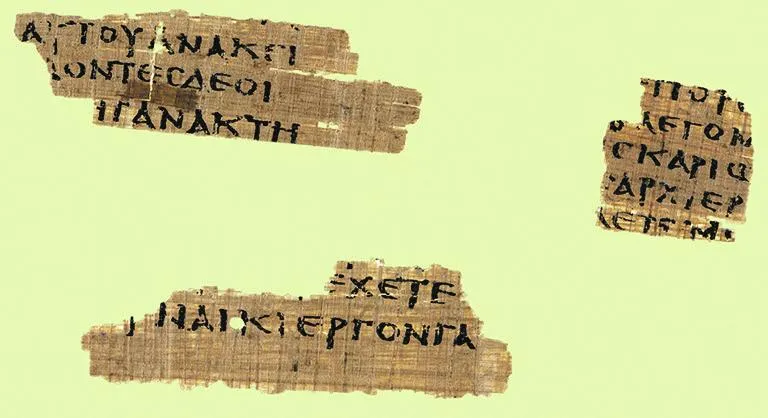
The P64 fragments of Matthew’s Gospel (photo: Wiki)

Have you ever held a P45 in your hand? Most likely you have, and it is the document you were given when you left a job in the UK. A P45 refers to things like the tax you have paid on earnings.

However, there is another P45 that refers to one of the earliest surviving New Testament documents. Dated to around AD 200 it includes parts of the four Gospels and the Book of Acts. It is enormously important to reconstructing what was originally written by the apostles and their friends. While substantially in agreement with the later manuscripts that the Authorised King James Version was based upon, there are enough variations to help clarify the original text.

You might come across such evidence from time to time and wonder why it is given such a dull label as “P45”. It is an interesting story.


On a recent trip to Oxford with our School for Discipleship students we had the privilege of handling P64. I had read about this early document but never seen it for myself. It is a collection of three tiny fragments of Matthew’s Gospel and is held at Magdalen College in Oxford. As it is dated to AD 150–200 it holds the prize for being the earliest surviving copy of Matthew. Intriguingly, one scholar, Carsten Peter Thiede, has argued for a much earlier date suggesting evidence that it could have been written prior to AD 70.

The P letter is an abbreviation of Papyrus and simply refers to the material the words are written on. During the period of the New Testament the use of animal skin (vellum) was being replaced by papyrus which is much cheaper to produce. The Hebrew scrolls of the Old Testament were written on one side of vellum while the New Testament was written on both sides of sheets of papyrus, stitched together to form a book (codex).

The P letter is often printed using the old gothic typeface and was a system introduced around 1908 to catalogue Biblical manuscripts. Prior to this there were only a handful of important manuscripts from the ancient world known to scholars. These came to include the codices (plural of codex) of Sinaiticus, Vaticanus and Alexandrinus. These are mostly complete collections of the New Testament in Greek dating to the fourth century AD. Their antiquity is extraordinary and give us a very close connection to the original writings. Codex Sinaiticus is as early as AD 330 and contains the complete New Testament.

So where do the P manuscripts come in? After 1900 something changed. There were a wealth of new discoveries of even earlier New Testament copies. As these are written on papyrus, an organic material, it is surprising anything can survive so long, but archaeologists and explorers began to carefully investigate ancient sites and surviving fragments emerged.

A site in Egypt, called Oxyhrinchus, produced a wealth of ancient writings. The town had a garbage dump and the dry desert climate of Egypt ensure the preservation of thousands of discarded pages. New fragments of pages are still being found here to this day – including writings of Plato, Homer and Paul.

Scholars after 1908 needed a clearer way to catalogue the new documents. The Gregory-Aland system was developed to do this with an identifying P number. The catalogue numbers are not related to the age or importance of the manuscripts. P1 is a portion of Matthew dating to AD 250 while P2 is part of John 12 from AD 500. Some of the earliest manuscripts have higher catalogue numbers. P52 is the famous John Ryland manuscript of John from AD 125, considered the earliest of those that have been found. P104, a fragment of Matthew’s Gospel, is of a similar age.

The Gregory-Aland catalogue now numbers up to P143 with the latest addition a fragment of Acts 2 dating to AD 500. It is important to remember that many of these fragments are the size of postage stamps but they are all important for reconstructing what was originally written. They are not complete books. In fact, the P64 that we saw in Oxford is generally thought of as belonging to the same original codex that P67 came from, which is held in a museum in Spain.

This catalogue is not the only collection of Greek New Testament papyri, but they are the earliest. The total manuscript evidence also includes Greek New Testaments that stretch from the fourth century into the Middle Ages. This larger collection gives us about 5,800 total Greek New Testament manuscripts. To those we can add editions in other languages such as Latin and Syriac. We can also add quotations found in other books and lectionaries. All of this together provides the manuscript evidence to be able to claim with confidence that we know the text of the New Testament has been faithfully preserved over the generations.

Share
< Previous article| Features| Next article >
Read more articles by Chris Sinkinson >>
Features
The Bible and Iran

The Bible and Iran

As bombs fall and a dangerous regime plunges the region into chaos, it might seem trivial to write an article …

Features
Ancient map decoded?

Ancient map decoded?

I often use this column to write about references to the Biblical world from outside of the Bible. It helps …

Looking for a job?

Browse all our current job adverts

Search

New here?

Register and get three free articles each month!

Register