
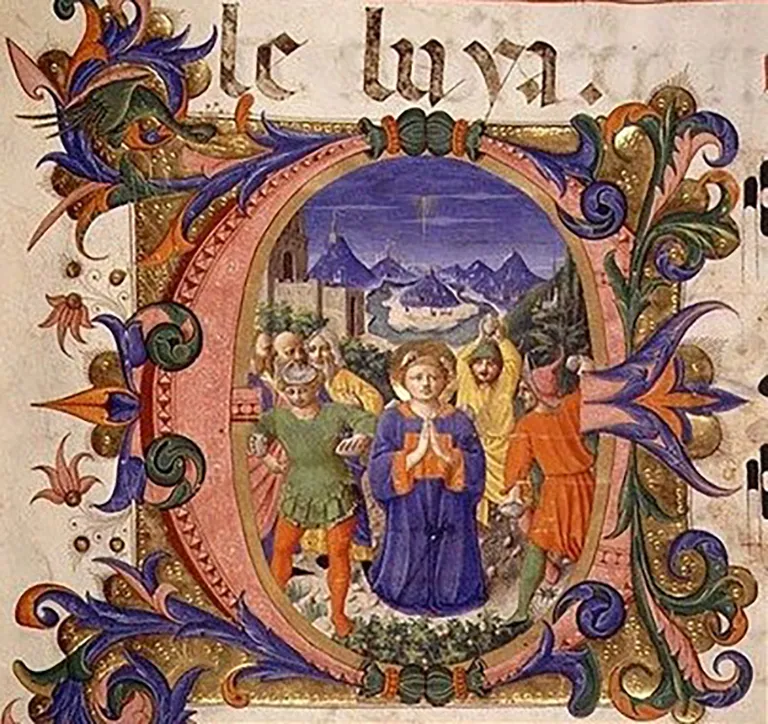
In February many will celebrate St Valentine’s Day with gifts of flowers and maybe chocolates to their loved ones.
The association of romantic love with St Valentine’s Day dates back to Geoffrey Chaucer in the High Middle Ages, but the actual figure after which this saint’s day is named comes from the early centuries of the Church. Details of his life are shrouded in the mists of history. Indeed, it may well be that there are actually two different Christian figures by the name of Valentine. Whether one or two, there is good evidence that the church remembered one of them as an early Christian martyr. Our Saint Valentine was an Italian bishop who was martyred on 14 February, 269, after a trial before the Roman emperor Claudius Gothicus (reign 268–270).
Our word “martyr” is derived from the Greek word martys, originally a legal term that was used of a witness in a court of law. Such a person was one who had direct knowledge or experience of certain persons, events, or circumstances and was therefore in a position to give evidence. In the New Testament the term and its cognates are frequently applied to Christians, who bear witness to Christ, often in real courts of law, when His claims are disputed and their fidelity is tested by persecution.
The transition of this word within the early Christian communities from “witness” to what the English term “martyr” entails is an excellent gauge of what was happening to Christians as they bore witness to Christ in the years after His death and resurrection.
In Acts 1v8 the risen Jesus tells the apostles that they will be his “witnesses” (“martyres”) in Jerusalem, Judaea, Samaria and to the ends of the earth. At this point the word does not have the association of death, although in Acts 22v20 we do read of the “blood of Stephen”, the Lord’s “witness”, being shed. But it is really not until the end of the writing of the New Testament canon that the term martys has acquired the association with death.
At the end of the Apostolic Era, the Risen Christ in Revelation 2 commends His servant Antipas, His “faithful witness”, who was slain for his faith at Pergamum, “where Satan dwells” (Rev.2v12-13). Pergamum was a key centre of emperor worship in Asia Minor, the first town in the province to build a temple to a Roman emperor, namely Augustus Caesar. It may well have been Antipas’ refusal to confess Caesar as Lord and worship him that led to his martyrdom. In fact, it has been estimated that by the mid-first century 80 or so cities in Asia Minor had erected temples devoted to the cult of the emperor.
Thus, the word martys seems to have acquired its future meaning first in the Christian communities in Asia Minor, where the violent encounter between church and empire was particularly intense. In this regard, it is certainly not fortuitous that Asia Minor was “unusually fond” of the violent entertainment of the gladiatorial shows. There was, in fact, a training school for gladiators at Pergamum. Along with this passion for such violence there would have been a demand for victims over and above the requisite gladiators. Thus, recourse was had to Christians, among others.
And so, the word martys became restricted in its usage to a single signification: bearing witness to the person and work of Christ to the very point of death. Stephen and Antipas were the first of many such martyrs in the Roman Empire. It is vital to note here that the term “martyr” is thus a Christian term. To use it, as our Western media sometimes does, of terrorists who die in the act of killing other human beings is utterly foreign to the meaning of the word.
The church in the first three centuries after the birth of Christ became a church of martyrs. The martyr was essential to the identity of the ancient church. His or her body was the boundary between church and state and between church and culture. The martyr bore witness to the nature of the church’s conviction, in the words of the American poet, Emily Dickinson, that:
This world is not conclusion;
A sequel stands beyond.
Invisible, as music,
But positive, as sound.
…To gain it, men have shown
Contempt of generations,
And crucifixion known.
In the next couple of months, we shall look at the story of Christian martyrdom and what the witness in blood means for the church in the West today.








Should the CofE pay slavery reparations?
During a recent trip to Ghana, Archbishop of Canterbury Sarah Mullally renewed her commitment to a £100 million reparation fund …