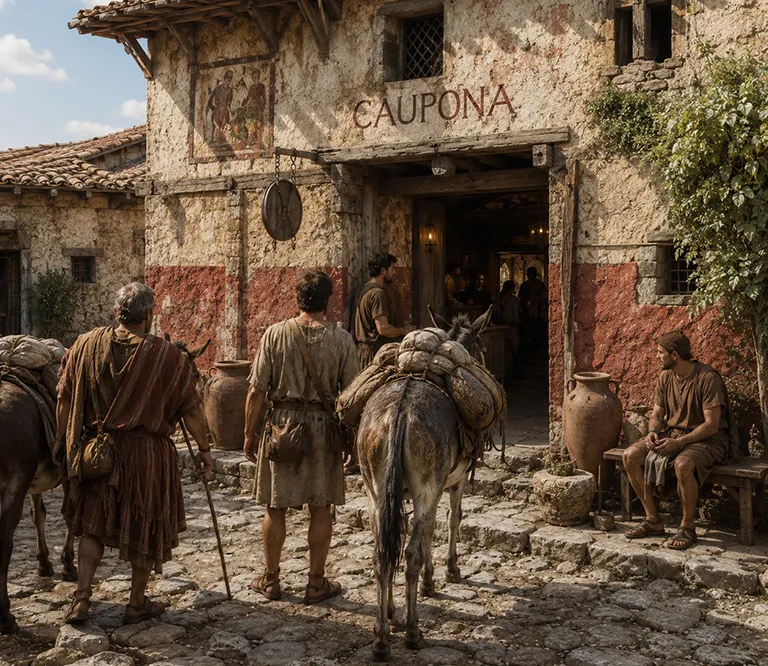
One of the earthly glories of the Roman Empire was its vast network of roads that criss-crossed the empire, built so as to facilitate the campaigns of their legions and to maximise trade.
In fact, so good were these roads that not only soldiers and merchants, but ordinary travellers were able to travel faster during the days of imperial Rome than under any later European state until the early 19th century. As a result the Roman world was a highly mobile one.
Now, in such a society, provision was needed for the lodging of travellers. One means of provision was the inns that were built on the major roads and in the major cities. Many of these inns, however, were disreputable establishments and some of them little better than brothels. Consider, for instance, the following account from the apocryphal Acts of John, as retold by historian Lionel Casson:
“The apocryphal Acts of John tells a story of how the Apostle [John] dealt with these [bed-bugs] … during a trip he took from Laodicea to Ephesus. He and his companions spent the night at an abandoned inn. Perhaps it had been abandoned for the very reason that the bed-bug population had increased beyond the tolerance point, because, during the night, John, who had been given the only bed, was heard to call out, ‘I say unto you, O bugs, behave yourselves, one and all and leave your abode for this one night and remain quiet in one place, and keep your distance from the servants of God’. The others, who stretched out on the floor, were spared the problem … yet, thereafter the Apostle slept in utter peace, and the next morning they found all the bugs dutifully lined up outside the door.”
Thus, discriminating travellers had recourse to lodging with relatives, friends, or business acquaintances. The institutionalised form of hospitality, i.e. the inns, did not therefore replace the private practice of hospitality, which had always been regarded as a virtue among the Jews, Greeks and Romans.
Christian hospitality
For the reasons mentioned above, believers in the Ancient Church also avoided inns when they travelled and had recourse to private hospitality. However, and this is vital to recognise, the Christian practice of hospitality in the ancient world was not simply viewed as a means of overcoming a practical problem. There were other more important motives.
First, it was a clear demonstration of the love that should mark the saints. Consider, for instance, Hebrews 13v1-2 and 1 Peter 4v8-9, and note the way that the admonition to be hospitable comes immediately after the love command. The clear implication is that hospitality is one form of showing love.
Second, hospitality was seen as a way of honouring Christ (see Matthew 25 v34-40) or even entertaining an angel (thus, Hebrews 13v2).
Third and most significantly: Christian hospitality was central to the missional advance of the church. As the Apostle John told a first-century Christian by the name of Gaius, one of his children in the Faith:
“Dear friend, you are acting faithfully in whatever you do for the brothers and sisters, especially when they are strangers. They have testified to your love before the church. You will do well to send them on their journey in a manner worthy of God, since they set out for the sake of the Name, accepting nothing from pagans. Therefore, we ought to support such people so that we can be co-workers with the truth. (see 3 John 5-8, CSB).
Should the CofE pay slavery reparations?
During a recent trip to Ghana, Archbishop of Canterbury Sarah Mullally renewed her commitment to a £100 million reparation fund …