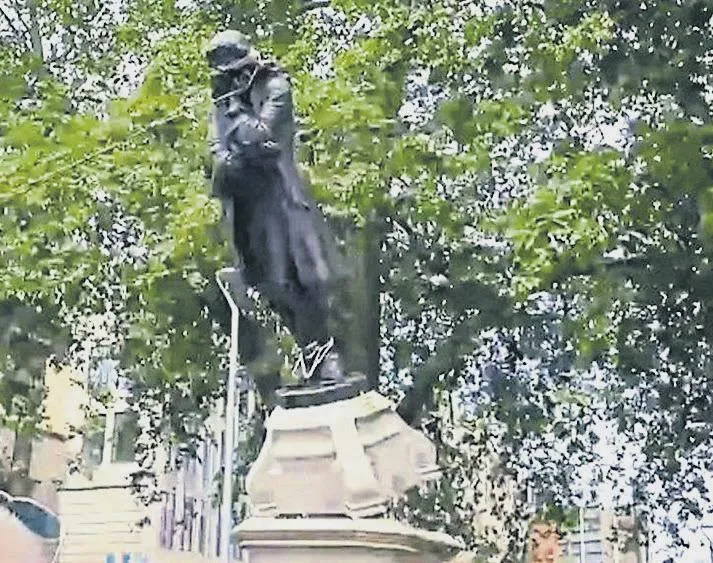
According to the online American edition of the Spectator, the famous statue of George Whitefield, which was the inspiration behind the Banner of Truth logo, is to be removed from its present locale because of Whitefield’s participation in the race-based slavery of his day.
The article does a credible job of seeking to understand Whitefield in his context without whitewashing his sin. Although one statement in the article, namely that Whitefield ‘was the Donald Trump of the 1740s, albeit with a slightly higher degree of biblical literacy’, seems quite ridiculous to this writer.
Now, it is readily understandable why a secular university kowtowing to cultural pressure would want to get rid of the statue of Whitefield, but the action raises important questions about how we as Christians remember the past. Some wise words of Eberhard Bethge, the friend and biographer of Dietrich Bonhoeffer, are of enormous help here:
‘Commemoration renders life human; forgetfulness makes it inhuman … even when remembrance carries grief and shame, it fills the future with perspectives. And the denial of the past furthers the affairs of death, precisely because it focuses exclusively on the present’.
Church history’s hall of sinners
We cannot pretend that the sins of our brothers and sisters from the past – sins that stir up grief and shame – did not happen. They did. Yes, Whitefield promoted and defended race-based slavery.
But John Wesley, who abominated this very sin and fought it, had a terrible marriage. He left his wife Molly and when she died, she was dead and buried three days before he even found out.
Oliver Cromwell killed my Irish forebears in a bloody campaign that helped perpetuate the myth of the Irish being sub-human.
John Calvin agreed to the execution of Michael Servetus for heretical views on the Trinity.
Martin Luther urged the use of violence against the Jews, and while it was Judaism as a religious system that he had in his sights, the Nazis used his words in the 1930s to promote their anti-Semitism. And ultimately Luther got the idea for destroying the German synagogues from Augustine, who believed force could be used to shut down the ecclesial dissent of the Donatists.
Peter played the hypocrite at Antioch. And we all know that David was a murderer, as was Moses. Once we start down the road of getting rid of all of the sinners in church history there will be no one left but Jesus – and pre-Fall Adam and Eve!
God’s perspective
Moreover, note this: God says of David that he is a man after his own heart (1 Sam. 13:14; Acts 13:22). And Moses served as a model for our Lord: a prophet like Moses (Deut. 18:15–19) was Jesus.
So, what gives? Does God wink at sin? Absolutely not. So, the situation is far more complex. Great saints can and do commit sins – even great sins – and yet they can still be models to imitate without us whitewashing their sins (see Heb. 13:7 and Heb. 11). We can honour them for their goodness and virtues without ignoring their faults and failings. We can remember the messiness and shame of aspects of the Christian past and allow ourselves to be grieved by the acts of men and women we also need to honour. Thus, we learn that the past is complex and messy – and they do things differently there.
Church historians are thus called to remember and seek to understand first of all the whys of what happened. To be sure, there is a place to make moral judgements, but it must be done with humility (Rom. 14:4) and with a catholic temper.
So, we can honour Whitefield for his God-centred evangelism and remarkable catholicity, while at the same time being grief-stricken and ashamed of his participation in the evils of slavery.