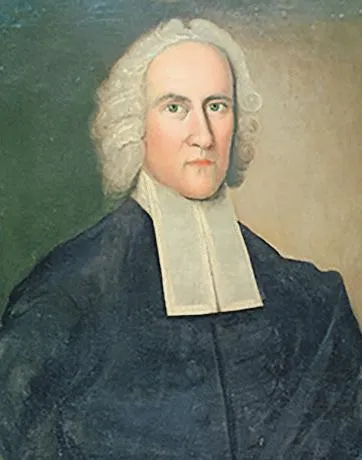
Often when people think of Jonathan Edwards as a preacher, his famous 1741 Enfield sermon ‘Sinners in the hands of an angry God’ is what first comes to mind. But the reality is that Edwards preached more often on heaven.
His sermon ‘Heaven, a world of love’, preached a few years before the Enfield sermon, was actually more typical of Edwards’ sermonic corpus. He was, as a number of books on Edwards have recently emphasised, preeminently a theologian of love. His concern for the salvation and welfare of native Americans in Massachusetts is another good example of this focus.
On 16 August 1751 Edwards delivered a sermon to a group of Mohawks in Albany, New York. The Mohawks had come to Albany to discuss with Edwards what might be entailed in sending their children to a school in Stockbridge. After the discussions, Edwards was given an opportunity to preach to them. He began by stating that ‘when God first made man, he had a principle of holiness in his heart’, like a light shining within Him. But then the man sinned against God and he ‘lost his holiness’. The light that he had was ‘put out’ and his mind became full of darkness. The long-term result was idolatry: the worship of heavenly bodies, ‘images of gold and silver, brass and iron, wood and stone’, animals and even the devil.

But God had mercy on mankind and gave them the Scriptures, ‘as a light shining in a dark place’. Then Christ came to ‘die for sinners’ and give further instruction. And so the Bible was completed. Christ gave clear instruction that the Bible and the gospel were to be taught to all the nations. Those nations that now have the Bible ‘enjoy light’, while those nations without it ‘live in great darkness’.
Edwards now spoke plainly: the forefathers of the Mohawk ‘have for a great many ages lived in great darkness’. The Europeans, who had the Scriptures and should have taught the Native Americans, have not helped them: ‘They have not done their duty to you’, he told his hearers, ‘they have greatly neglected you’, and that neglect was shameful. The ‘white people have not behaved like Christians’, for if they had, Edwards continued, they would have given the Indians the Scriptures and so shown love for their souls.
In fact, many of the ‘English and the Dutch’ wanted to keep the natives ‘in the dark for the sake of making a gain’ of them and their lands. Here Edwards clearly drew upon the thinking of his grandfather Stoddard who had made similar charges nearly 30 years earlier. He also drew upon his long ministry in Northampton where he had been publicly critical of those who lived for material gain – some of whom were his own relatives. Such a life, Edwards believed, was positively dangerous to the soul.
Edwards then urged his Mohawk hearers: ‘Don’t content yourselves to live in darkness any longer’. He pleaded, ‘We invite you to come and enjoy the light of the word of God’. If they did, this light would shine into their hearts and change them and make them like Christ, just as ‘when you hold a glass out in the light of the sun, the glass will shine with a resemblance of the sun’s brightness’.
Though simple in language and structure, this is nevertheless a powerful presentation of the gospel. There is little doubt that this Stockbridge sermon reveals a true missionary heart. Interestingly enough, the whole sermon revolves around the theme of light, which had also dominated his earlier brilliant depiction of the world to come, ‘Heaven, a world of love.’
American historian Ronald Story has noted that, for Edwards, ‘light connotes sight and insight, brightness and illumination … something of “sweetness” and even rapture’. Edwards’ use of the imagery of light bespoke a heart of love for those Mohawks. We hope that some, if not all, of those Mohawks on that long-ago day on the American frontier embraced the light offered so freely to them by ‘America’s Augustine’.