From time to time in the history of the Church, God raises up men, who, because of their God-given talents, exercise extraordinary influence for good.
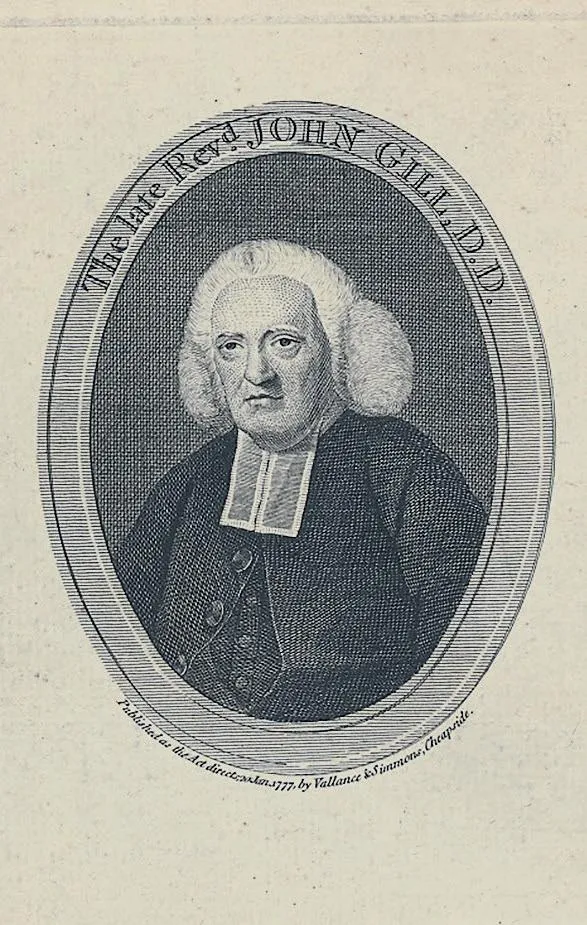
In the Ancient Church, Athanasius and Augustine were such pastor-theologians as they defended the Christian Faith. At the time of the Reformation, Martin Luther and John Calvin were critical to the advance of that great movement of God. In more recent times, Dr Martyn Lloyd-Jones played a central role in the recovery of the doctrines of grace among British Evangelicals. And in his day, especially among members of his community, the Particular or Calvinistic Baptists, John Gill may rightly be reckoned, in the words of Lloyd-Jones, ‘a very great man, and an exceptionally able man’.
Gill viewed negatively
Yet, contrary to this perspective, Gill has been remembered by many as a hyper-Calvinist whose theology has been seen as a major cause for the decline of his Baptist denomination for much of the 18th century. By the time the Victorian Baptist historian JM Cramp came to write his influential and widely-read Baptist History, the responsibility of Gill for the decline of the Baptist cause in the 18th century was a given.

Gill ‘abstained from personal addresses to sinners, by inviting them to the Saviour.’ Instead, he was content ‘with stating men’s danger, and assuring them they were on the high road to perdition’. When his teaching was embraced by many in the Baptist community, Cramp was not surprised that their churches experienced declension.
In the middle of the 20th century, historian AC Underwood reiterated the charge: despite his great learning, Gill ‘never addressed the ungodly’ in his preaching. On the other side of the Atlantic, Southern Baptist historian H Leon McBeth likewise opined in a massive study of Baptist history that Gill’s ‘hyper-Calvinism’ with its ‘rigid “non-invitation” style of theology and preaching, while ringing with impressive logic, brought the kiss of death’ to the Calvinistic Baptists.
Gill defending the Trinity
This perspective on Gill has a good deal of truth in it, but, like so many other figures in church history, Gill’s legacy is complex. While his theology did contain definite elements of hyper-Calvinism, it was also a bastion against the destructive forces unleashed during the 18th century by what is called the Enlightenment, which exalted the omnicompetence of human reason. In the crosshairs of many of the rationalistic protagonists of the Enlightenment was the central Christian truth of the doctrine of the Trinity.
Some Christian communities, like the English Presbyterians, largely succumbed to this attack on the Trinity, but not so the Particular Baptists – and that largely because of John Gill. This Baptist theologian stood firm for the doctrine of the Trinity that had been hammered out in the fourth century and codified in what came to be called the Nicene Creed. This creedal statement declared Christ to be fully God, since he shared the very being of God and all of his divine attributes to the full. The Spirit was also fully divine, since he was worshipped and glorified with the Father and the Son.
Gill’s written works, including a powerful study of the Trinity, came to be possessed by most Baptist pastors. By standing squarely for this vital doctrine, Gill thus enabled his Baptist contemporaries to maintain their hold on orthodoxy and so have the capacity to receive the fire of revival later in the century.
Gill comes to London
Gill was in the position to exercise such influence since he was the pastor one of the largest and most important Baptist congregations in London, which met at Goat Yard, Horselydown. When its pastor, Benjamin Stinton, had died unexpectedly in February 1719, Gill was invited to preach in the summer of that year. This preaching engagement led to Gill being invited to preach for the whole month of August, during which time a goodly number of the church clearly came to the conviction that they had found their new pastor in this 21-year-old who hailed from Northamptonshire.
A church meeting was held on Sunday 13 September 1719 to vote on calling Gill. The motion passed ‘by a very great majority’. Although there was significant opposition to his calling from the deacons, Gill came to London as the pastor of this church in 1719. And in the providence of God, it was good that he did, for he and his books would be critical in preserving the orthodoxy of the Calvinistic Baptists.