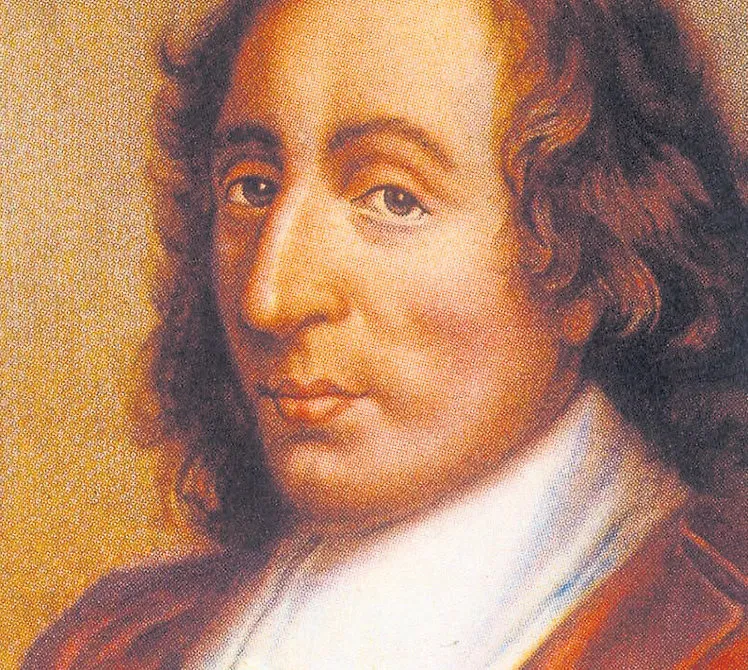
Blaise Pascal

Chris Sinkinson  |  Features  |  defending our faith
Date posted:  1 Feb 2019
Share Add       
Blaise Pascal

Isaac Newton famously said: ‘If I have seen further it is by standing on the shoulders of giants.’

Like our ‘cloud of witnesses’ in Hebrews 12.1, we have a wealth of wisdom to draw upon from the example of those who have gone before us in their defence of the faith.

Some of our historic forebears were muddled or confused; some were compromised or misleading. But many still bear reading about and reflection upon their writings, so that we don’t repeat the mistakes of the past.
Remarkable man

One of the great 17th-century apologists was the Roman Catholic thinker, Blaise Pascal (1623-1662). His ideas continue to be discussed and one of his (greatly misunderstood) apologetic arguments for believing in God is still debated in the GCSE curriculum.

Pascal was a remarkable man by anyone’s estimation. His diverse talents probably meant he would have excelled in anything he turned his hand to. At the age of 16 he broke new ground in geometry. At the age of 19 he designed the world’s first mechanical computer, of which about 50 were built (a modern computer language is named after him).

His work in mathematics and probabilities would become textbook material. Many inventions emerged out of his scientific experiments including the humble, but profoundly important, syringe. And throughout this endeavour Pascal was in poor health. He died at the age of 39 from a complication involving stomach problems and a brain lesion that all indicate he must have lived in great pain as an adult.

Defending the faith

Pascal also wrote widely on the Christian faith. An unfinished work, published as Pensées (Thoughts’), had originally been titled Defence of the Christian Religion. It is not a logical presentation of the Christian faith like C. S. Lewis’ Mere Christianity but a collection of fragmentary reflections and ideas including what would become known as Pascal’s Wager.

Taken out of context, Pascal’s Wager is easy to dismiss. Using his analysis of gambling, Pascal made the point that there is infinitely more to be gained by living as if God exists than not. If doubtful of God’s existence then choosing to believe is the better bet. It sounds cynical. It does not apply too easily in a multi-cultural society where there are many options rather than a choice between two.

However, in context, Pascal’s Wager has an enduring appeal. The wager reminds us that we cannot sit on the fence. He wrote: ‘You must wager. There is no choice, you are already committed. Which will you choose then?’ The wager encourages us to try faith.

Faith is not the conclusion of an abstract philosophy. Pascal was concerned by the limitations of reason. Having shown that Christian faith is not irrational we should ‘Next make it attractive, make good men wish it were true, and then show that it is.’ Pascal’s point is insightful. Compelling arguments from an unattractive witness will fail to persuade.

Holy fire

After his untimely death a page from Pascal’s diary was found to have been sewn inside his jacket. It was an account of an evening in 1654 when he was 31 years old. He wrote:

‘From about half-past ten in the evening until about half-past twelve … FIRE … God of Abraham, God of Isaac, God of Jacob, not of the philosophers and of the learned.

Certitude. Feeling. Joy. Peace … This is eternal life, that they know you, the one true God, and the one that you sent, Jesus Christ. I left him; I fled him, renounced, crucified.

Let me never be separated from him. He is only kept securely by the ways taught in the Gospel… Complete submission to Jesus Christ … May I not forget your words. Amen.’ He would keep these words close to his heart, hidden in his jacket, for the rest of his life.

Pascal has reminded us that Christianity is intellectually robust and compelling, but that it must not be reduced to a mere rational exercise. Faith is a total, personal, commitment to Christ.

Share
< Previous article| Features| Next article >
Read more articles by Chris Sinkinson >>
Features
Migration – lessons ancient and modern

Migration – lessons ancient and modern

I’m writing this from the island of Crete where I am filming with the Christian Television Association. It’s a land …

Features
In the footsteps of David

In the footsteps of David

Generally, the further back in time the harder it is to prove that something has happened. We regularly report in …

Looking for a job?

Browse all our current job adverts

Search

Give a subscription

Our monthly newspaper is the perfect gift for those who love to think deeply

Give here