John Calvin’s preaching

Michael Haykin  |  Features  |  history
Date posted:  1 Oct 2017
Share Add       
John Calvin’s preaching

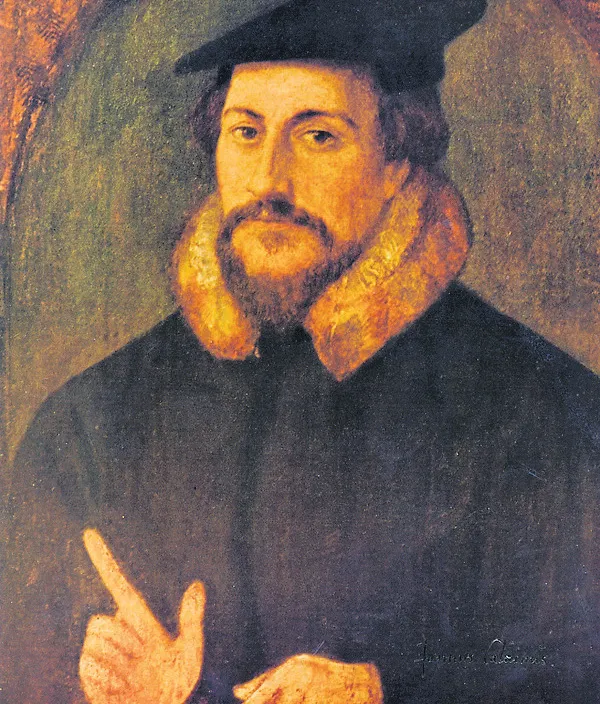
John Calvin by Holbein

To see the heart of the Reformation fleshed out, we can do no better than to look at John Calvin’s ministry as a preacher.

After Calvin came to Geneva in 1536, he looked upon his work in the Swiss city as primarily ‘proclaiming the Word of God’ and ‘instructing believers in wholesome doctrine’. He was, of course, involved in the other aspects of pastoral work, but at the centre of his ministry was preaching the gospel. By this means, Calvin said time and again, God reveals himself in judgment and mercy, turning hearts to obedience, confirming the faith of believers, building up and purifying the church.

Expository

Calvin’s method of preaching was expository. Not for him the single text or isolated passage. Rather, he would preach steadily through book after book of the Bible. On Sundays he always took the New Testament, except for a few Psalms on Sunday afternoons. During the week, it was nearly always the Old Testament. He would begin at the beginning of a book and expound it clause by clause, passage by passage, until he had come to the end. Then he would start on another book. As Calvin scholar T. H. L. Parker once noted: ‘Those in Geneva who listened Sunday after Sunday, day after day, and did not shut their ears, … received a training in Christianity such as had been given to few congregations in Europe since the days of the fathers’.

Denis Raguenier

We owe the sermons that we possess from Calvin to the labours of a French evangelical by the name of Denis Raguenier, who, following an elaborate system of stenography, copied down all that Calvin preached. Initially the sermons were copied into folio volumes and entrusted to the care of the deacons for anyone who wanted to read them. Later some of them were published and others translated, especially into English. A copy of Calvin’s sermons on Ephesians, for instance, was later found at the bedside of John Knox after his death in 1572.

As a result of Raguenier’s labours, there are now, in manuscript or in print, over 2,042 of Calvin’s sermons. An additional 263 have been preserved through other means. In them we hear the authentic tone of the Reformer, speaking a plain, colloquial but metropolitan French, and ranging over, as he spoke, all of the central issues of his day.

‘The pure Word of God’

Now, what was the reason for such monumental preaching?

First of all, there was Calvin’s view of Scripture. When he speaks about the nature of the Bible, his position is unambiguous. The Scriptures, he stated, are ‘the pure Word of God’, ‘free from every stain or defect’, ‘the certain and unerring rule’. For Calvin, the Bible is an unerring, infallible book’. Unlike all other texts, these alone are a sure and certain guide for the believer’s life and thinking. Thus Calvin was faithful to the Reformation rediscovery of that central biblical princi-sola ple: scriptura. He assumed that Scripture, rightly interpreted, will not be found to make false assertions. This was the basic presupposition of all his exegesis.

Moreover, for Calvin, in the Scriptures God speaks clearly. As he said: ‘The office of preaching is committed to pastors for no other purpose than that God alone may be heard there’. Consequently, the whole message of the Bible had to be brought before God’s people and this could be done only in one way: ‘connected exposition’.

Genevan Confession

So Calvin was convinced that the chief task of the minister was to preach the Word of God. In the words of the Genevan Confession of 1537: ‘We recognise no other pastors in the church than faithful pastors of the Word of God, feeding the sheep of Jesus Christ on the one hand, with instruction, admonition, consolation, exaltation, deprecation; and on the other resisting all false doctrines and deceptions of the devil, without mixing with the pure doctrine of Scripture their dreams or their foolish imag-inings. To these we accord no other power or authority but to conduct, rule, and govern the people of God committed to them by the same Word, in which they have power to command, defend, promise, and warn and without which they neither can nor ought to attempt anything.’

Share
< Previous article| Features| Next article >
Read more articles by Michael Haykin >>
Features
The martyrdom of Cyprian

The martyrdom of Cyprian

The church in North Africa was a leading centre of Christianity throughout the Ancient World. It was only with the …

Features
Martyrdom and schism

Martyrdom and schism

Tertullian (c.160/170–c.220) had a genuine knack for pithy sayings that stick in the mind. For instance, there is his well-known …

Need to advertise?

We can help you reach Christians across the country

Find out more

New here?

Register and get three free articles each month!

Register