Latimer: England’s prophet

Michael Haykin  |  Features  |  history
Date posted:  1 Jun 2017
Share Add       
Latimer: England’s prophet

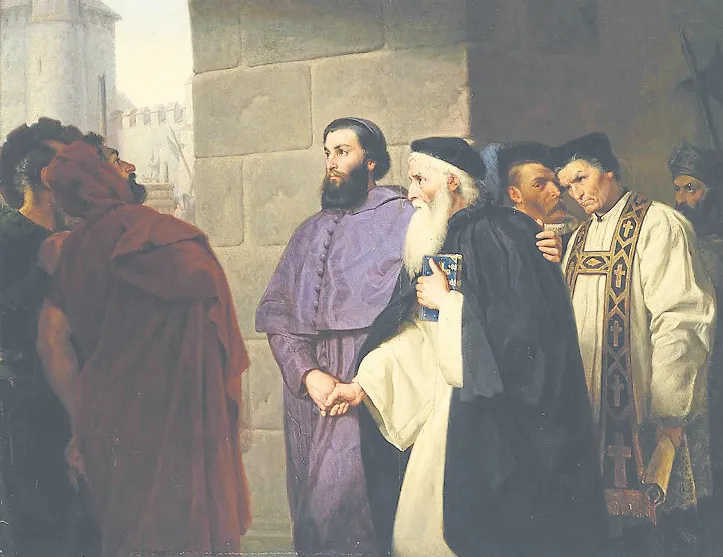
Hugh Latimer (holding Bible) led to execution in Oxford with Nicholas Ridley

Historian Iain Murray has rightly noted: ‘The advance of the church is ever preceded by a recovery of preaching [the Word].’

The Reformation, a time of great spiritual advance, was no exception. Now, among the remarkable cadre of preachers raised up during the Reformation, the English preacher Hugh Latimer (c.1495–1555) deserves more attention than he is often given in accounts of the English Reformation. The 20th-century historian Patrick Collinson once described Latimer as one of the greatest English-speaking preachers of the 16th century. And according to Augustine Bernher (fl.1550s –1570s), a Francophone pastor who was mentored by Latimer and later pastored during the reign of Elizabeth I (1533–1603), ‘if England ever had a prophet, he was one’.

‘The child of everlasting joy’

Hugh Latimer’s father, also called Hugh Latimer, was a yeoman-farmer in Thurcaston, a small village in Leicestershire. The younger Latimer was the only son among seven siblings, and having profited from his early education, he entered Clare Hall (now Clare College) at the University of Cambridge when he was 14. He received his BA in 1510 and his MA four years later, in 1514. Around the time that he received his MA, he was ordained a priest at Lincoln. In 1524 he obtained his BD, which proved to be a key turning-point in his life.


Up until this time he had been a staunch Roman Catholic. As he stated later: ‘I was as obstinate a Papist as any was in England.’ On receiving the BD, Latimer was expected to deliver a public speech. He used the occasion to deliver a bitter attack on the teaching of Philip Melanchthon (1497–1560), the German Reformer and co-worker with Martin Luther. Now, among those listening to Latimer was Thomas Bilney (c.1495–1531), who was at Trinity College and the earliest of the Cambridge Reformers. Bilney was concerned by what he heard and after the lecture, he went to speak with Latimer. Latimer would later say that he learned more in the space of that conversation than he had had in all of the years of his studies at Cambridge.

This then was his conversion, which can be dated to around the Spring of 1524. As he stated in a sermon years later: ‘All the Papists think themselves to be saved by the law, and I myself was of that dangerous, perilous, and damnable opinion till I was 30 years of age.’ As he said on another occasion: ‘I am a Christian man, … the child of everlasting joy, through the merits of the bitter passion of Christ.’

‘A weeping matter’

By the late 1520s Latimer was regularly preaching in Cambridge and in 1530 he was asked to preach before King Henry VIII. In September of 1535, Latimer’s preaching gifts led to his being appointed Bishop of Worcester, which was probably the most neglected diocese in England. It had been occupied by Italian bishops for the 40 years prior to Latimer becoming its bishop and not one of them had ever set foot in England. The failure of episcopal oversight in the diocese led to a lack of interest in preaching.

For instance, Latimer once came to a town where he had made arrangements beforehand to preach on the Lord’s Day, and found the church locked up. He waited for half an hour for someone to show up, but no one did and when he went into the village to find out the reason why no one was at the church, he was told by one of the town’s inhabitants, ‘Sir, this is a busy day with us, we cannot hear you; it is Robin Hood’s day.’ Later, when recounting this incident, Latimer said that this ‘is no laughing matter, my friends, it is a weeping matter, a heavy matter; a heavy matter, under the pretence of gathering for Robin Hood, … to put out a preacher, to have his office less esteemed; to prefer Robin Hood before the ministration of God’s Word; and all this hath come of unpreaching prelates. …If the bishops had been preachers, there should never have been any such thing…’

To Latimer’s way of thinking, the great calling of the bishops of England was to be preachers of the Word. Without preaching, Latimer was assured that there was no hope for England. As he rightly said: ‘Take away preaching, and take away salvation.’

Share
< Previous article| Features| Next article >
Read more articles by Michael Haykin >>
Reviews
Raising an Ebenezer!

Raising an Ebenezer!

What a delight it was to come across this board book in a Christian bookstore, Reformed Book Services in Brantford, …

Features
The martyrdom of Cyprian

The martyrdom of Cyprian

The church in North Africa was a leading centre of Christianity throughout the Ancient World. It was only with the …

Need to advertise?

We can help you reach Christians across the country

Find out more

New here?

Register and get three free articles each month!

Register