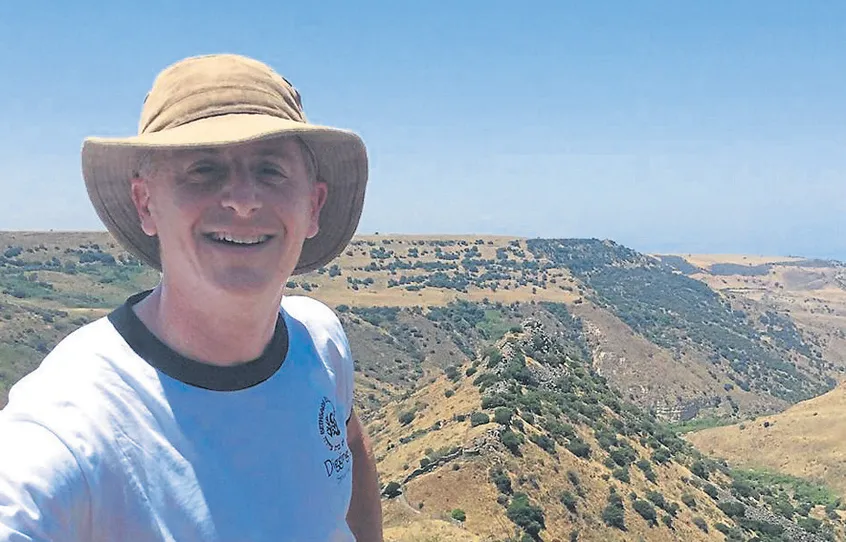
I have just returned from another season in Galilee joining the excavation of biblical Bethsaida.
This is a fascinating archaeological site, casting much light on the world of the Bible. In fact, Bethsaida is a rare location for a number of reasons, many of which help to explain the apparent challenges of history to the biblical record.
Lost town
Bethsaida was a lost town of the Gospels. As one of three towns associated with the Galilee ministry of Jesus, it is often referred to alongside Capernaum and Khorazim as the ‘evangelical triangle’. Remains of these two latter towns have been known since Roman times and, though abandoned, would continue to be identifiable in the modern age. So what about Bethsaida?
Bethsaida was a fishing town – its name means ‘House of the Fisherman’– and home to a number of apostles, including Philip and Andrew. The search for Bethsaida would focus on the shoreline of Galilee. However, a claim was made in the 1980s that a mound two miles from the Sea of Galilee might be the missing town. When archaeologists investigated the area over the years following they discovered that the shoreline at the time of Jesus was different. In fact, the lake had reached the foot of this mound and had over the years silted up, for a number of geological reasons. Left landlocked, the fishing community abandoned the town and it was left to be buried with the dust of centuries.
Pavement from Jesus’ time
Excavations at Bethsaida have now revealed a thriving New Testament town. A beautiful pavement from the time of Jesus has recently been revealed, along with fishing equipment and domestic objects. One of the great advantages of it having been a lost city is that no one built a church, synagogue or mosque on top of the ruins as a site of pilgrimage. That means the archaeological dig is relatively uninhibited in its work. The obvious lesson for apologetics is that if someone tells us that there is no evidence for a person, a place or an event outside of the Bible we may simply reply: ‘Not yet!’
Secret escape tunnel?
However, my own involvement was in a much earlier period. These ancient mounds (called Tells) preserve many levels of occupation extending back into earliest times. The further down you go, the earlier the period you can reach.
Recent work uncovered a palace and major gateway destroyed by the Assyrians near the time of the end of the northern kingdom. This summer we were digging even further back into Bethsaida’s hidden past. A much older gateway has begun to emerge and a cave near the palace, which may prove to be a secret escape tunnel dating to the time of King David. But what is the name of this ancient city and who lived here?
Bethsaida was a town from the time of Jesus. The earlier ruins that are emerging are a thousand years older, long before the existence of Bethsaida. Sadly, no road sign has emerged giving us the name of this town. It was substantial, wealthy and fortified. Who lived there? All the evidence suggests that this was the capital city of the Old Testament Kingdom of Geshur. While not an Israelite town, it was on friendly terms with the people of God and King David married the daughter of its king (2 Samuel 3.3).
Confidence and caution
Within a few years it seems that not one but two lost cities from the biblical world have been found and brought back into the light! However, here lies another lesson for apologetics. We need both confidence and caution in using such evidence. We can have confidence that archaeology is an ally. God revealed himself through history and the historical record supports the biblical account of the ancient world. Christians can have confidence in the historicity of the Bible. But we also need caution in the claims that we make. Archaeology, like any science, is a work in progress and sometimes an apparent discovery turns out to have been misunderstood. We should be cautious not to overstate the case. Stunning discoveries only to be found on Google are dubious at best, fraudulent at worst. But with proper confidence, and without extravagant claims, we can set forth the truth plainly!
Chris shot some simple, short videos of life on a dig in Galilee this summer, if you would like to see them then search his Facebook page ‘Chris Sinkinson Theology.’