Experiencing both the ‘already’ and the ‘not yet’ in the Christian life
When I was considering becoming a Christian as a teenager thousands of years ago, I had a question to which I never got a satisfactory answer.
It was this. The gospel invites me to be forgiven my sins, to be saved from God’s just condemnation and to enter eternal life. But part of being saved is that I would be changed, through new birth and the sanctifying work of the Holy Spirit. (I’m not sure I would have framed things in those theological terms then.) Here’s the question: If I am changed, I would no longer be me. I would be a different person. So in that case is it really me who is saved? Isn’t it actually some other person? Is, therefore, Christian salvation a real salvation? Paul’s assertion in Galatians 2.20 was a worry: ‘I have been crucified with Christ and I no longer live.’
Ever-changing people?
Perhaps some secularists would say it’s a non-question, since 98% of the atoms which go to make up our bodies are replaced each year and so we are always changing and never precisely the same person. But the Bible assumes a continuity of personhood. Peter the fisherman is the same person as Peter the apostle. Perhaps the best answer I have heard to my question is to say, concerning new birth and sanctification, that ‘you are a broken person and God restores you to become your true self – the person you are meant to be.’ In this context, salvation is not innovation but restoration.
However, the nub of the question concerns what we might see as the overlap between the ‘old self’ and the ‘new self’, the ‘you’ which belonged to this present evil age, and the true ‘you’ that you have become in Christ as part of God’s kingdom. As time has gone on I have come to realise the immense importance of the overlap.
Already and not yet
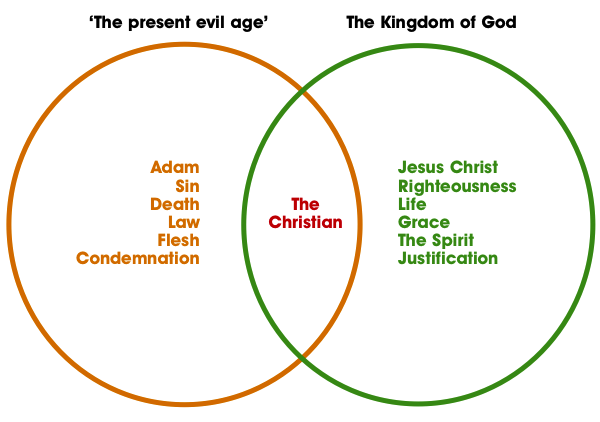
The situation is often helpfully conveyed in a diagram (see above) which seeks to summarise the New Testament teaching regarding what it is to be a Christian.
Through being ‘in Christ’ through faith, a whole string of wonderful benefits becomes ours. With Christ as our Lord and Saviour we are under the reign of righteousness. We are granted eternal life. We are beneficiaries of God’s saving grace. We are born again by the Spirit, who takes up residence in our hearts. We are forgiven and clothed in Christ’s righteousness, justified by God. We are God’s children, citizens of God’s kingdom. Before becoming Christians something very different pertained. We were in Adam, not Christ. We were under the reign of sin and death. We were under God’s law, which we failed continually to fulfil. We had no spiritual life, only the life of the flesh. We stood condemned before God, part of this present evil age.
This parallel and the contrast between being in Adam or in Christ is worked out for us by Paul throughout the book of Romans, but especially in Romans 5.12-21. But we note that at present the Christian lives in the overlap. It is the place of ‘already and not yet.’ We are already saved, but our salvation is not yet experienced in its fullness as it will be when Christ returns. We are already citizens of God’s kingdom, but we are still living in this present world. We are already indwelt by the Holy Spirit, but not yet free of our sinful natures. However, the ‘us’ which was (and still is to some extent) part of this world, is the same ‘us’ that belongs to Christ and God’s kingdom.
Misleading heresy
The importance of all this came home to me recently through contact with a dear Chinese couple, who have sadly bought into a heresy. We might call it the ‘new creation heresy.’
I hope I am summarising this correctly, because I do not speak Chinese and English was not their first language. However, the teaching which seems to have taken them captive is that when we become Christians we become ‘new creations’ – but not in the already/not yet sense of the NT – but absolutely. This means that nothing of your old self is left once you become a Christian. You are a totally different person. It is as if my teenaged question has been extrapolated to the limit. It is taught that when you become a Christian you are no longer you at all – but someone else created to be acceptable to God. In fact one of those I spoke to who had taken on this false teaching no longer wished to be called by her old name but came very close to saying that their true name was ‘Christ.’
As an aside, one obvious question to ask people who believe that this is what has happened to them concerns their memory. Can they remember anything of their life before they became a Christian? Could they remember the way home to their house after they had experienced being ‘saved’? If they could, then surely they are not totally new. Even at that simple level the falseness of the idea is exposed.
Half correct
As with all the ‘best’ heresies, of course, what is being claimed is half correct. There is a sense in which we are ‘new creations’ (2 Corinthians 5.17). But that must be seen in terms of the restoration of God’s image in us, the already/not yet dynamic of the NT and indeed of other NT formulations of salvation. For example, salvation is spoken of as a person being forgiven, and the individual who is forgiven is the same individual who committed the sin – not a different person – otherwise what would forgiveness mean?
Again, salvation includes adoption into God’s family. But the child who is adopted into the family is the same child who once was not part of the family. And of course we are raised with Christ. But we know that, although changed, the Jesus who died is the same Jesus who rose again. As Thomas came to see, it was not a different person (John 20.27, 28). The fact that we as Christians are not perfectly ‘new’ people is also reflected in the ongoing command to Christians to ‘put off’ the old self and ‘put on’ the new (Ephesians 4.22-24). In status we have already put off the old and put on the new, but that change in status is the basis and motivation of ongoing practical change (Colossians 3.9).
How this pans out
Those who take on the ‘new creation’ heresy actually attack the very roots of Christian faith in multiple ways. Here are some examples: is not required. This is
1.The cross because God does not actually atone for sin and so make us sinners acceptable to himself. Instead he dismisses the old self and creates a completely new person, who never sinned. (The implication here is that those who are ‘new creations’ can never sin – contrary to 1 John 1.8,9; Luke 11.4 etc.)
2.The Bible is closed to us. Only those who are ‘new creations’ are able to understand what it really means, because they alone have new minds with which to comprehend it. This makes it very difficult to argue with those who have taken on this heresy.
3.Mankind is irredeemable. There is actually no hope for sinners. The only hope there is resides in becoming someone else totally. You can never be saved.
4.God is not actually a God of grace. He has no love for us as we are. There is no continuation between before and after salvation. He simply makes us into someone else completely. This has implications for what we might say about the ongoing presence of the image of God in the human race.
No doubt much more could be said.