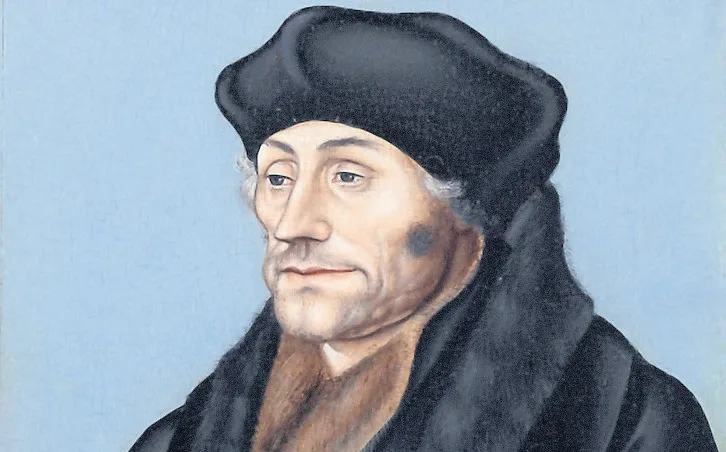
‘The name of Erasmus will never perish’.
This comment in a 1516 letter by John Colet, one of Erasmus’ (c.1466−1536) scholarly friends, says much about the way that Erasmus was viewed by many in his day: he was, without doubt, the most famous scholar of his time. The illegitimate son of a priest, Erasmus was born at Gouda in the Netherlands between 1465 and 1469. His early education was with the Brethren of the Common Life, a semi-monastic movement of lay people founded in the Netherlands by Gerard Groote. Erasmus studied in this communal context for eleven years or so and it was here that he began his study of Greek that would lead to his fame later in life.
Faithful heretic
In 1492, he was ordained a priest in the Roman Church. It is vital to note that although he would be eventually condemned by Rome as a heretic, he strove to remain a faithful member of this church body. As he mentioned in a letter to Alberto Pio III, the Italian Prince of Carpi, written on October 10, 1525: the ‘Lutherans alternately courted me and menaced me. For all this, I did not move a finger’s breadth from the teaching of the Roman Church’.