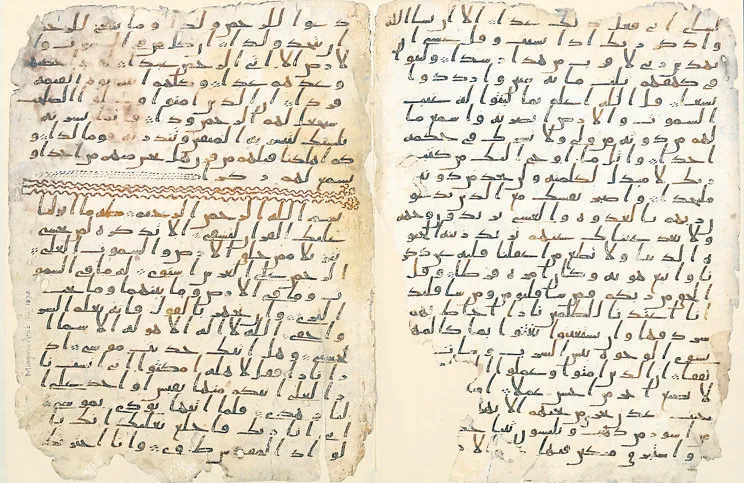
An ancient manuscript of the Qur’an has recently emerged.
This was announced in the news in Autumn 2015 and apparently it was found, not in the dry deserts of the Middle East but in the rather damper city of Birmingham. The manuscript is actually part of a larger copy of the Qur’an held in Paris, and originally discovered in Egypt. Carbon dated to AD 568–645, the implications are enormous, but a bit of background first.
Muslims believe that the contents of the Qur’an were revealed by an angel to their prophet, Mohammad, over a period of 22 years from AD 610–632. It is important to them that the content has never changed for 1,400 years and that there has only ever been a single Qur’an. They suggest that there are no variations in ancient Qur’an manuscripts and at this point, many Muslims will draw a contrast with the New Testament.
Textual criticism
For 200 years a scholarly discipline, called Textual Criticism, has done its best or worst (depending on your point of view) to discern the original New Testament in the light of the 5,686 ancient manuscripts available (24,000 if we include languages other than Greek). What has Textual Criticism achieved? The excellent critical edition of the New Testament which forms the basis for every modern translation. It confirms that over 95% of the original New Testament text can be reconstructed. The remaining problematic portions of the New Testament are mostly matters of spelling or word order, and certainly nothing of doctrinal significance (everything that matters is found in the footnotes of any NIV or ESV translation).
How does the Qur’an compare? The simple fact is that there has never been a critical edition of the Qur’an. In fact, the very attempt to engage in this kind of study meets with resistance, and many scholars write under pseudonyms or speak off the record.
The Sana’a manuscript
One of the oldest incomplete Qur’anic manuscripts was found among 12,000 ancient fragments during the restoration of a mosque in Yemen in 1972. What is interesting about this example, the Sana’a manuscript, is that it is a ‘palimpsest’ which means that an earlier, faded copy of the Qur’an can be seen underneath a later copy. This palimpsest is dated to AD 671 and has variants not found in the later, standard, text of the Qur’an.
A variant reading of the Qur’an like this offers enormous potential for critical scholarship, but such study has been met with hostile resistance. Saarland University scholar Elisabeth Puin claimed that Yemeni authorities tried to suppress research and controversy followed. Few of the manuscripts have been made publicly accessible.
The recent announcement of the Birmingham manuscript will continue to offer material for textual criticism of the Qur’an, but will continue to meet resistance. However, work is being done. Keith E. Small’s detailed study of the variations of a small section of the Qur’an can be read in a scholarly volume, Textual Criticism and the Qur’an Manuscripts, but if you want a quick, and fascinating, introduction to the subject that you could also pass on to Muslim friends without causing offence try Holy Books Have a History published by Avant.
Variants suppressed
According to Muslim tradition, the third caliph, Uthman, edited the final form of the Qur’an and destroyed all previous versions. What is now called the ‘Uthmanic Recension’ became the authoritative version and all variants were suppressed. But what does this tell us? Keith Small comments: ‘The action of destroying the other versions, prohibiting their further use, and promulgating one unified text-form implies that the other versions that needed to be destroyed were of sufficient authority to command the allegiance of significant groups of people.’ Criticism and the Qur’an (Textual Manuscripts). What might these rival versions have contained?
How will the Qur’an fare?
This is where the Birmingham copy becomes of interest. It adds to the supply of early forms of the Qur’an and demonstrates the concern in later Islamic history to standardise their scriptures. It seems we are on the verge of an Islamic equivalent to what was called the rise of Higher Criticism and the Bible. The New Testament has already been put to the test and found reliable. It will be interesting to see how the Qur’an fares in the scholarship of the coming years. In particular, scholars at the Berlin Academy of Sciences are preparing the Corpus Coranicum which will be the first critical edition of the Qur’an, taking into account the many ancient variants available. Islam will have to deal with the obvious fact that the Qur’an does have a history of development.