How a campfire helped bridge cultural divides

Jason Roach  |  Comment
Date posted:  11 Sep 2026
Share Add       
How a campfire helped bridge cultural divides

Photo by Kindel Media via Pexels

His ice cream was using the cone to do a very good impression of a waterfall. The sweat on his brow seemed to be viewing this as a competition. Using a tissue as a temporary dam between his forehead and his shirt, he gazed out at the beach from the promenade. It was shimmering with heat and laughter and beach towels.

Ten metres to his right were some Nigerian families. The pot of Jollof behind the windbreak was making his mouth water despite the distance. Beyond them were two Polish families. He’d overheard their banter as he’d debated between salted caramel and vanilla at the kiosk. To his left were some Ghanaians, happily setting up deckchairs.

All three groups looked content, comfortable and self-contained.
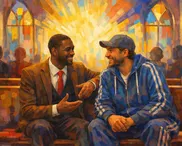
The only issue was that they were all from the same church.

Perhaps the only clue that something strange was happening was that the teenagers in each group were glancing from one circle to the other, with what looked like longing. It seemed, almost imperceptibly, that territory had been marked and that deviation would be dangerous. Somewhere along the way from the coach to the cobbles of the beach, something more than deck chairs had been set up. Invisible barriers had too.

A church leader described a similar scene to me recently. I think it's a common phenomenon in many churches: despite worshipping together on a Sunday, things can look very different socially.

While ethnicity makes the pattern easy to see, the same thing happens across many subcultures such as class, age, education, marital status and personality.

Some of this is to be expected. For example, the biological family has a special place in Christian theology. Likewise, nurturing friendship is precious. There is nothing wrong with family ties or close friendships. The problem is when that natural attraction leads to exclusion. This was the problem that the church leader, knowing his congregation well, had recognised.

A netball match and a campfire

It reminded me of a gathering I was at many years ago in Uganda. I was visiting a seminary with a small group of theological students to lead a preaching workshop. As we sat outside on the grass one evening, it was easy to spot the same pattern. Nigerians, Congolese and Rwandan students sometimes stuck in separate social circles. Two events though, stood out as helping to nurture friendships and break down barriers: a netball match and a campfire. They exemplified an approach that didn’t simply ask people to work harder. They provided invitations into shared experiences that felt natural and enjoyable.

The principal of the seminary announced an exhibition netball match where the visitors played alongside staff and students. While some of us were teachers, and others students, the court was a leveller. The principal rolled up his sleeves and dived across the grass. Sweat dripped through my T-shirt as I tried to block shots. What mattered was not our passport or position, but passing the ball and scoring points. In the heat of sporting battle, our status was shared. In other words, the game made us all teammates who needed one another to succeed.

One evening, we were asked to sing a song around a campfire that reflected our culture. Group after group without hesitation stood up and sang. I’m not sure why the national anthem didn’t come to mind: perhaps it was a felt need to include actions. We sang a nursery rhyme. I’ve tried to block our performance out of my mind. But the point wasn’t the quality of our performance, but the commonality of our experience.

On the one hand, the songs showed our cultural uniqueness – we had different stories to tell. On the other hand, they pointed to our common humanness – we all enjoyed music, laughter and the space and safety to be more fully known.

In different ways, both these moments provided a structured environment where we had shared roles and common goals. The netball match gave us a reason to need one another. The campfire gave us a story to share with each other. The genius was that they weren’t one-off events, but regular features of seminary life that allowed friendships to develop.

Shared identity in Christ

Cultural integration doesn’t happen on command. Telling people to make friends without providing the time and space will ultimately prove fruitless. The key is creating the conditions for the fruit to grow.

Shared tasks, shared responsibility and shared vulnerability can be practical ingredients. Pairing people from different backgrounds on your visiting teams creates space for listening and cooperation. Making room for testimony and struggle in our Bible study groups has uncovered common ground amidst cultural differences. Organising a project where everyone needs to contribute, such as painting a church hall or decorating for Christmas, has worked well for us.

This isn’t culture blindness. It's not advocating that we ignore our cultural identity. We simply live in a way that honours our shared identity in Christ. We ask who might be left out, and what shared activity might, over time, help us bridge the invisible divides between us.

Share
< Previous article| Comment| Next article >
Read more articles on:   church  /  culture  /  identity  /  unity
Read more articles by Jason Roach >>
Comment
How Hollywood can help us understand hospitality

How Hollywood can help us understand hospitality

Biblical hospitality – welcoming strangers – is fading in Western Christian life. Yet, Christine Pohl said “as a way of …

Features
Communion from the hands of the tailored and the track-suited

Communion from the hands of the tailored and the track-suited

There was a glint in his eye. I couldn’t quite tell if it was a tear or a smile. He …

Need to advertise?

We can help you reach Christians across the country

Find out more

Looking for a job?

Browse all our current job adverts

Search