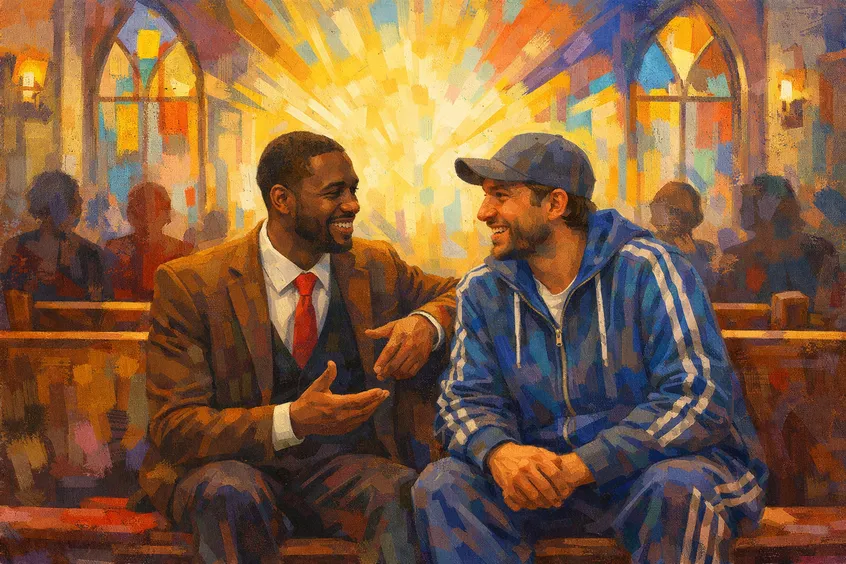
There was a glint in his eye. I couldn’t quite tell if it was a tear or a smile. He grinned, put his coffee down on the table and said: “As a teenager, it was the most special thing about church every Sunday.”
We’d been talking about life on estate churches.
Despite his middle-class background, his church had been a rich tapestry of classes and cultures. It was an example of a church that defied the world’s attempts to draw those within it apart.
He felt that one practice in particular declared to the community that status was measured differently.
That practice was the Lord’s Supper.
The Lord's Supper
He described, as if it were yesterday, moments that had occurred decades before.
In story after story, members had reconciled before taking bread and wine. In some cases, this was broadly equivalent to two men who’d sworn never to speak again shaking hands at the school gates.
On his estate, fallouts were rarely private. Problems became public and trenches were dug along family lines. As a result, reconciliation was all the more powerful.
Time and again, my friend had seen that it didn’t matter if you were a bricklayer or a banker, black or white. Distinctions were downgraded at the foot of the cross and as a result at the front of the building too, as they ate bread and drank wine together.
I was struck by the impact that these physical dynamics had had on a teenage boy. The gospel was not just an idea that he heard, but a lifestyle he saw lived out in a way that involved him personally and viscerally week by week.
'Class distinctions'
Thinking about social class specifically, our society has learnt to silently stratify one another by our speech, our shoes, our streets and our schools. To rank ourselves against one another and divide us along difference.
It’s all too easy for the same distinctions to seep into Christian communities.
Yet what warmed my friend’s heart and arrested his soul was the mark of resistance that Christ gave His church. Each week he saw that differences were real – not least differences of opinion. But that the differences in the amount of cash in their wallets gave way to the shared covenant that Christ had won for them. The social capital they needed from each other more than anything else was grace; and all had access to the currency of the kingdom.
"The differences in the amount of cash in their wallets gave way to the shared covenant that Christ had won for them."
Unsettled
As I listened to his story, I was unsettled by how different his experience had been to my own.
The Lord’s Supper often seemed more wrapped up in my individual experience and time-keeping, than the community experience and reconciliation.
Could it be that the form that the Lord’s Supper took in our church’s life made it more difficult to experience what my friend had enjoyed week by week?
Could the cultural liturgies that I had inherited be limiting?
I still don’t have all the answers. But I’m grateful that the leadership of our church has experimented with more corporate forms of celebration alongside individual devotion. For example, people getting up from their seats and gathering in groups.
I’m thankful that the hands holding out the bread are both the tailored and the track-suited – a sign that there is no glass ceiling in the pastoral roles in church life.
I also pray that to a watching world that prioritises "progress," our church might give people a sense that the way up is in fact down.
In the words of Augustine, “the first just men were set up as shepherds of flocks, rather than as kings of men” (Augustine, The City of God, XIX.15).
How Hollywood can help us understand hospitality
Biblical hospitality – welcoming strangers – is fading in Western Christian life. Yet, Christine Pohl said “as a way of …