Faithful and imaginative cultural engagement

John Woods  |  Reviews
Date posted:  7 Oct 2025
Share Add       
Faithful and imaginative cultural engagement

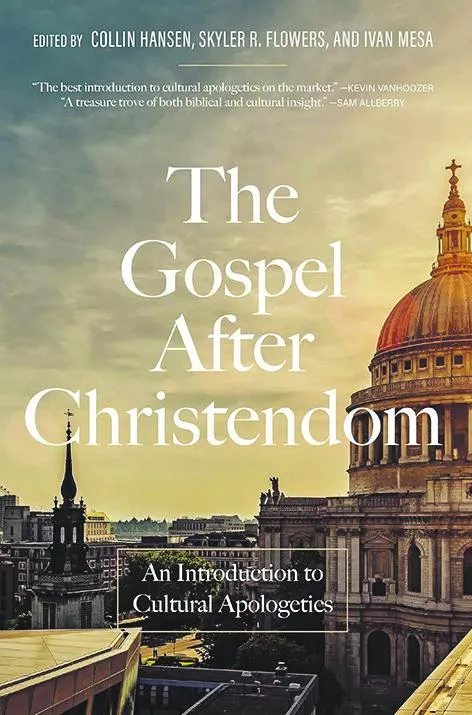
John Woods reviews The Gospel After Christendom.

If there were a perfect recipe for a book, what would it be? You would need a timely but worthy subject, capable author or authors who know their stuff, clear writing, and an engaging title. This book does tick most of these boxes.

Scholars connected to the Keller Centre have produced a wide-ranging book that addresses a variety of apologetic issues in a clear and succinct way. Each of the chapters is brief (10 to 15 pages). The authors are to be congratulated for packing their area of expertise into short readable chapters.

The book begins with an Introduction by Collin Hansen on why we need what he calls cultural climatologists. By this Hansen means that Christian communicators need to be aware of the changing cultural weather patterns and shape their apologetics accordingly.

The book is then divided up into four main sections:

  1. What is Cultural Apologetics?

    This section aims to clarify the terms and explore how cultural apologetics has been done historically. The standout chapter here is by Christopher Watkin, who reminds us that we find ourselves at a similar cultural moment to Augustine when he penned his magnificent City of God and, like him, we need to know how to tell the better story of Scripture to our times.

  2. How is Cultural Apologetics done?

    Alan Noble, the first contributor, reminds us that the posture of the apologist must be neither accommodating nor condemning, but one of grace, “which means a desire to understand the person or culture in front of you, a desire for them to see their idols are lifeless, and a desire for them to repent.”

    Dan Strange provides the missiology by helpfully summarising the origins and use of his thinking on subversive fulfilment in apologetics. He suggests that some people are better at confronting culture than connecting to culture. To both affirm and contradict our culture is like walking a tightrope; it is a task that both tears down and builds up. It requires the responsible use of subversive fulfilment and a theological nimbleness and cultural intelligence in engaging in apologetics. This requires gospel words but also committed gospel lives that seek spiritual and cultural transformation.

    Gray Sutano builds on this by exploring the goal of cultural apologetics, which is to challenge false beliefs but also help people to see the true God that they are suppressing.

    Gavin Ortland concludes this section by showing that unbelief is unlivable, because it is “exhausting to keep suppressing what we know in our heart of hearts.” He does this by exploring disenchantment, meaninglessness and loneliness in contemporary society before making the claim that “God himself is the antidote to modern secularism”, and also that “too often Christians fail to start with God”.

  3. What Questions Do Cultural Apologetics Answer?

    This section helps us to identify the right questions for our time. Is Christianity Good? (Rebecca McClaughlin), Beautiful? (Rachel Gilson) and True? (Derek Rishmawy).

    The question that Christians used to be asked was: “Is it true?” Then it became: “Does it work?” Now it is: “Is it compelling (in the sense of good and beautiful)?

  4. Where Does Cultural Apologetics Happen?

    The three authors suggest that it happens in the church, on the front porch, and in everyday life. Cultural apologetics seeks to be up close and personal, engaging in conversation that listens as well as speaks, and endeavours to live authentic Christian lives that live out and model the gospel.

    In the conclusion, Collin Hansen returns to the aim of this book: “In the cultural apologetics showcased by this book, we hope to awaken the memory of Christianity and the hope of a new heaven and new earth to come in Christ. Cultural apologetics helps Christians share the truth, goodness, and beauty of the gospel as the only hope that fulfils our deepest longings.”

    That sounds a lot like Tim Keller, to whom this timely book is dedicated. Keller modelled so many of the things that are addressed in this book in his ability to hold a humble and winsome conversation between Scripture and contemporary culture.

Some of the chapters are stronger than others, and apart from the footnotes there is not much in the way of signposting other resources or questions on this vital subject. It will however, be a useful resource for all who seek to transform our culture with the gospel.

THE GOSPEL AFTER CHRISTENDOM: An Introduction to Cultural Apologetics
Editors Collin Hansen, Skyler R. Flowers, and Ivan Mesa.
Zondervan. 202 pages. £20
ISBN 978 0 310 175 568

Share
< Previous article| Reviews| Next article >
Read more articles by John Woods >>
Reviews
Give me joy in my heart

Give me joy in my heart

“Everyone wants to be happy”. That is how Andrew Wilson begins this brief but timely book.

Reviews
Rest refocussed through Christ

Rest refocussed through Christ

It is always a treat to receive one of these silver-covered volumes in the “New Studies in Biblical Theology” series. …

New here?

Register and get three free articles each month!

Register

Subscribe

Enjoy our monthly paper and full online access for just £40/year

Find out more