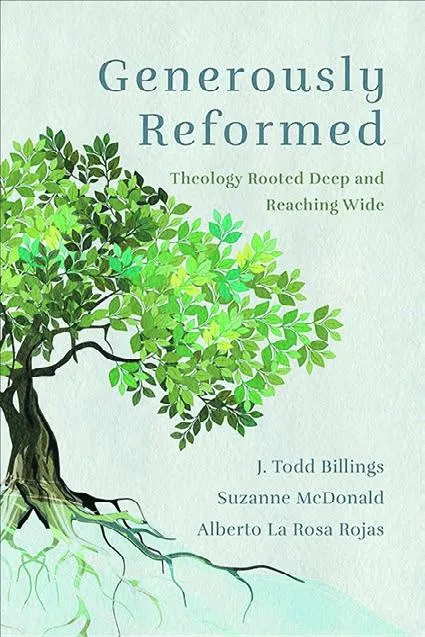
GENEROUSLY REFORMED: Theology Rooted Deep and Reaching Wide
By J. Todd Billings, Suzanne McDonald and Alberto La Rosa Rojas
Baker Academic. 191 pages. £19.99
ISBN 978 1 540 963 321
I have enjoyed books by Todd Billings in the past and my attention was gripped by the intriguing and tantalising title and subtitle of this one!
It is possible to have books that approach difference by merely reaching for the lowest common denominator. Others try to preserve a grand old stately home, but in the process sell off the family silver. I like the tone of generosity with which this book is written and the care to maintain deep roots in Reformed theology while reaching wider than what some would see as Reformed theology.
The book challenges the reductionism that limits our understanding of what it means to be Reformed by equating it to “Calvinism”, or the headlines of the five Solas or the five points (TULIP).
The authors remind us that the Reformed tradition stems from many other figures than Calvin. They argue that there might be more focal concerns of being Reformed than the five Solas; (they suggest the church and the work of the Spirit as potential additions).
In a helpful section on the five points, the authors remind us that the so-called five points of Calvin emerged after Calvin’s death, as a rearguard defensive action in response to five assertions made by Jacob Arminius. They add that the order of the original points would come up with a less snappy acronym than Tulip – it would be ULTIP! The authors reflect on the potential unhelpfulness of the phrasing of the points Total Depravity, Irresistible Grace and Limited Atonement, and while retaining the concepts suggest a nuanced rephrasing and interpretation of the terms.
The main body of the book deals with a wider sweep of concerns that have occupied Reformed Christians, including the church, infant baptism, the mystery of election, providence and the problem of suffering, the church’s mission, and eschatology.
Infant baptism
The chapter on infant baptism is interesting. Some Reformed Christians would claim that unless this practice is embraced, a person cannot be Reformed. The authors recognise the existence and validity of Reformed Baptists, while making a reasoned pitch of the practice of infant baptism, which I found compelling, but not convincing.
The standout chapters are the ones on election and providence. There is some good work here exploring the wide range of understandings on what it means to be chosen by God and what that has got to do with human freedom. In the chapter on providence the authors deal with the intellectual challenges of believing in the doctrine; here there is a fascinating interaction with the words of David Bentley Hart on the 2004 Tsunami in the Indian Ocean. The authors also interact with John Piper, amongst others, on the way that Biblical lament can be an appropriate response to the negative experiences in “our “Father’s world”.
The chapter on mission explores the question of whether the idea of widening the concept of mission to include social justice is part of the Reformed tradition, citing Calvin’s support for refugees from France and other countries who were fleeing religious persecution.
The chapter on eschatology, although interesting, does not have the traction found in the other chapters.
The book concludes with two appendices: one is a “just so story”, on why the Reformed are called the Reformed, the other is an examination of the origin and value of the phrase: “Reformed and always reforming”. It is always good to understand our roots and to make sure words like Reformed are not merely a vague label. This timely book is a helpful way to re-evaluate what it means to be Reformed in the widest sense of the term.
Big Church Festival: 'The site became eerily quiet'
We live in West Sussex, just down the road from the site of the Big Church Festival (BCF) – an …