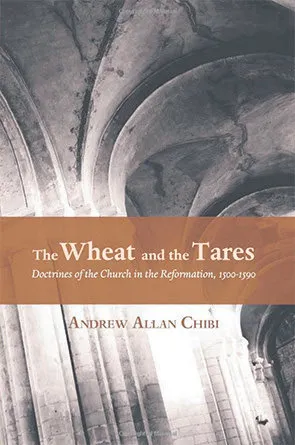
THE WHEAT AND THE TARES
Doctrines of the Church in the Reformation,
1500 –1590
By Andrew Allan Chibi
James Clarke & Co. 486 pages. £40.00
ISBN 978 0 227 176 382
This detailed book is the work of a freelance scholar and sometime lecturer in the University of Leicester.
He has previously written on the European and English Reformations. His students have often questioned him about the diverse views of church government extant during the Reformation period. Since he could direct them to no single work dealing with these views, he wrote this book. He ranges from the approach of Erasmian humanists through to the teachings of the second generation of Reformers, before turning to the response of the Roman Catholic Church to the demand for structural reform. Each of these constituencies struggled to deal with the question of the response of Christianity to the secular society in which it ministered.
Privileged position
The Reformers inherited a concept of the church living in a Christian society where it occupied a privileged position from which it acted as a spiritual guide. It claimed the whole body of citizens as its members, although few of them showed marks of true Christianity, hence the title, The Wheat and the Tares. In return for its patronage, the state expected the church to act as one of the instruments of civic and national unity. The concept of the church as a separate spiritual body acting as salt in a degenerate society was too radical a notion for most to accept. Those who promoted such views were treated as theological outcasts, usually fiercely persecuted and, sadly, they often developed their own eccentricities or in some cases heresies. These people included the Anabaptists, who fought against the popular notion that the ‘world’ referred to in Matthew 13.38 is in fact the church or perhaps ‘Christian society’.
This work offers a wealth of information, but while students of the Reformation may find it useful, it is not likely to prove attractive reading for the average church member.