evangelicals & catholics
Who might be the next pope?

Leonardo de Chirico
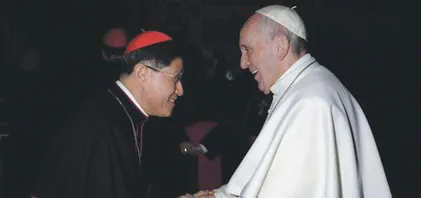
When the reigning pope creates new cardinals, it is because he is thinking not only of the Roman Catholic Church of today but, above all, that of tomorrow.
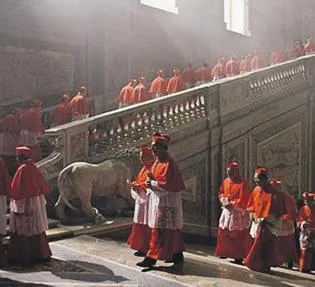
Cardinals are those who, in addition to assisting the pope with governing the universal Church, meet in conclave and elect the successor once the reigning one has died or, as in the case of Pope Ratzinger, resigns.
evangelicals & catholics
A Roman stop after a Catholic push
Leonardo de Chirico
Roman Catholicism can seem to be a pairing of contradictions. It is both Catholic (inclusive, welcoming, absorbing) and yet at the same time it is Roman (centralised, hierarchical, institutional).
The former characteristic gives it its fluidity, the latter its rigidity. Certainly there are historical phases in which the Catholic prevailed over the Roman and there are different combinations in the way the two qualities are intertwined with each other.
evangelicals & catholics
Eating God? A glimpse of Roman Catholicism
Leonardo de Chirico
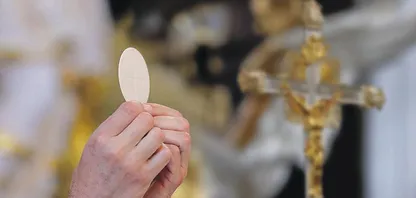
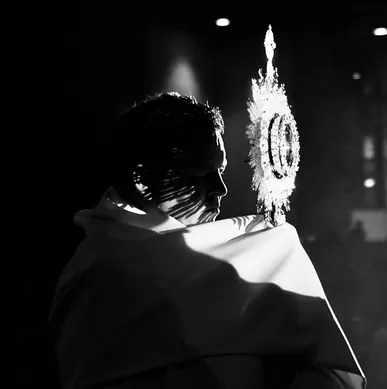
At first glance, it seems like a cannibalistic gesture, even if it is addressed to God and not to a human being. Yet it is the quintessence of Roman Catholicism.
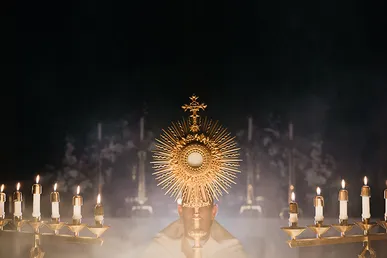
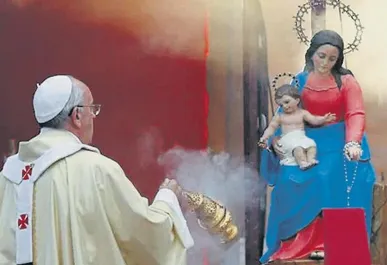
We are talking about ‘eating God,’ an act that is at the heart of the Roman Catholic understanding of the Eucharist. Can Roman Catholicism really be thought of as the religion of ‘eating God’? Exploring it is Matteo Al-Kalak, Professor of Modern History at the University of Modena-Reggio, in his latest book, Mangiare Dio. Una storia dell’eucarestia (Eating God. A History of the Eucharist).















The execution of Archbishop William Laud
On 28 January at St Paul's Cathedral, Sarah Mullally will be confirmed, officially making her the Archbishop of Canterbury. The previous Archbishop, Justin Welby, ended his term on 6 January 2025. Both managed to avoid the auspicious day of 10 January, the date on which Archbishop William Laud was executed in 1645.
Yes. You read that right. An Archbishop of Canterbury was executed by Parliament in 1645. The church wardens of St George’s Church, Beckington in Somerset – the church in which I was baptised 50 years ago – would not have been all that sad to hear the news of Laud’s fate. England was three years into a civil war, partly caused by Laud and his reforms. Families, villages and towns had been torn apart, having been forced to choose between King and Parliament.