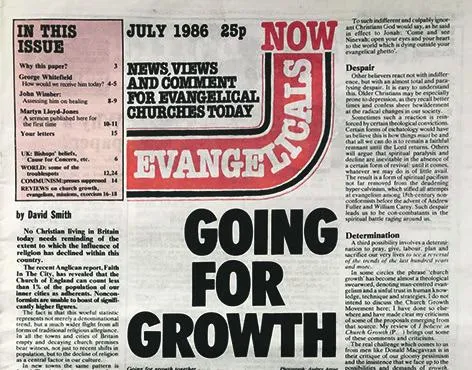
Evangelicals Now was first published in July 1986 and so, from Easter for the rest of this year, we will be celebrating the paper’s 40th anniversary with a series of events to mark the occasion.
It’s an excellent opportunity for regular readers to thank God for sustaining the publication for so long, to take stock of en’s current situation and assess future plans. You might say that this article is about Evangelicals Then, Evangelicals Now and Evangelicals to Come.
Evangelicals Then
It began in the years preceding the summer of 1986 when the proprietor of Evangelical Times increasingly objected to the paper’s editorial stance. The matter came to a head when in late May, a week after the June edition went to print, he nominated new Board Directors, one of whom was elected Chairman.
The new Board stopped the printing of the June edition, required the editors to replace the editorial with a statement by the Chairman and to remove sample letters from the many hundreds supportive of the editorial stance despite also planning to publish some from the minority that were less supportive. In addition, the Chairman required a photocopy of future issues be sent to him for approval before publication. His decision was final regarding content.
Sir Fred Catherwood
The editors were unable to accept the removal of editorial independence and were suspended. A month later, with the encouragement of Sir Fred Catherwood, an acclaimed politician and businessman, Evangelicals Now was launched by the original editors. Their aim was to carry on as before, but to safeguard editorial independence, the Board of the new charitable company was to be appointed by and answerable to elected members.
For 40 years, initially under the editorship of Bob Horn, then John Benton from 1992, followed by Jonathan Worsley in 2019 who was succeeded by the current senior editor, David Baker, in August 2020, en sought to publish unashamedly Reformed, Evangelical content to encourage readers in their knowledge and understanding of Scripture and the times they live in.
Acknowledging that evangelicals may come to different conclusions and that en did not always get the journalism right, the paper was immovable on the fundamental truths of evangelical Christian faith, and tried to encourage lively debate between those who loved the gospel and looked to the Bible as their ultimate source of authority on all things spiritual.
Evangelicals Now
As with all conventional publications, en has needed to adapt to the ever-evolving new media landscape. Print circulation has declined, but not nearly as dramatically as most well-known titles. Indeed, print subscriptions could well begin to rise in the coming year. More on this below. The growth in digital subscriptions is equally encouraging and since its reordering in 2024, visits to the website have increased dramatically.
Covid accelerated the move to remote working, so now all staff work from home. That has the advantage of building a team based far and wide with journalists representing different parts of the country. The editorial team currently comprises four employed journalists (Sussex, Wiltshire, Cheshire and Scotland), two retained freelance reporters (South Yorkshire and Scotland), an operational team of four based in London and the home counties, and over 80 signed-up contributors from around the country and overseas.
There are now 67 members who are kept informed through a bi-annual newsletter and a well-attended Annual General Meeting online each October. Mindful of the issues leading up to the launch of en, an Editorial Review Group, made up of six members, was recently established to provide helpful feedback on content whilst not compromising the integrity of the paper’s editorial independence.
Evangelicals To Come
At their board meeting in February, on the back of strong finances in the current financial year, en trustees approved a 22% increase in expenditure for the financial year commencing 1 April and have set ambitious targets for circulation growth, particularly digital subscriptions.
From the summer, the senior editor’s part-time hours will more than double, a full-time junior journalist will join the staff and for the first time en will appoint a managing director. In addition, en’s marketing spend will be significantly enhanced through a combination of social media advertising and a high-profile presence at key conservative evangelical conferences.
Beginning with Rising Lights, FIEC’s inaugural gathering in Torquay in April, followed by Bible By The Beach in Eastbourne in May, Co-Mission’s Revive in Canterbury in June and three weeks of the Keswick Convention in July and August, en will be manning an exhibitor stand, distributing free newspapers, conducting roving video interviews and, at most of the conferences, hosting a panel discussion similar to BBC’s Question Time – all designed to grow awareness among the paper’s core target audience and make significant progress achieving subscription targets.
In July we will print a special 40th anniversary issue to mark the month the first edition was published. There will be extra copies available for regular readers to distribute in their churches. Ideally, we’d like you to ask your pastors if a time of thanksgiving might be allotted at your church’s prayer meeting that month, or similar gathering, with a chance to promote en. If you would like to participate, please contact us at editor@e-n.org.uk