
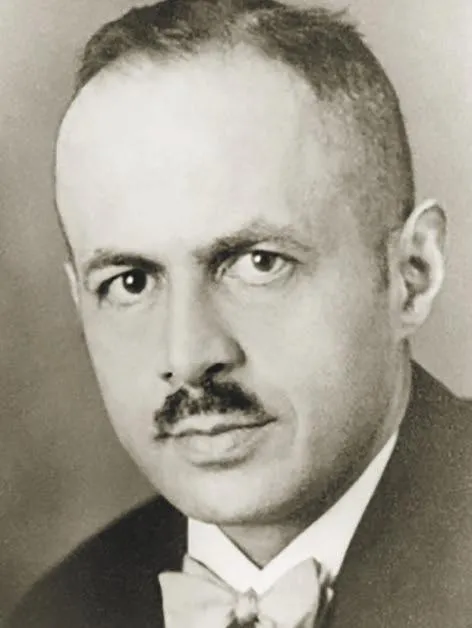
Who was Friedrich Weißler? He was born of German Jewish stock on 28 April 1891, in Königshütte in what was then Upper Silesia, now part of Poland.
While an infant his parents embraced the Protestant faith and so Weißler was baptised as a Protestant. By the outbreak of World War I, Weißler had completed his law studies and gained a doctorate in law. During that war, he served as a lieutenant in the German army. Upon its close, he returned to the field of law, passing the equivalent of the bar exam in 1920 and being appointed an assistant judge in Halle in 1922. That same year he was married to Hanna Schäfer and the couple had two sons. In 1932 Weißler became director of the regional court in the central German city of Magdeburg.
Within a year, though, Adolf Hitler and the Nazis had taken power and begun to systematically reshape German society and culture, and to implement their racial policies. Given his ethnic background, it is not surprising that Weißler was branded a non-Aryan in 1933 and experienced bullying and harassment from the Sturmabteilung – literally the ‘Storm Detachment’ and usually known simply as the SA – which was the Nazi Party’s original paramilitary wing before the SS.
After Weißler had imposed a fine on a defendant who was a member of the SA, the SA had him dismissed from the judiciary on 21 July 1933. Despite his distinguished record of service during the First World War, the Nazis regarded him henceforth as ‘politically unreliable’.
The ‘Hitler Memo’
Weißler subsequently moved with his family to Berlin to work as a lawyer in the private sphere, and in November of 1934 became the legal advisor to the Confessing Church. This group of churches had staked out its theological position in what is known as the Barmen Declaration (1934), a key confessional document of the 20th century that declared forthrightly this Christian community’s resistance to all attempts to limit or weaken the Church’s autonomy.
In 1936, due to the growing harassment of pastors and lay people of the Confessing Church, a memorandum was drafted – sometimes called the ‘Hitler Memo’ –that called for an end to such persecution by the Nazis. Politely but unflinchingly this document opposed the Nazi regime’s attempts to ‘de-Christianise’ Germany. As the following quote from this document reveals, the memorandum also forthrightly declared this Christian community’s opposition to Nazi antisemitism:
‘If blood, ethnicity, race and honour are ranked as eternal values … the Evangelical Christian is compelled by the First Commandment [‘You shall have no other God but me’] to reject that evaluation. Wherever Aryan humanity is glorified, testimony is provided in support of God’s word that all men are sinners. If – in the context of the National Socialist world vision – an antisemitism is imposed which obliges the individual to hatred of Jews as an article of civic duty, then for the individual Christian this stands in opposition to the Christian commandment, ‘love thy neighbour’.
Along with the theologian Hans Asmussen (1898–1968) and pastor Martin Niemöller (1892–1984), Weißler played a key role in the drafting of this document so as to ensure that it was in compliance with the law. In hindsight, it was politically naïve to think that Hitler, to whom the document was to be presented in private in June of 1936, would have heeded it. And the fact that the memorandum was leaked – probably by one of the young pastors in the Confessing Church by the name of Ernst Tillich (1910 – 1985) – to the foreign press, who publicly interpreted it as an open challenge to Hitler’s rule, further endangered those who drafted it.
Hitler and his Nazi henchmen were furious at the publication of the document. The Gestapo immediately launched an investigation into what was considered by the Nazis as an act of national treason. Suspicion fell primarily on Weißler – as a ‘Jew’ – as well as on two young pastors, Tillich and Werner Koch (1910–1994). He was arrested, along with Tillich and Koch, in October 1936, questioned at a police prison and then sent to the concentration camp of Sachsenhausen in February of 1937.
The Confessing Church’s failure
Leaders of the Confessing Church, including Martin Niemöller, might have been able to secure Weißler’s release if they had stood by him. But they wished to avoid any hint that the Confessing Church might be politically disloyal to Germany and thus said nothing and in effect left Weißler to his fate. Six days after arriving at Sachsenhausen, Weißler, after having been tortured, was brutally murdered by the Nazis on 19 February 1937.
To be sure, Hitler’s Nazi regime murdered Weißler, but the pastors of the Confessing Church failed to stand up for their Jewish Christian brother. In 2005 a leading churchman of the Lutheran churches in Germany, the theologian Wolfgang Huber, publicly admitted: ‘We in the Evangelical Church have to acknowledge our guilt in not standing up for our co-worker Friedrich Weißler. Our history is not always one of heroic resistance to tyranny.’
In the words of Matthew Hockenos, the story of Friedrich Weißler involves ‘courage and cowardice, opposition and accommodation, and resistance and complicity’.








Should the CofE pay slavery reparations?
During a recent trip to Ghana, Archbishop of Canterbury Sarah Mullally renewed her commitment to a £100 million reparation fund …