
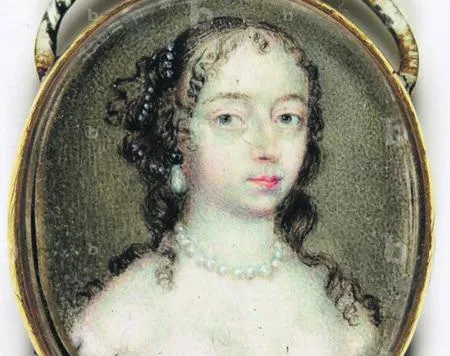
Brilliana Harley (1598-1643) was born in 1598 at the seaport of Brill (after which she was named), near Rotterdam, daughter of Edward Conway and Dorothy Tracy Conway.
Among her ancestors were royalty, including William I and Henry II. Her father, Sir Edward Conway (later Viscount Conway), was the Governor of Brill at the time of her birth, hence her unique name. Brill was one of three so-called ‘Cautionary Towns’, key seaports in the Dutch Republic that had been garrisoned by English troops from 1585 onwards when the English aided the Dutch in their fight against the domination of the Spanish in what is known as the Eighty Years War or the Dutch Revolt (1566/1568–1648). They were governed as English colonies – hence the role of Brilliana’s father as the Governor of Brielle – and were eventually returned to the Dutch Republic in 1616.
There is much that we do not know about Brilliana’s early years, but her education included French and Latin. Later in life, she tutored her sons in Latin when she felt that the local schoolmaster was unreliable. She acknowledged that she was actually more at home reading French than English.
When she was in her mid-twenties, Brilliana married Robert Harley (1579– 1656) of Brampton Bryan Castle, on 16 July, 1623. Her husband’s ancestral home can be found in the small village of Brampton Bryan in north-western Herefordshire, close to the Welsh border. This castle, ruined during the Civil War in 1644, dated back to the 1290s. It guarded a vital route into Central Wales and was thus of military importance.
Robert Harley had been twice-widowed and, before marrying Brilliana, he had also buried ten children. His mother, née Margaret Corbett, had been a committed Puritan and had taken great care to hand on her Protestant faith to her family. Shaped by this faith, Harley became a prominent and distinguished Presbyterian. At his funeral, the presiding minister, Thomas Froysell, commented that Harley had been ‘a great saint by grace’ and ‘if other saints are candles, he was a torch’.
The Harleys were full-throated Puritans, but the county of Herefordshire surrounding Brampton Bryan was largely Royalist, and hostile to the Harley family. In 1641, as the nation began to slide towards civil war, Brilliana stationed guards on the battlements of the castle and brought into the castle a stock of bullets. In a letter that Brilliana wrote in December 1642, she describes the climate in north-western Herefordshire at the time: ‘They [some of her wealthy neighbours] are in mighty violence against me. … I never was in such sorrows, … I hope the Lord will deliver me; but they are most cruelly bent against me’.
However, despite being surrounded by those committed to the Royalist cause in the Civil Wars, the gentry in the rest of the county appear to have been reluctant to attack the Harley family home, which was partly out of their personal respect for Brilliana. Nevertheless, eight months after the letter cited above, on 26 July, 1643, the castle was attacked and besieged by Royalist forces under the command of Sir William Vavasour, the governor of Hereford. Vavasour surrounded Brampton Bryan with a mixed force of cavalry and infantrymen of about 700 soldiers. The formidable Brilliana held the castle in the face of this onslaught and siege till 9 September. She had three of her seven children with her, along with 50 soldiers and about 50 civilians.
The Royalists burnt all of the buildings in the neighbouring village of Brampton Bryan and the castle was bombarded nearly every day. Although the bombardment left the castle roofless, casualties were low and only one death and a few injuries are recorded. The attackers, on the other hand, lost nearly 70 men who were either killed or injured. At one point, Brilliana discovered that the Royalists were planning to fire the castle with grenades. In an audacious move, she sent ten men out of the castle to find the building in which the grenades were being kept. They did so and were able to destroy them all.
Charles I himself wrote Brilliana on 21 August, encouraging her to surrender. But she refused. In her reply to the king she stated that he had made ‘many solemn promises that he would maintain the laws and liberties of this kingdom. I cannot then think he would give a command to take anything away from his loyal subject, and much less to take away my house … I must endeavour to keep what is mine as well as I can, in which I have the law of nature, of reason, and of the land on my side, and you [that is, the King and his troops] none to take it from me.’
The siege was lifted on 9 September when the Royalists left to join an attack on the city of Gloucester. A second siege took place in the Spring of 1644. This time the Royalists prevailed and took the castle after only three weeks. Using mines and more powerful artillery, the Royalists inflicted further substantial damage upon the castle. The siege ended when the castle was surrendered to the attacking forces. The building was sacked and burnt and the 67 prisoners, including the three young daughters of the Harleys, were taken to Shrewsbury for a year. Brilliana, though, was not alive to witness the surrender of the castle, for she had died the previous Autumn, on 29 October, 1643, possibly of pneumonia.
Next time. Brilliana was a prolific letter-writer. Most of her 370 or so surviving letters were to her eldest son, Edward (1624-1700), nicknamed Ned. We will focus on the piety of these letters in next month’s column.



Should the CofE pay slavery reparations?
During a recent trip to Ghana, Archbishop of Canterbury Sarah Mullally renewed her commitment to a £100 million reparation fund …