
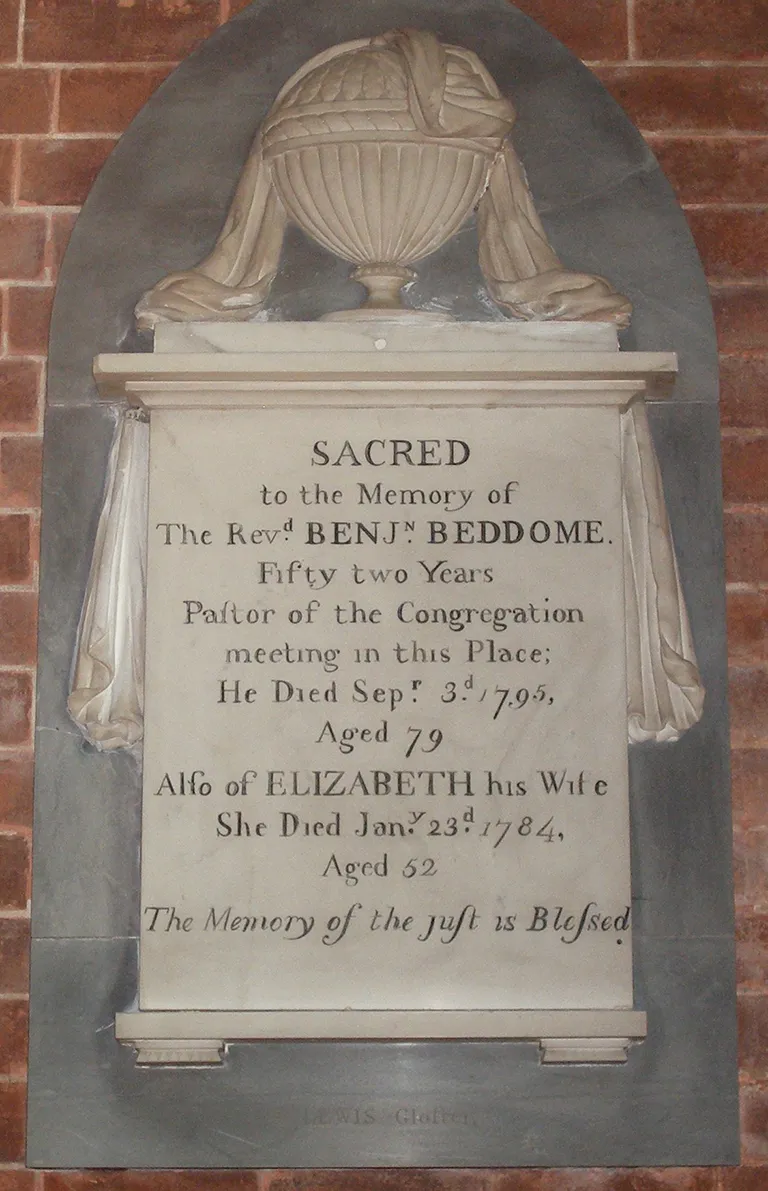
For some odd reason, I am drawn to the lives of Christians who can only be regarded as obscure or marginal to the main story of Christianity that is usually told in our church history books.
So, for example, I am currently writing a life of Benjamin Beddome (1718–1795), who pastored a Baptist work in the village of Bourton-on-the-Water in the Cotswolds for over 50 years. The English historian A.C. Underwood well described him as a ‘Calvinist of the best type’, passionate in preaching, ardent in prayer for revival, eager for the conversion of the lost, and the strengthening of his people.
John Newton (1725–1807), the well-known evangelical leader and author of the ever-popular hymn ‘Amazing Grace’, had the opportunity to meet and hear many of the leading evangelicals of his day. It is intriguing, therefore, to read some remarks that he penned in his diary on 7 August 1776, after he had heard a sermon by Beddome. The text on this particular occasion was Zechariah 11:12, the verse cited in the Gospel of Matthew with regard to the amount of money Judas Iscariot received for the betrayal of Christ. ‘He is an admirable preacher’, Newton observed after hearing the sermon, ‘simple, savoury, weighty’.
This was not the first time that Newton had heard Beddome preach. The Anglican evangelical had heard him speak the previous year on 2 Corinthians 1:24. Of that occasion Newton later recorded: ‘[the sermon] gave me a pleasure I seldom find in hearing. It was an excellent discourse indeed, and the Lord was pleased to give me some softenings and relentings of heart’. For one who often heard the greatest preacher of the day, George Whitefield, these words are high praise indeed. But who was Benjamin Beddome and why should his life be remembered today?
Though raised in a godly pastor’s home in Warwickshire, Beddome was not converted until he was nearly 20. On 7 August1737, a visiting preacher to his father’s church by the name of Ware spoke on Luke 15:7. So deeply was Beddome affected by the sermon that for some time afterwards he would be in tears while his father preached, and he would hide himself in one of the galleries so that his weeping would not be widely observed.
Soon after his conversion Beddome was led to consider pastoral ministry. He spent a couple of years in theological training at Bristol Baptist Academy and a further year at an academy in London. It was during this sojourn in London that Beddome became a member of Prescot Street Baptist Church in October, 1739. Early the following year the London church took steps to formally recognise God’s hand on Benjamin’s life for pastoral ministry and to set him apart for that work.
Beddome’s father, John Beddome, was the source of much sage counsel for his son in his early days as a pastor. The younger Beddome’s preaching in his early years, for instance, was quite different from that which Newton admired in the 1770s. The tone of his preaching was often strident and harsh, and his sermons far too long.
John Beddome thus told his son in a letter that he wrote on 17 May 1742: ‘If you deliver the great truths of the gospel with calmness, and with a soft, mellow voice, they will drop as the gentle rain or dew. For the good of souls, then, and for your own good, be persuaded to strive after this.’ A few weeks later he again urged him: ‘Soften your voice, and shorten your sermons … Let two hours be the longest time you spend in the pulpit at any place’!
Beddome must have followed his father’s advice or he would never have made the impression that he did upon Newton many years later. In next few monthly columns, we shall catch some glimpses of the remarkable ministry that God gave him at Bourton, often called ‘the Venice of the Cotswolds’.






Should the CofE pay slavery reparations?
During a recent trip to Ghana, Archbishop of Canterbury Sarah Mullally renewed her commitment to a £100 million reparation fund …