
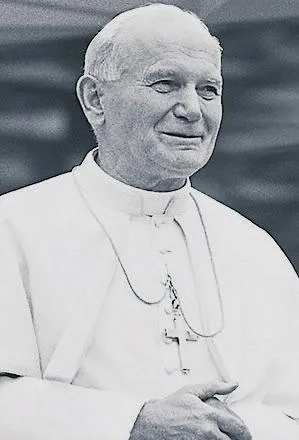
Karol Wojtyła (1920–2005), since 1978 better known as Pope John Paul II, has been one of the most influential men of the 20th century.
The centenary of his birth is a useful opportunity to reflect on his legacy. His life was at the centre of the major affairs of the 20th century: the tragedy of Nazism and the trauma of the Second World War, the apex and fall of Communism, the Second Vatican Council and its debated implementation, the apparent triumph of Western democracy and the oppressive costs of globalisation for the Majority world, the fracture of ideologies and the rise of secular hedonism. Supporters have acclaimed his achievements in terms of navigating, surviving and overcoming the dangerous streams of our post-something world. Critics have pointed out the double-faced, contradictory trajectory of his life and his very backward-looking Catholic outlook.
How do we assess John Paul II’s legacy? This Pope was the one who called his Church to be engaged in mission, encouraged the pro-life front, welcomed some of the Evangelical concerns related to Bible literacy and liturgical variety, and seemed to be closer to the Majority world than his predecessors.
Certainly there has been a significant shift of attitude, and John Paul II has made quite an impression on many Evangelicals. The Legacy of John Paul II: An Evangelical Assessment, edited by Tim Perry, contains positive comments on each encyclical signed by Wojtyła, and the tone is close to admiration, with some minor criticism.
Of course much of it is a fair summary of what the Pope wrote, if selective in many ways. For instance, there is no mention that each encyclical ends with an invocation to Mary, which does not represent a Christocentric and biblical pattern. Moreover, there is little recognition of the fact that, besides the Bible, papal encyclicals quote sources of the tradition of the Church even more extensively. The Bible is only one source amongst many, and apparently not the decisive one. On specific contents, Fides et Ratio (Faith and Reason, 1998) combines Aristotelian reason and Thomistic faith, a choice that leaves out many biblical strands. Ecclesia de Eucharistia (The Church from the Eucharist, 2003) reinforces the traditional Roman Catholic doctrine of the sacrificial nature of the Eucharist, its re-enactment of Jesus’ death and the practice of adoration of the host. Ut Unum Sint (That They Be One, 1995) claims that the Pope is willing to change the forms of his universal ministry, but not the substance of his petrine office that supplements the headship of Christ over the church. Redemptoris Mater (The Mother of the Redeemer, 1987) is a Marian-centred re-telling of salvation history, which is something that the Bible does not encourage, as the Bible wants people to see Christ (not Mary) in all the Scriptures. The list could go on and on.
On the whole it seems that the Evangelical writers of these chapters only want to look at the alleged ‘common ground’ that they find in the writings by John Paul II, and are unable or unwilling to see what is contrary to basic gospel truths, let alone to denounce it. The book is therefore informative, but of limited use for an evangelical evaluation of the legacy of Karol Wojtyła.
One final point must be further elaborated. Marian devotion was a characterising feature of John Paul II’s life. He believed the so-called secrets of Fatima, in which Mary played a decisive role, deviating the bullet when the Pope was shot in 1981 by the terrorist Ali Ağca. Apparently, the Pope believed in Marian providence, considering Mary a major player in world affairs, both earthly and cosmic, both material and spiritual. For this reason he was able to dedicate planet earth to her at the beginning of the new millennium, pleading for protection and guidance all the while. Moreover, his personal motto was totus tuus, totally yours, with ‘yours’ referring to Mary.
His legacy is therefore difficult to square with the ‘Christ-centred’ focus that some would want to see in it. John Paul II embodied a full Roman Catholic mindset, apparently strong on every aspect of the Roman Catholic identity. He has been very ‘Roman’ and very ‘Catholic’ at the same time.






Rome & Mary: Fresh clarity, or further confusion?
"Roma locuta, causa finita est!" ("Rome has spoken, the issue is over"). This phrase taken from Augustine (Sermo …