A year with Pope Leo

Leonardo de Chirico  |  Features  |  evangelicals & catholics
Date posted:  21 Jul 2026
Share Add       
A year with Pope Leo

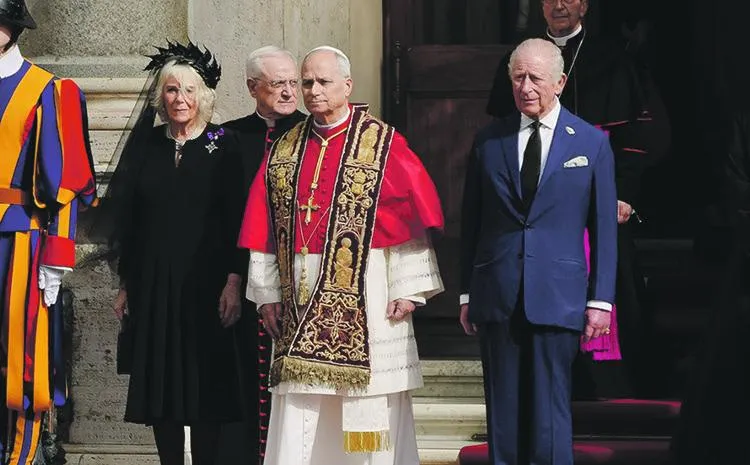
Leo with King Charles III and Queen Camilla during the King’s visit to the Vatican, October 2025. Wearing black is the standard etiquette for non-Catholic visiting royals. Only designated Catholic Queens and Princesses are granted il privilegio del bianco (the privilege of the white), allowing them to wear white before the Pope. (photo: Wiki)

One year after his election in May last year, is it possible to discern some key themes of Leo XIV’s pontificate?

Here are three remarks.

The global geopolitical landscape

Over the past year, the American Pope has assumed a prominent “political” role on the global stage. It was predictable that the clash with Trump would erupt sooner or later, given the President’s combative temperament. And so it did. Preceded by Leo’s criticism of the handling of the deportation of undocumented migrants, the conflict with the US administration erupted over the war in Iran. Trump has repeatedly criticised the Pope, and the Pope has responded in kind.
From someone like Trump, this was to be expected; less predictable was Leo’s decision not to rely on the soft-spoken ways of Vatican diplomacy, but to use direct communication to respond blow for blow. In fact, for months now, the Trump vs Leo dynamic has dominated the global political narrative, casting the Pope as Trump’s ultimate opponent in the name of “peace”.

Meanwhile, with his trips to Turkey, Lebanon, and Africa, Pope Leo has confirmed contemporary Catholicism’s focus on the Global South, where the Roman Catholic Church is grappling with Islam and with growing evangelical churches. Following in Francis’s footsteps, he confirmed the offer of “dialogue” to the former and highlighted the “bizarre” nature of the latter, while simultaneously emphasising “Catholic” superiority.

The internal peacemaking line

Even within the Roman Catholic Church, Leo has acted in line with the reasons that led the conclave to elect him Pope. Francis had left behind a church rife with internal conflicts and with the issue of “synodality” left confusingly unresolved. In this first year of his pontificate, Leo has not fanned the flames of division, but has sought to tone down the rhetoric, calm tempers, and manoeuvre in search of compromises.

With Catholic Germany calling for changes regarding the recognition of same-sex unions, he has maintained a firm stance without breaking with the more progressive factions. On the subject of synodality, he has tempered the zeal of the most ardent supporters, but has not dampened their enthusiasm. Regarding appointments to top positions in the Church, he has not yet made any radical or ground-breaking decisions, preferring to let the situation settle.

In short, on the domestic front, Leo has proven himself to be a seasoned and experienced political figure; a bridge-builder seeking to preserve the “integrity” of Roman Catholicism in the face of tensions.

The ecumenical approach and relations with evangelicals

In his first year of pontificate, Leo placed great importance on the ecumenical significance of the celebrations of the Council of Nicaea. He paid particular attention to the world of Eastern Orthodoxy and the Oriental churches, with which the Pope’s Catholicism feels a growing affinity. Beyond institutional courtesy, he has been more reserved toward the liberal and ecumenical Protestant world. Proof of this is the bureaucratic reception he gave the Archbishop of Canterbury during her visit to Rome. The impression is that Leo’s ecumenical agenda looks more to the East (Orthodoxy) and to the South (Islam) than to the West (the traditional ecumenical world).

And what about the evangelicals? They do not seem to be on Pope Leo’s radar, aside from a few indirect critical remarks between the lines of his speeches in Cameroon and Angola. Even during his previous tenure as bishop in Peru, he showed no particular interest in the evangelicals. On the other hand, evangelicals around the world do not yet seem to have taken the measure of him. Unlike Francis, who boasted many evangelical friends in Argentina and beyond, Leo has not cultivated such relationships, with the result that the evangelical world remains distant and remote to him.

Meanwhile, his thinking, as expressed in his daily addresses, weaves together Augustinian themes (peace, grace, the Catholic experience), profound Mariology, and traditional Catholic teachings. His theological framework appears to be a Catholic Augustinianism reimagined from a post-Vatican II perspective.

Share
< Previous article| Features| Next article >
Read more articles on:   Catholicism  /  the Pope
Read more articles by Leonardo de Chirico >>
Features
Ecumenical or evangelical?

Ecumenical or evangelical?

As expected, the highlight of the 1,700th anniversary of the Council of Nicaea was the ecumenical prayer presided over by …

Comment
Rome & Mary: Fresh clarity, or further confusion?

Rome & Mary: Fresh clarity, or further confusion?

"Roma locuta, causa finita est!" ("Rome has spoken, the issue is over"). This phrase taken from Augustine (Sermo …

Give a subscription

Our monthly newspaper is the perfect gift for those who love to think deeply

Give here

New here?

Register and get three free articles each month!

Register