One of the worst!

Michael Haykin  |  Features  |  history
Date posted:  1 Dec 2017
Share Add       
One of the worst!

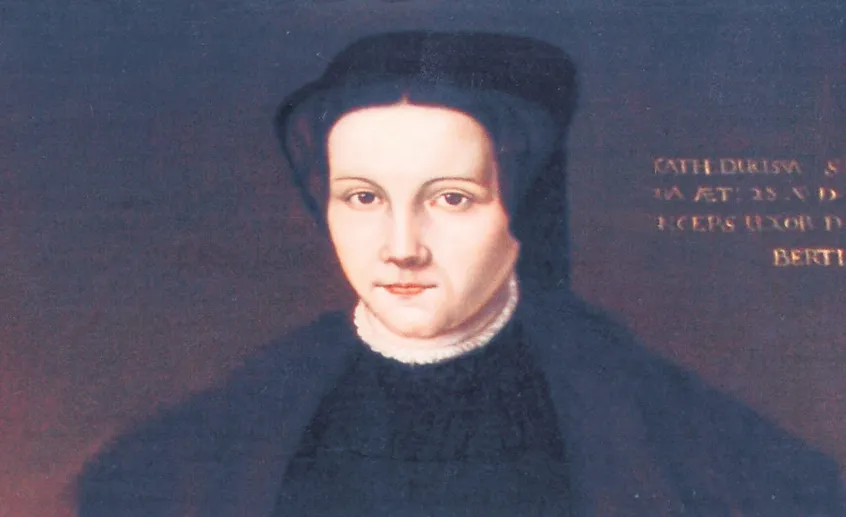
Katherine Willoughby

Recently, British historian Alec Ryrie has described Katherine Willoughby as an ‘evangelical firebrand’ and perhaps ‘the most aggressive of the reformers’ within the royal circle around Henry VIII.

A hostile Spanish Roman Catholic source described her as ‘one of the worst heretics in England’.

Early years and marriage

Her life began in a staunch Roman Catholic environment. Her mother was an ardent Spanish Roman Catholic, who was the confidante of Queen Katherine of Aragon, the first wife of Henry VIII.

Her first marriage was to Charles Brandon, the first Duke of Suffolk and a close friend of the King: she was only 14 and he was 49! Throughout the 1530s, despite the massive religious changes that were taking place in England, Katherine, the Duchess of Suffolk, remained a committed Roman Catholic.

Katherine’s Evangelicalism

When was Katherine Brandon converted to Evangelical convictions? It was probably during her time as a lady-in-waiting within the household of the Evangelical queen, Katherine Parr, Henry’s sixth and final wife. By the mid-1540s, Katherine believed that Scripture was the supreme guide to the Christian faith. She had acquired a copy of William Tyndale’s New Testament and begun to be openly critical of Roman Catholicism.

After her husband died in August of 1545, Katherine became more open in her commitment to Evangelical views.

As one of the wealthiest women in England she began to use her wealth to support the cause of reform. In Lincolnshire, for example, she did all she could to ensure that every parish church had a copy of the Bible. When the great German reformer Martin Bucer came to Cambridge as Regius Professor of Divinity in 1549, Katherine befriended him. She also served as the patron of various leading Evangelical preachers like Hugh Latimer.

Re-marriage and exile

By 1552 the Duchess was firmly in love with a man named Richard Bertie. Although he was not a nobleman, they were married by Hugh Latimer in either 1552 or 1553.

When the fanatical Roman Catholic Mary I came to the throne in 1553, however, Katherine and her new husband were in danger. It became clear to them that they needed to flee to the European continent. Katherine was prepared to relinquish all of her lands and wealth, aristocratic standing and position, for the sake of her Evangelical faith. They eventually found refuge in Poland.

Mary I died in 1558 and it was now safe to return. As soon as Katherine heard that Elizabeth I had become queen she wrote the following letter to her. The text is a key window into her faith.

‘The almighty and ever-living God so endue your Majesty with his Spirit, that it may be said of you, as of his prophet David, “He hath found one even after his own heart”. …now is our season, if ever anywhere, of rejoicing, and to say, after Zachary, “Blessed be the Lord God of Israel”, which hath visited and delivered your Majesty, and by you us, His and your miserable and afflicted subjects. For if the Israelites might joy in their Deborah, how much we English in our Elizabeth that deliverance of our thralled conscience. …I greedily wait and pray to the Almighty to … give me a prosperous journey once again presently to see your Majesty, to rejoice together with my countryfolks, and to sing a song to the Lord in my native land.’

The return to England

Katherine and Richard travelled back to England in 1559. Like many of those who came to be called Puritans, however, she was ultimately disappointed by the Queen’s religious policy. While Elizabeth shared many of the Puritans’ theological convictions, she insisted that she was the head of the church and was tolerant of worship practices that reminded the Puritans of medieval Catholicism.

In the final 20 years of her life, Katherine was disappointed with the Elizabethan settlement. Well has Paul Zahl described her as ‘a frustrated Puritan’ during this period of her life and spoken of her ‘insistent impatience with Elizabeth’ and her ‘snail’s pace in the Reformation of the church’.

“Our Redeemer lives’

When Katherine died in 1580 her husband Richard had a sculptor by the name of Thomas Goodlord erect a huge memorial to his wife in the parish church of St James, Spilsby, which also became a memorial to him when he died two years later. On the back of the memorial are six panels of texts. One of them, in Latin, expresses Katherine and Richard’s hope: ‘We know that our Redeemer lives, and we believe that we shall rise again out of the dust and though after our skin worms destroy our bodies, yet shall we see God in our flesh, and not another.’

Share
< Previous article| Features| Next article >
Read more articles by Michael Haykin >>
Features
The martyrdom of Cyprian

The martyrdom of Cyprian

The church in North Africa was a leading centre of Christianity throughout the Ancient World. It was only with the …

Features
Martyrdom and schism

Martyrdom and schism

Tertullian (c.160/170–c.220) had a genuine knack for pithy sayings that stick in the mind. For instance, there is his well-known …

Looking for a job?

Browse all our current job adverts

Search

Need to advertise?

We can help you reach Christians across the country

Find out more