
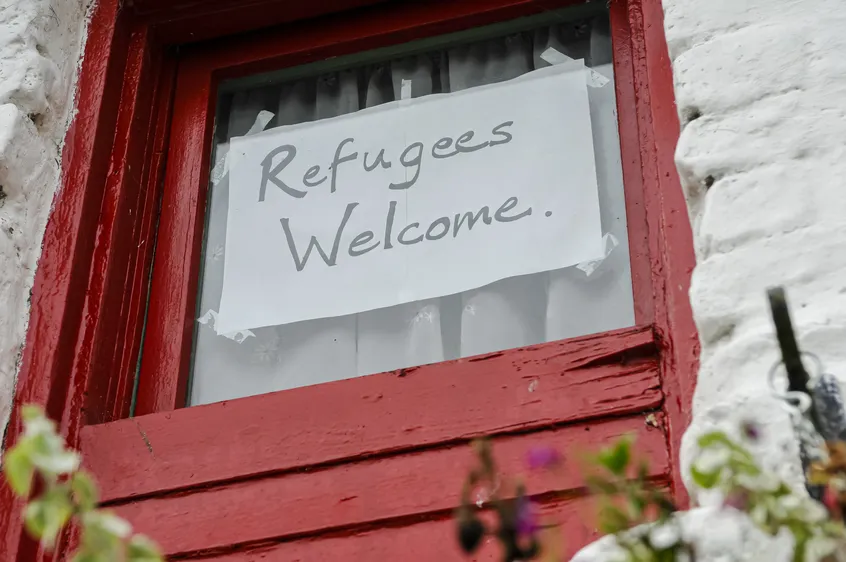
In 2015, one image of a three-year-old boy washed up on a beach in Turkey changed the way the world saw asylum seekers.
That terrible morning, every newspaper displayed Alan Kurdi’s body front and centre. His story was not only desperately sad, but intensely disturbing. No human being with a conscience could look at his picture for long - or, indeed, turn away from it.
That day, I began a journey into the Bible that led me to re-examine the call to love the stranger.
I read about Abraham encountering three strangers on his campsite and then Jacob meeting a stranger in the middle of the river. I reflected on the strangers that interacted with Lot, Rahab, Gideon, Mary, and the disciples on the road to Emmaus. To my surprise, there was a common theme... The stranger in all these stories - and many others beside - turned out to be the same person: God Himself.
Those Biblical reflections became the foundation for my book God is Stranger. Later, they inspired me to launch Sanctuary Foundation, a charity that advocates for and with refugees.
Small boats
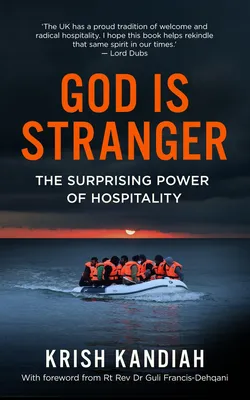
Today, the dominant picture shaping people’s views about immigration and asylum is not a small boy but small boats. This is why, in the new 10th anniversary edition of God is Stranger, the cover portrays a flimsy inflatable dinghy, crammed with people in orange life jackets, moving across dark water towards a smudge of orange light on the horizon. It is an uncomfortable image taken not in the Aegean Sea, but in the English Channel.
Small boats have become all too common on the front pages of our newspapers. Like the famous blue-and-black/white-and-gold dress, people see different things. Many still see families, as desperate as that of Alan Kurdi. Others instead see a threat - to their jobs, security and even their Christian heritage. They increasingly talk about “fighting-age men”, “illegal immigrants”, “a swarm breaking into our country", “an invasion”, or “Muslims intent on 'Islamifying' our nation.”
Navigating changing times
This is a major shift over the last 10 years - and the Bible is being used by those on both sides of the increasing divide over immigration in the UK. But what does the Bible really say? What bearing does it have on the defining moral political questions of our age? How can we ensure that what we are reading is shaping our conscience and action, and not simply being used to justify fear and exclusion?
For thousands of years, the Bible has helped Christians navigate our changing times. Romans 12 says: "Therefore, I urge you, brothers and sisters, in view of God’s mercy, to offer your bodies as a living sacrifice, holy and pleasing to God—this is your true and proper worship. Do not conform to the pattern of this world, but be transformed by the renewing of your mind."
These verses press home to us two gifts: God’s mercy given to us, and our worship given in response to God. This worship transforms our minds (the way we think), and our bodies (the way we act). It teaches us to resist worldly values and cultural tides of opinion and to refuse to compromise with or accommodate prevailing patterns of thinking. It should therefore be expected that Christians take a very different view on immigration than those around us.
At the time of Jesus’ earthly ministry, Samaritans were despised because of their mixed heritage and suspect worship. They were a minority, blamed for problems they didn't cause. Today we might call that "punching down". At the same time, there was "punching up". The Romans were despised because they were the occupying force in the Promised Land. They weren’t a vulnerable minority - they were the ones using power and authority to dominate and oppress. They too were hated - for the taxes that had to be paid, for the soldiers who patrolled the villages.
No wonder the crowd winced when Jesus told a story about a man left for dead on the road to Jericho, and the hero was a Samaritan. The parable forced its listeners to recognise grace in someone most people looked down on with hatred.
No wonder the crowd winced when Jesus healed the Roman centurion's servant. Without hesitation or conditions, full restoration was offered to the representative of the empire that had stolen their land and crucified their brothers. Just imagine how furious people were.
Jesus offered love precisely where hatred felt most justified.
Showing love to the stranger
Jesus refused to let hatred, whether directed down at the vulnerable or up at the powerful, to define the boundaries of His kingdom. Instead, the stranger was always to be shown love - even when the stranger is an enemy.
Whether people on small boats are seen to be invaders or victims, a Christian response is the same: like Jesus, we reach out to lost sheep in need of a Saviour with love, compassion and hospitality.
Worship is not just what we do with our mouths. It is what we do with our minds and our bodies.
Worship offers up all that we are to God in sacrificial service to others: friends and family, colleagues and neighbours, strangers and enemies.
We don’t get to pick just one category, or wait until we’ve mastered one group, before levelling up to the next.
The undeserved kindness that God has lavished on us - as foreigners and strangers, as enemies of the gospel (Ephesians 2, Romans 5) - is to be the defining dynamic of our lives.
I never set out to write a policy book, or a weapon in the culture war. Instead, I sought to listen hard to Scripture and allow it to turn my thinking upside down.
I discovered that the powerful, counter-cultural way the Bible teaches about strangers is truly transformative.
When Scripture, not social media, informs our approach to issues such as immigration and hospitality, it doesn’t just change our politics - it changes the way we relate to God and to all those made in His image.
Krish Kandiah is the author of God Is Stranger: The Surprising Power of Hospitality (Hodder Faith, 2026) and director of the Sanctuary Foundation.





Is this the biggest challenge for any Prime Minister?
What does it mean to be the Prime Minister of the United Kingdom in 2026?At the time of writing, …