
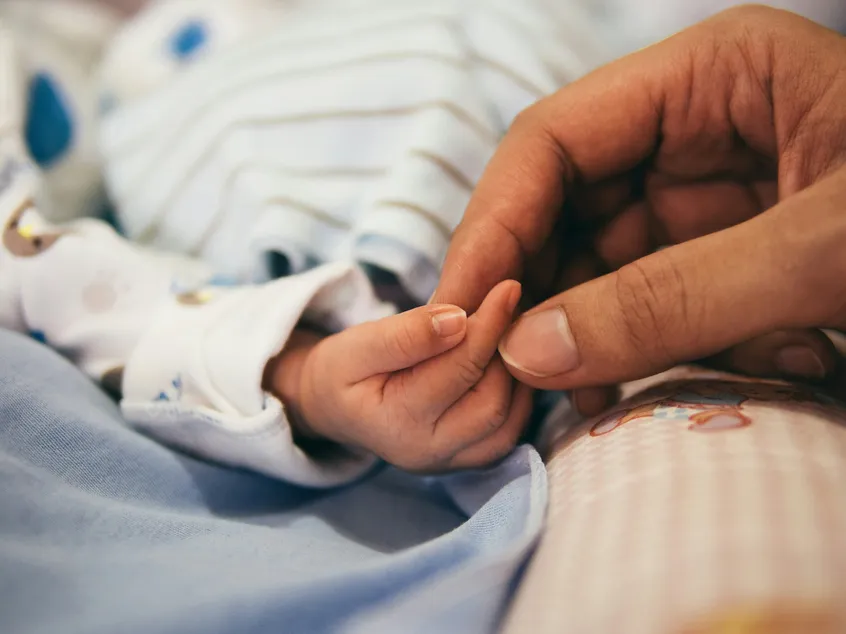
Keir Starmer has apologised to me.
On 2 July, he stood up in Parliament and apologised to mothers and adoptees for forced adoptions between 1949–1976, which he described as a stain on our history.
He was referring to the practice of mothers – young, vulnerable and without support – who were "coerced, bullied or misled into feeling that they had no choice but to have their children taken away from them".
This practice, he said, was embedded in the state and charity sector.
The Archbishop of Canterbury has also apologised for the Church's role in adoption. Bridget Phillipson described this at the Education Select Committee as a shameful period in English history which caused deep and lasting harm.
Apologising for historic wrongs for which you personally have no responsibility seems to be quite trendy at the moment – easier than solving current problems.
'I'm grateful that I was adopted'
This story hit my radar when the Archbishop apologised. My daughter drew my attention to it because I am one of those estimated 185,000 babies who were taken from young, unmarried mothers between 1949–1976. I had been unaware of the campaign groups speaking out about this period. I had not realised that my adoption is now framed in a narrative that considers it to have caused deep trauma and lasting harm. I had missed the academic papers that said there is no such thing as a clean adoption.
I know that adoption is complex. I am aware that some had very difficult experiences and unsuccessful adoptions. But I also know several contemporaries who had positive outcomes similar to mine.
Keir Starmer said that he had heard the stories of adoptees but he hasn’t heard mine: I’m grateful that I was adopted.
Adoption
Post-war Britain and the liberated 60s brought a new sexual ethic, and with it, many unwanted pregnancies.
There was not ready support for young, unmarried mothers to bring up children on their own.
The prevailing attitude of the immediate family and the community was that adoption was a solution in the best interests of the mother and child. This was extremely hard for the young mother but was believed to be a sacrificial and loving choice to enable the baby to thrive. Is it possible to go back and impose our modern mindset upon that time and pronounce that what was happening was wrong?
I, for one, am extremely grateful to my birth mother for being prepared to do this for me. It is easy to criticise others from the past who were seeking to do the best they could. No doubt there were individuals within the system who lacked compassion and were cruel. But should everyone who was involved be criticised by our elites today for doing what they considered to be moral and good?
'The log in our own eyes'
The offer of a mother-and-baby home in the 1960s was a solution that previous generations would have relished. In other times, far worse happened to young, pregnant girls, from destitution on the streets, to the Victorian workhouse, to lifelong incarceration in mental hospitals.
Bridget Phillipson is not right when she said to a select committee that this was a shameful period in our history. It was a period in history with a different morality and different worldview.
Today we self-righteously condemn others and fail to see the log in our own eyes. We approve surrogacy and use birth mothers as incubators of children. Despite the availability of contraception, abortion is commonplace. I expect I would not be here today if that act had been in force in 1965.
And most astounding of all is that this Parliament has decriminalised abortion up to birth by the mother on the grounds of compassion. I wonder if any politician will one day seek to apologise for these harms.
Adoption is not always successful; some have heart-breaking experiences. There are good outcomes, bad outcomes and ugly outcomes, but we mustn’t reject it as a positive option for some.
'Hope'
In the 1990s, I worked as a social worker. I remember sitting in a case conference where professionals discussed a teenage girl who was pregnant and in care. She was booked in for a termination. When I asked what other options had been discussed with her, I was told that she had been given none. No one had even considered adoption, and the consensus was that it was too late to raise it as a possibility at that stage. The prevailing opinion was that adoption was not good for anyone; abortion was better. Should she have an apology for being misled into thinking she had no options?
How helpful is it to recast the adoption stories of the 1960s in a negative light? Birth mothers who have believed that they gave their baby the best start in life will now worry that their child suffered "deep, lifelong traumas and harms" [1]. But adoption can be in the best interests of the child, and this narrative must not be lost.
It still gives hope to birth mothers today. I was recently supporting a woman who has battled drug addiction and has had all of her children forcefully removed from her by social services. She knows that her children have been adopted into families who can care for them better than she can. Reframing adoption as inherently negative is naïve and reductionist.
Parliament's apology
Parliament’s apology is well-meaning but may in the end cause harm.
Adult adoptees who were emotionally settled may now worry that the narrative they were told is false and be concerned to reconsider the trauma their mothers faced. Will this mean more adoptees will feel obliged to trace their birth families? The government seems to be planning to make this process easier, prioritising those born before 1976. But everyone I know who traced their birth family found it caused more harm than good. Nothing is straightforward. Birth families can be good, bad and ugly too. Many have suffered at the hands of their biological families. There is sin in all kinds of places.
I am reminded that we cannot make the crooked straight [2], but there is a heavenly Father who welcomes us in and can restore us.
Keir Starmer says that adoptees struggle with their sense of self, identity and belonging. I have no personal need to find out more about my identity because I am secure in Christ, adopted into His family.
My adoptive family helped me to understand that I am not rejected. It grounded me. Ultimately, this is true for us all; only through the gospel do we know real security.
Every now and then I consider whether or not I need to trace my birth mother. I will continue to consider it, just so she knows I am thankful for her choice (even if she felt she had no choice). I am, however, extremely grateful to my adoptive parents and, most of all, to my heavenly Father who has directed my life from the start.
So, Keir Starmer, please don’t apologise to me.
- adultadoptee.uk
- Ecclesiastes 1v15
Karen Soole is a writer, speaker, and women’s worker at Trinity Church, Lancaster. She is the chair of the Northern Women’s Convention and a trustee of The Proclamation Trust.



We live in a culture of deception – so what?
The phrase "it does what it says on the tin" suggests transparency and, certainly, no surprises. But if you buy …