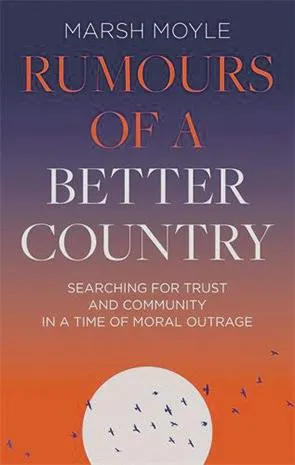
RUMOURS OF A BETTER COUNTRY:
Searching for Trust and Community in
a Time of Moral Outrage
By Marsh Moyle
IVP. 257 pages. £19.99
ISBN 978 1 789 744 675
One of the things I do is try and teach people to preach. In the process I have discovered that the best books for preachers are not about preaching at all.
Whether you are preacher, a church leader or a member of the congregation, we all need to have a big vision of what it means to be a Christian in our times. This year we have been treated to two substantial books that have done this. The first was Chris Watkin’s blockbuster Biblical Critical Theory, the second was Remaking The World by Andrew Wilson. I would place this book as a worthy companion to those wide-ranging and penetrating volumes. Why do I say that?
1. The stable from which the book comes. Marsh Moyle writes as one substantially shaped by the richly textured synthesis of the pursuit of true spirituality, careful Biblical reflection and deep cultural analysis of the L’Abri movement. Anyone who has benefitted from the writing of the L’Abri founder Francis Schaeffer will recognise lots of echoes here.
2. The context in which the author writes. Moyle has spent a substantial part of his life in Central and Eastern Europe. This period has coincided with the run-up to the seismic events of the collapse of the Soviet Union and its immediate aftermath. This has been a time that has plunged the churches in that zone into a steep learning curve, as they learn to adapt to the demands of the new freedoms of post-Soviet democracies.
3. The tone that the author uses. This book is written in a clear, intelligent way that is full of insight. It is a joy to read a book that does not trade in superficial generalities, engage in simplistic arguments that are patronising, or descend into partisan rhetoric that alienates the reader. This book is warm, sensitive and practical.
4. The narrative style of the book. This roots what has been written in the personal story of a man who has thought Christianly about what it means to live faithfully for Christ in a time of dramatic change.
5. The subject matter. It is not immediately obvious from the title, but this book is an exploration of the ‘Ten Words’ found in Exodus 20 and Deuteronomy 5.
The author uses the term ‘Ten Words’ rather that Ten Commandments because he wants to make the valid point that the Hebrew concept of Torah means so much more than law. This care concerning the use of language is important everywhere, but is of particular importance in Central and Easter Europe where there can sometimes be a tendency to literalism and legalism.
The big idea of this book is that the ‘Ten Words’ are an invitation to freedom – liberating words for a liberated people. Each of these words is illuminated by a freshness of approach to how the reader should respond to what God says. If you think that you have the ‘Ten Words’ sussed, read this book!
A standout chapter for me was on the fifth word, concerning honouring our parents. Reflecting on the challenges of relating to parents, who for a variety of reasons fail to live up to the name, the author helpfully deals with how to navigate relationships that are dishonourable.
The author writes with a faithful imagination. I like the way he describes what he has in mind: ‘Our moral imagination is the ability to conceive fruitful alternatives to present realities.’
The author imagines himself in a café, where readers can sit down with him over a coffee to chat and humbly try to put the world to rights. With such a hospitable mind such table talk might well hear rumours of a better country.