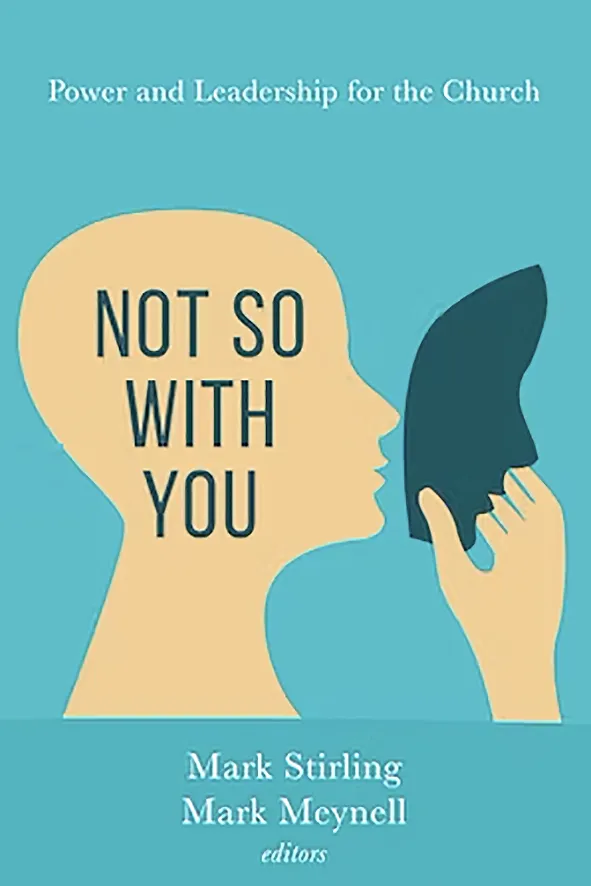
NOT SO WITH YOU:
Power and Leadership for the Church
Editors Mark Sterling and Mark Meynell
Wipf and Stock. 278 pages. £26
ISBN 978 1 666 760 163
How do I know I am safe in church? Or that anyone I bring is safe in church?
The spate of recent scandals of abuse within churches has made many of us think about how we can best pay attention to power. Edited by Mark Stirling, a former medical doctor and pastor, and Mark Meynell, the Director of Langham Preaching, this book wants to remind us that the misuse of power is not a new problem; there are profound Biblical, theological, and historical precedents for thinking about how power can be used, and abused.

But God has given the church power for our flourishing – Meynell uses the analogy of a conductor leading an orchestra, serving them by seeking to draw out the best from each of them in harmony together as they combine their gifts and talents.
This book provides an anthology of essays from many different kinds of people, and brings together reflections that are more academic (with footnotes and Greek references galore) along with those that are more testimonial. Authors are international too, with a mix of men and women. There are reflections from Old Testament scholars, New Testament scholars, historians and systematic theologians, as well as those in leadership simply sharing their stories. We know that ignorance of the potential pitfalls of leadership is no longer an excuse, but this isn’t about merely avoiding scandal, it is about how each of us can be responsible in the roles God has called us to.
The first half of the book sets out a Biblical theological framework for how to think about power. Who is the God that we are made in the image of, who church leaders represent? How would He have us lead? There is a fascinating chapter from systematic theologian Jared Michelson on the Trinity, which considers how the Trinity is an antidote to authoritarianism.
As an interlude between the two halves, Stirling offers the ‘anti-beatitudes’, from a meditation on the Greek text of Matthew 5:2–12. They are sobering reflections on what the world sees as success, and they pack a punch, as the reader moves on to read more on the experiences of people who have been affected by power.
There is a great chapter from Professor Tasha Chapman on how pastors can encourage women to flourish, and I wish I could give a copy of Blythe Sizemore’s words on the painful and lasting effects of ‘spiritual sunburn’ (the raw state someone is left in following church related abuse) to everyone I know in leadership.
This is not a book to speed through, but one to read and ruminate on. There are helpful lists of questions to consider, and pastoral and practical applications interjected. Helpfully, it could be useful not only for individual reading but also for groups of church members or church leaders, and in a mentoring relationship (it offers guidance on how to be a mentor not a master) . It offers suggestions as to not only what a healthy church culture looks like, but how to spot when things might be moving towards an unhealthy trajectory.
It can be nerve-wracking when questions are asked in our churches about power, and its use. The old adage says that the road to hell is paved with good intentions – and this book helps us think about how our well-intentioned but unwitting behaviour may, in some cases, not be God’s best for those we lead, and a roadmap to help with prayerful self-reflection. We are, each one of us, both made in God’s image, and fallen, broken people. We need God’s help to love others the way that He calls us to.