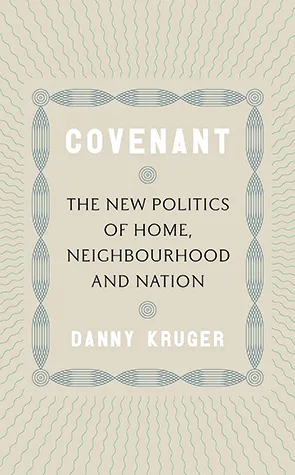
Covenant:
The New Politics of Home, Neighbourhood and Nation
By Danny Kruger
Forum. 192 pages. £20
ISBN 978 1 800 752 115
Danny Kruger is an evangelical Christian, the MP for Devizes, and a fan of Edmund Burke (indeed while at Oxford he wrote a doctorate about him).
This fascinating book considers all manner of thinkers as varied as Bowlby to Tom Holland; there is philosophy and history mixed in with politics and economics. This is a dense book, not for the faint-hearted. But for those with an interest in not just politics, but in how our society is now ordered, how we got here, and how this could be better, this short book is well worth the effort.
The word covenant has a Christian meaning, but Kruger is careful to avoid too much Christian language, keeping this book accessible for those with no faith. He does however outline the Christian origins of political liberty, and how men began to wander from this path from the Enlightenment onwards; chapter one opens with the words ‘you are what you worship’. He is clear that in a society that seems to be crumbling, ‘the true tyrant is our own caprice, the power of our appetites and our impulses to selfishness and self-harm.’
Covenant sets out what Kruger calls The Order vs The Idea. The former is ‘the arrangement of society around a common conception of the way to live’, with a focus on community, on the other, while the latter is the notion ‘that there exist autonomous agents, called individuals, who both self-determine and self-moralise’ as if we can be almost God-like alone. Instead of this, he argues, what we really need is ‘somewhere to live, something to do and someone to love’; to focus on family, community, and neighbourhood and on being useful, and being part of something bigger than ourselves.
Kruger has made headlines for expressing his views on abortion in Parliament, but he argues not only for an economy that should make it easier for households to be both formed and sustained but for women to be able to be fully economically active. There is no suggestion that we wind the clock back to the 1950s, a period of time he sees as anomalous. In contrast to so much of what we hear (and witness) from our modern MPs, he sees marriage as ‘a golden thread of our culture’, and is clear that it is the ‘safest and best place for sex’.
For anyone wondering how on earth In Britain we have got to a point where it is possible to be arrested on the basis of what you are thinking while praying silently, he offers insights into the European Convention on Human Rights, the Human Rights Act and the Equality Act, which he would amend or replace.
It might be easy to become despondent reading Kruger’s insight into what a mess he thinks Britain has got into. He notes ‘the culture no longer expects us to live for others’ which calls to mind this year’s truly terrible Marks and Spencer Christmas advert! But this book also provides an alternative vision; a way to work our way back to becoming a happy and virtuous people. He thinks there is still time to turn things around. Let’s hope (and pray) he is right.