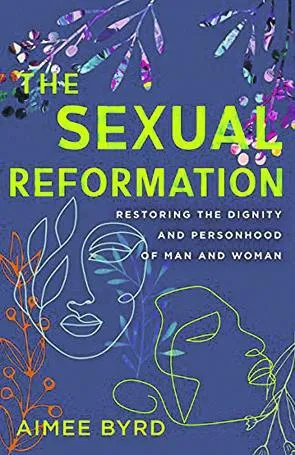
THE SEXUAL REFORMATION:
Restoring the Dignity and Personhood
of Man and Woman
By Aimee Byrd
Zondervan Reflective. 224 pages. £12.99
ISBN 978 0 310 125 648
Slap bang in the middle of the Bible sits the Song of Songs, which Aimee Byrd describes as ‘a sexual reformation call for the church’.
For Byrd this much-misunderstood book reveals the meta-narrative of Scripture and shows our longing for communion with God and with one another. In The Sexual Reformation, as she unpacks her theology of gender, Byrd returns us gently to the view of rabbis and the early church (quoting both at times, along with a fair amount of Pope John Paul II) that the Song of Songs should be seen as an allegory of love between God and His people – between Christ and the church.
Men and women as disciples
This is no line-by-line commentary, but reflections on what Byrd calls ‘the Song’ has to say about men and women as disciples; on their meaning, value, and desires – in particular our longing to love and be loved, and how our souls and bodies are intertwined. She frequently looks through an eschatological lens that brings her to a place of love, not legalism. The reader cannot help but notice how Byrd dislikes labels, and is clear that masculinity and femininity should not, and cannot, be reduced to roles or specific cultural qualities.
It has been a while since I’ve seen references to Susan Foh or Phyllis Trible, but Byrd brings them in boldly as she unpacks some of the differing interpretations around desire in Genesis 3.16. This is not a woman shying away from discussing what she calls ‘the Christian ‘f-bomb’ of feminism. This book was ‘conceived in the midst of a lot of pain’ and Byrd describes how she has been slandered, harassed and called Jezebel for what she has said and written on this subject. Is it possible that we are still in reactive mode as a church when it comes to sexuality and gender? Byrd calls us to make sure women are welcomed in the church – and can discover not just their place, but their voice.
Interesting insights
Some of the analogies she draws out arguably stretch things somewhat, and there is much more that could be drawn out around the implications of what she writes. What exactly does joyful submission look like – when and how does one do it? But there are interesting insights on power, and it is intriguing enough to make you turn back to the original poetry of ‘the Song’ itself, and to meditate again with renewed enthusiasm on the mystery of being made in the image of God, and for what it means for each of us join in ‘the Song’.