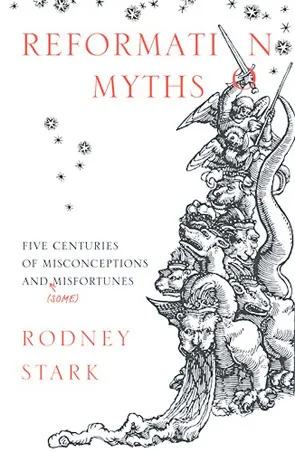
REFORMATION MYTHS:
Five Centuries of Misconceptions and (Some)
Misfortunes
By Rodney Stark
SPCK. 194 pages. £9.99
ISBN 978 0 281 078 271
As an historian I have profited from and enjoyed a number of the works of Rodney Stark, Distinguished Professor of the Social Sciences at Baylor University.
Although his books betray a contrarian at heart (a recent work on the Crusades provided a balanced perspective on those wars that are often regarded as a major blot on medieval Western Christianity and another, published in 2016, critiqued the legacy of anti-Catholicism in American history), as a sociologist by training he often brings fresh eyes to knotty historical issues. This most recent of his books proves to be no exception.
The long view
Given that Stark’s arguments address the long-range impact of the Reformation, his discussion is necessarily a wide one, covering not only the 16th century and the decades immediately following, but even extending to such things as Liberation theology and the Charismatic Movement of the present day. And in less than 200 pages he puts forward a number of controversial positions. Among them is that the Reformation was not responsible for the emergence of modern capitalism, pace Max Weber’s The Protestant Ethic and the Spirit of Capitalism (1930; published originally 1904–1905), nor was it the primary cause of the rise of modern science (here Stark argues that an equal number of Roman Catholic scientists and Protestants were engaged in scientific discoveries). The Reformation was not the origin of modern Western individualism (its roots go further back, at least to the northern Italian Renaissance), nor a significant factor in the secularisation of the West. Here Stark disagrees strongly with the view expressed recently by Professor Brad Gregory in The Unintended Revolution: How a Religious Revolution Secularized Society (2012).
Controversial
Definitely controversial is Stark’s claim early on in the book that the various European Reformations ‘did not contribute anything to religious freedom and tolerance’ (p.44). In fact, according to Stark, Protestant state churches were far more repressive than churches in Roman Catholic territories (p.44) and the Reformation led to ‘religious wars [that] raged for centuries’ (p.36). However, if one begins with the advent of French religious conflict in the 1560s and concludes with the British Civil Wars of the 1640s and 1650s, these ‘religious wars’ lasted less than a hundred years, though they did significant damage to the credibility of the Christian faith.
Forgetting perspectives
And to say that religious tolerance was not a product of the Reformation is to forget the perspectives of the various evangelical Anabaptists, the arguments of Jean Morelli – a remarkable Huguenot author in Paris with whom Théodore de Bèze clashed over church government and who defended Congregationalism in the 1560s – and the thinking of men like Robert ‘Troubelchurch’ Browne and Robert Harrison 20 years later seeking to implement the same position in Norwich as that of Morelli. All of these individuals were ardent advocates of religious freedom.
Such criticisms are indicative of the fact that few historians will agree with all of Stark’s arguments. But there is so much helpful historical reflection here that this is a welcome, though admittedly different, addition to the crop of literature that this year’s celebration of the Reformation has produced.