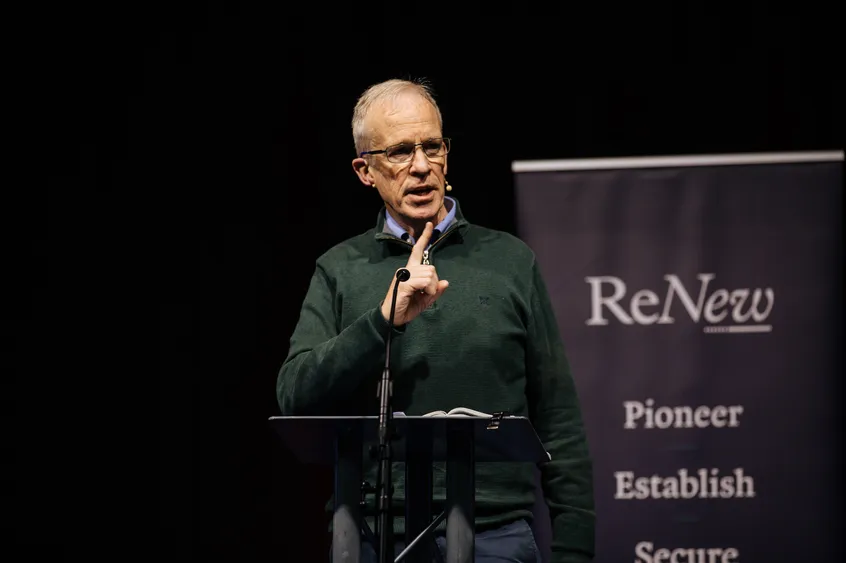
Tim Vasby-Burnie and Neil Robbie reflect on the 2025 ReNew Conference, Growing Leaders, which was held from 29-30 September in Leeds. The event is all about "advancing Anglican Evangelical ministries for the salvation of England", and ReNew describes itself as a mission, a network, and conferences.
Reflections from day one - Tim Vasby-Burnie
Why should people attend a conference like ReNew?
Catching up with friends and acquaintances can be enjoyable. It is also nice to meet people in real life whose names I recognise from Facebook groups. As I reflect on the first day, two significant benefits come to mind.
- Identifying with a wider group
Parish ministry can get lonely. Tensions in the Church of England make it difficult for many people to feel a sense of true belonging in Deaneries and Dioceses. At the ReNew Conference, I know that I share so many assumptions with those in the room: the priority of God's Word; the essential place of prayer; the need to reach the lost; a commitment to Biblical orthodoxy on matters of marriage, and the need to contend for orthodoxy.
Tribalism can be bad but belonging to a tribe is often extremely helpful. Shared assumptions mean that we can hear the wisdom of others without constantly filtering and assessing what is being said. Sadly, a “hermeneutic of suspicion” is often necessary in Church of England gatherings!
We have differences of course. Personally I would like to see the worship at an Anglican conference look a bit more, well, Anglican. Yet a sense of belonging allows for connection and learning that is so much easier than in other contexts. - A chance to think beyond the immediate
After an excellent seminar from Church Society's Lee Gatiss, I realised with a jolt that I'd left my programme in the main hall. It wasn't the timetable I needed, or the list of speakers - it was my scribbled notes with subjects to think about and ideas to implement.
The ReNew Conference aims to be very practical together with being robustly theological. Ministers and lay leaders in normal churches across the country were sharing ideas and I jotted down things that might work in my own context.
A conference like this is a chance to step away, albeit briefly, from the next Bible study to prepare and Sunday service to plan. It is a chance to ask longer term questions such as: who might be suitable to be trained up to preach? How might our church connect with, benefit from, and serve other churches who share Reformed Anglican convictions? How can I prepare the PCC for the time (God willing, many years from now) when they need to find a new vicar with gospel priorities, and possibly resist the pressure to appoint someone who does not share those doctrinal commitments? What next steps might we take as a church to help us reach our nation in evangelism?
The ReNew Agenda seeks to pioneer healthy churches, establish Biblical ministries, and secure churches who will be faithful to Christ and His Scripture for decades and generations to come. These are gospel shaped commitments that we agree with but sometimes neglect in the busyness of life and ministry.
Attending the ReNew Conference is a vital way of bringing this agenda to the forefront of our thinking, planning and action.
Reflections from day two - Neil Robbie
Phil Colgan
The second day began with Phil Colgan, from St George North, Sydney, opening 1 Thessalonians 2. He considered: Paul's motivation for ministry - to please God, not man; Paul's model of ministry - not structures, programmes and pipelines but the love and gentleness of a mother for her children; and Paul's goal of ministry - that God's people might live lives worthy of the Lord. Phil set gospel ministry in the context of the day of Christ - an eschatological perspective causes people to give themselves to gospel work.
Kieran Bush during his Chairman's address
ReNew chair, Kieran Bush, led a session exploring the strengths and weaknesses of the five pathways to ordination to Anglican ministry in England. Those pathways are through Anglican Mission in Europe (AMiE), the Bishop of Ebbsfleet, Ready to Serve under the Bishop of Southall and Nottingham, having an Orthodox Diocesan Bishop and ReNew ASP (Alternative Selection Pathway).
Kieran reminded us that the recruitment crisis in the church is wider than the Church of England, and that we need to address our own issues in the wider cultural context. He called us to four reactions:
- First, to pray a lot. Establish new prayer meetings. Pray with other local churches. We are weak but the Lord is strong. So pray fervently and expectantly.
- Second, celebrate the gifts of the Lord Jesus. Thank Him for existing and for faithful preachers and teachers. Be generous. Do not heap more pressure on preachers and teachers. Don't make life more difficult, across networks. Give thanks for every ordinand in every pathway. Respect the decisions each individual makes. Work together, even when we have different tactics.
- Third, envision the next generation with the glorious. Grow leaders within your congregation. Prioritise your own relationship with the Lord Jesus so that others can see the difference He makes in you.
- Fourth, keep contending for the gospel, humbly calling all false teachers to repent. Contend with, beyond and within the Alliance. Join the Alliance, even if you have already taken significant action. Contend beyond the Alliance, set an example, go ahead of others, make bold decisions and take action. Contend for improved pathways to ordination.
The situation is complicated. The ideal situation does not exist at present. No single pathway satisfies every condition. Respect the efforts and conscience of others.
Robin Sydserff, Director of the Proclamation Trust.
Robin Sydserff combined painful experience in Scotland with wisdom for the road ahead. He compared the five options to an American freeway. Each option a separate lane going in the same direction. We must collaborate on the freeway and accept that our lanes are important for different reasons. We might want to call our lane by a different name - like the fast lane - but the reality is the freeway is full of potholes and obstructions. The situation is a hugely complex web of relationships. Stay in lane. Keep going. Grow leaders. Don’t be surprised when obstacles are huge, painful and difficult to navigate through.
These 36 hours deal with the essential business of Anglican church ministry. The focus remains the Lord Jesus, His death, resurrection and return in glory to judge both the living and the spiritually dead. The actions arising for local church ministry to grow leaders are clear. The way to engage with an heretical hierarchy, pushy revisionists and wider institutional issues are far from clear.
The ReNew conference provides vital direction in the storm. For some, it does little to provide spiritual refreshment. That soul food needs to come from elsewhere. It is a boost in the arm for brothers and sisters in arms. A call to stand and contend when weary arms might otherwise be wilting.
What does FIFA's dispute reveal about leadership?
Some of the most powerful people in world football are currently arguing about power. And one of the things they …