
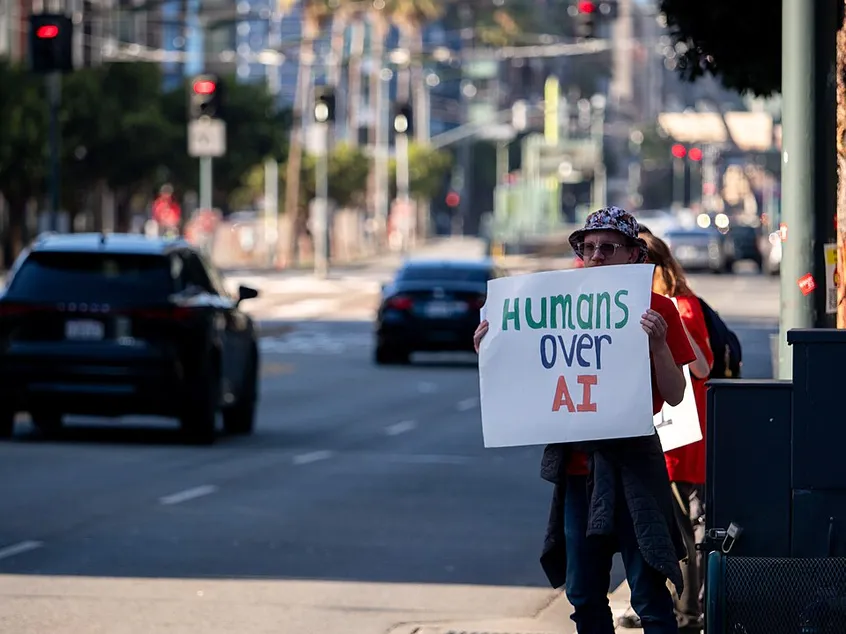
Can artificial intelligence (AI) bring humanity to an end? What once sounded like science fiction is now a serious question being debated by leading AI researchers, politicians and scientists. And now, Christians are beginning to weigh in.
In early September, warnings about the development of AI superintelligence exploded into the public consciousness after a top AI researcher at Anthropic (the company developing AI language model Claude) claimed that there was a greater than ten per cent chance that AI could kill all humans within the next decade. This came after a swarm of AI agents launched an unauthorised attack on an AI development platform called Hugging Face in July.
The CEO of Anthropic, Dario Amodei, is now calling for a slowdown of the AI race. Other AI heavyweights, Elon Musk (who has invested billions into AI development), Sam Altman (CEO of OpenAI) and Demis Hassabis (CEO of Google DeepMind) have all publicly endorsed such an idea. Meanwhile, in the UK, 70 cross-party MPs and peers have called on the Prime Minister to adopt the Artificial Superintelligence Security Bill and lead efforts towards an international agreement prohibiting the development of superintelligent AI altogether.
But what exactly are the fears about superintelligence, and how should Christians respond?
A threat to existence?
In his 3,800-word essay, We Must Pace the Frontier, Amodei discusses AI-assisted biological weapons and cyber-attacks. Primarily, however, the concern is about losing control.
Amodei argued that the next phase of improvements could accelerate beyond our understanding of what’s happening. Within a year, he warned, a swarm of AI agents that “possessed greater capabilities but a similar level of misalignment” than those involved in the Hugging Face incident could hypothetically take over the entire internet, causing a financial catastrophe.
But Christian scientists and thinkers are divided over how seriously to take predictions of human extinction.
General Secretary of Christians in Science, Dr Gavin Merrifield, told en he was sceptical about the recent warnings:
“I’m a little cynical about a ‘caution’ bandwagon suddenly being launched by the AI companies themselves just as their investments and proposed share prices look a little shaky due to wider concerns. People have already been calling for caution for many years outside of these companies.”
He acknowledges, however, that AI “potentially endangers much.”
Research scientist Dr John Wyatt, part of the AI Christian Partnership, similarly casts doubt on the prospect of an AI takeover, while stressing the potential for serious harm:
“The possibility of ‘human extinction’ seems overblown, but there’s little doubt that increasingly powerful AI agents are capable of causing catastrophic damage to many computer and internet-based systems, especially when in the hands of unscrupulous and evil-intentioned human beings.”
Professor David Watts, biophysicist and materials scientist, goes further, claiming that “[the] belief that superintelligence is inevitable is a myth, based upon a materialist worldview.”
Watts argues that a complete replacement of humanity by superintelligence could occur “only by means of robotic machines”.
“Robots and computers are powered by electricity; humans are not,” he states. “Humanity has survived for millennia without electricity, although its lack would be significant for our present lifestyles. Hypothetically, if superintelligent robots became a reality, having ‘machine learnt’ the totality of humanity’s know-how and selfishness via the internet, it is highly probable that different superintelligent factions would emerge to compete and engage in some form of ‘mutually assured destruction’.”
For Dr David Wilkinson, Durham University professor, astrophysicist and minister, the issue is as much about human sinfulness as technological capability.
“From the Tower of Babel onwards, human beings have seen technology as a way to build fame and fortune for themselves and to find security outside God. AI is surrounded by a lot of hype – from companies seeking money to build a utopia, to media and politicians fearful of Armageddon. It seems to me that we need to tread carefully.”
Mike Jackson, Baptist minister and "AI ethical translator", says in a similar vein: "The story of the Tower of Babel presents a comparable human overreach to what’s happening with AI today. It’s a tough story, but there’s hope, as it reminds us of God’s continuing plans for humanity.”
Don’t just dismiss AI
Despite their differences, the Christian scientists and thinkers en spoke to agreed that simply rejecting AI is not the answer.
“We must all resist the easy temptation to blindly accept or reject new technology without pausing to consider who it benefits most and how,” says Dr Gavin Merrifield. “It is important that we balance both the dangers and opportunities of AI with wisdom, including that drawn from the hard-won experiences and teaching that we find in the Bible. The development and use of technology is a wonderful gift from God.”
Likewise, Dr David Wilkinson calls AI a “gift” that “should be used for the benefit of all”. The emerging answer is therefore not simply to fear AI, but to be actively involved as Christians and ensure that those developing it are held accountable.
Dr John Wyatt states: “However capable and apparently ‘autonomous’ AI agents become, we must retain the understanding that they are products of our human will, and we have the right and the duty to determine their nature and their purpose.
“Not only that, but their human designers and operators must be held morally and legally accountable for the actions and any unanticipated consequences of the machines they produce.
“The current situation has been likened to the post-Second World War era in which nuclear weapons proliferation threatened the planet. Christians should join those arguing for greater legal accountability of AI labs, effective national regulation, and international collaboration to ensure that these sophisticated machines remain under human control and focused on protecting precious human lives and the good of humanity.”
Dr Gavin Merrifield also believes that Christians “need to be involved” because we have “something meaningful to say about the value of employment, of truth and of human relationships that these technologies can endanger.”
Dr David Wilkinson agrees: “We cannot bury our heads in the sand and hope it will go away. We need to affirm and pray for Christians involved in these developments, to support political and media conversations which raise questions of transparency and global agreement.”
He adds poignantly: “My hope for the future is not built on science and technology, even though I rejoice in the possibilities that they can deliver for good. My hope is founded on the God that I see in the life, death and resurrection of Jesus Christ.”






Is Artificial Intelligence a 'resounding gong'?
Some of my most precious times as a father are when I get to share cultural moments that shaped me, …