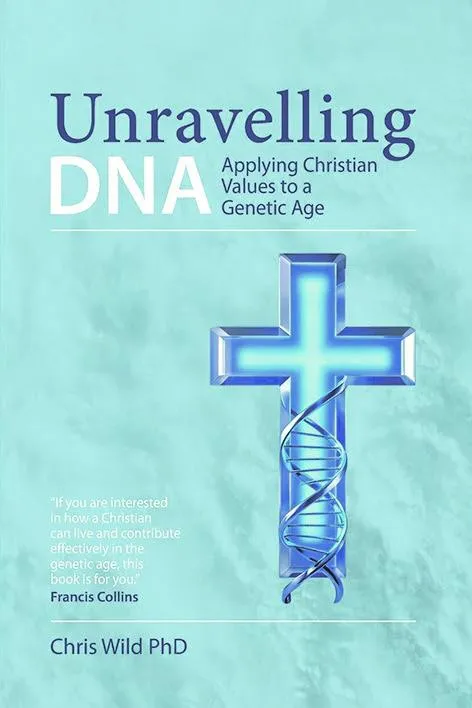
Steven Bowers reviews Unravelling DNA by Chris Wild.
The author is highly qualified to write this volume and no doubt merits the heavyweight commendations on the cover. Formerly a Director of the World Health Organization’s cancer agency and Professor of Medicine at Leeds University. Wild’s Christian and Biblical commitment is very clear as he traverses this complex subject, with its huge potential benefits and the profound ethical questions connected with it.
This excellent book has the following chapters – 1. Genetics Matters 2. Reading the Code: Genetic Testing 3. Copying the Code: Cloning 4. Editing the Code: Genetic Engineering 5. Saving the Code: DNA Storage 6. Life and Relationships 7. Relationship with Self 8. Relationships with Family 9. Relationships in Society 10. Relationships with the World 11. Moving Forward with Genes and Relationships. There is a detailed and accessible bibliography, and a scientific appendix on “From DNA to Proteins”.
As the first five chapter headings indicate, there is a guide through the various facets of this daunting science in which the reader is skilfully led. The task is so well carried out that if the reader’s knowledge of the subject is slight, it is not a barrier to gaining a good understanding. Wild writes: “In chapters 2–5 we will examine the application of genetics to a wide range of areas of daily life focused on the four areas of: testing (reading), cloning (copying), engineering (editing) and storing (saving) our genetic text. An awareness and familiarity with these topics and the moral and ethical questions they raise is an important foundation for forging opinions. We need to know what we are talking about” (p.12).
The remaining chapters, 6–11, seek to explore the deeper understanding, ethical questions, actual and potential outworkings of genetics. This is helpfully done by looking at a range of relationships and how the science is having, will have, or could have an effect on our lives. Again, the author writes: “In chapters 6–10 we will look at how to make sense of the science by considering how genetic advances impact relationships in four areas: self, family, society and the world. This framework, grounded in Biblical principles, should permit a more structured way of thinking about the underlying principles and important consequences of introducing new genetic technologies into daily life” (p.12).
There are also invaluable tables summarising each area explored (pp.202–205). These tables are arranged in four columns. First, there is: The Basic Principle Considered – the unique place of humans. Then, second: A Biblical Insight – made in God’s image. Followed by: The Relevant Genetic Technology – genetic testing. And, finally: Potential Interpretations and Consequences – the biological view may dominate analysis of value, detracting from spiritual relationship with God. These tables enable the reader to review the huge range of issues quickly.
The author draws his highly informed red lines, and this book will help the reader to think carefully where he or she should draw theirs. Not only are there great scientific insights, but also light on the legal and data complexity of the subject. There is good interaction with Biblical principles. This volume is invaluable for any interested Christian to read, and particularly for those in the health professions, counsellors, teachers and ethical committee members. It will prove a supplemental and surefooted guide for theological educators/students and pastors.
It is more than a book – it is a course! The last words on page 200 put the matter into perspective, “So that’s it. Genetics has the potential to change the very nature of humanity: the value we assign to human life, the future of our species and of the world we live in. Who can afford to ignore that?”
UNRAVELLING DNA: Applying Christian Values to a Genetic Age
By Chris Wild
CBJ Books. 255 pages. £12.99
ISBN 978 1 068 227 509