Isaac and Rebekah: Narrative 'nesting' in Genesis 24

Stephen Moore  |  Features
Date posted:  5 Dec 2025
Share Add       
Isaac and Rebekah: Narrative 'nesting' in Genesis 24

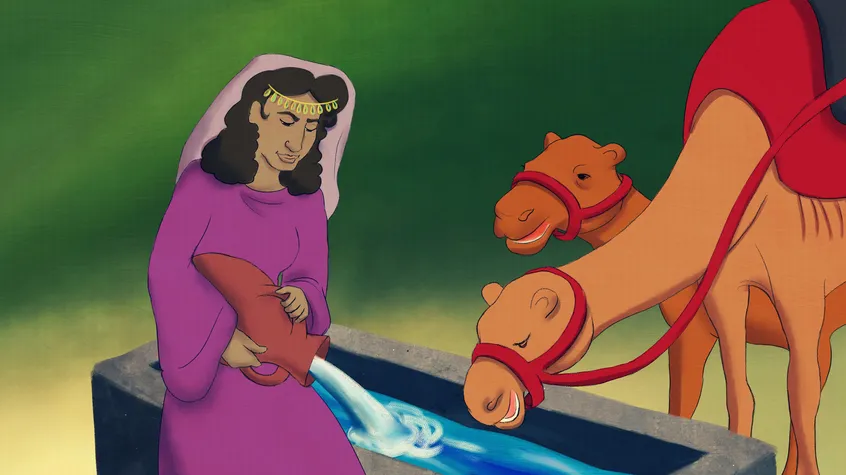
Image: FreeBibleimages (freebibleimages.org) & www.fishnetbiblestories.com

It is a remarkable thing about the book of Genesis that it tells universal history by means of particulars – the small details.

"And before he had finished speaking, out came Rebekah – who had been borne to Bethuel son of Milcah the wife of Nahor the brother of Abraham – and her water jar was upon her shoulder. Now the young woman was very beautiful, a virgin whom no man had known. And she went down to the well and filled her water jar and came up. Then the servant ran to meet her and said, ‘Let me gulp a little water from your water jar’, and she said ‘Drink, my lord’ then hastily brought her water jar down onto her hand and gave him a drink. And when she had finished giving him a drink she said, ‘For your camels too I will draw water until they’ve finished drinking" (Genesis 24v15-19).

Ordinary individuals, private persons, and their mundane movements, are vested with world-significance. A man barters for a field and cave in another man’s property and unbeknown to the seller he buys a share in the future world (Gen 23). An old man on his deathbed speaks to his twelve sons and in doing so fixes the future allegiance of nations to one of those sons (Gen 49). The goal here is to study how it does this, by turning to several examples from Genesis 24. It is a long and beautiful chapter all about the seeking and finding of a wife for Abraham’s son, Isaac.

The water well

We begin with a well-known scene, quoted above. When we read the events at the water well, we hardly need to be told it is full of meaning. Two things have charged it with meaning, one more obvious than the other.

First, the servant, seeking a wife for Isaac, had contrived a litmus test involving watering ("let the young woman … who shall say, ‘Drink, and I will water your camels,’ let her be the one you have appointed" v14). So, we are naturally rapt the moment that Rebekah lowers the water jar from her shoulder.

But the second, more important thing is that the servant’s mission, for which he is under oath, gets its significance from a larger oath, by the LORD to Abraham. For this we need to go back to the start of chapter 24.

Abraham said: "Put your hand under my thigh, that I may make you swear by the LORD," and so the servant did. The whole mission of the servant from here on is bound by an oath. But it is not the only oath in view. Before the servant swears, Abraham speaks about the LORD, v7, "who swore to me, 'To your offspring I will give this land,' he will send his angel before you and you shall take a wife for my son from there."

There are then two oaths in this chapter. The servant’s oath sits within the LORD’s oath to Abraham. This creates a kind of "nesting". And the inner story of the servant’s mission never leaves the other oath behind. We must keep it in mind as readers.

Such "nesting" is one way to describe what is at work in Genesis 24.

The servant’s oath-bound mission to find a wife for a man’s son can narrate by its details something as grand as the LORD’s steadfast love to Abraham. It is never left behind in the details and we have the sense that more is at stake than first appears in the details of this mission. For the man’s oath rests within the LORD’s oath.

To see this at work, let us return to events at the water well. The servant sets a test all about watering. "Let the young woman to whom I shall say, ‘Please let down your jar that I may drink,’ and who shall say, ‘Drink, and I will water your camels’ – let her be the one you have appointed for your servant Isaac."

Any sensible reader can tell this test is a good one. It is crafted to reveal a virtuous woman. In other words, there is nothing arbitrary about it, as if it would have done just as well to set a test: "Let her be the next woman who comes round the corner wearing a brown tunic."

So, we can all agree it is a good test. But what makes it the best and most fitting test for this mission? The answer lies in the Hebrew term ḥesed "steadfast love", "loving kindness".

The servant’s test describes this concept very well. The right woman will show ḥesed-in-action. Now, we are used to ḥesed being shown by God towards a human person. This is the common usage. But it is not unusual or improper for it to be asserted for human-to-human action. The giveaway that we are dealing with ḥesed here is the presence of excess. The servant’s test runs like this: let me ask her for water for myself and let her answer surpass it with an extra kindness ("drink and I will (also) water your camels").

It reminds us of other passages where steadfast love is exercised between people. Boaz’s treatment of Ruth is a famous instance. At table he beckoned Ruth to eat bread and dip her morsel in wine. He passed her roasted grain, and "she ate and was satisfied, and she had some left over," and he instructed some bundles of sheaves to be deliberately left over for her to glean (Ruth 2v14-16). This is the nature of ḥesed. It surpasses and surprises by its excess.

That we are right to describe the servant’s test in Gen 24 as ḥesed-in-action is confirmed in the same verse, v14, "By this I’ll know that you (LORD) have shown ḥesed to my master." Here is the "nesting" of the oaths again. The LORD’s oath is about steadfast love to Abraham. So, the servant chooses a test fit to match it. The common link is "steadfast love" and this leads to a remarkable re-reading of the scene at the well for the action occurs on two planes.

We’re not only watching the movements of the young Rebekah. The servant asks, "let me gulp a little water", and the adverb makes it a modest request. Her answer, with a simple imperative, has no constraints: "Drink, my lord". She lowers her jar quickly, as later she runs to draw water. As soon as she finishes giving him his drink, she states unprompted (as it must be), "I will draw water for your camels too". This is already far in excess of the modest request, but there is also a surplus on the surplus: she says the camels will drink to satiety, "…until they have finished drinking".

This is steadfast love by the standards we’ve described above. But whose steadfast love are we witnessing?

Given the common link of steadfast love between the two oaths, we watch Rebekah show steadfast love, and at the same time – in the same event – we trust the LORD is showing steadfast love to Abraham. The human details of a moment in a betrothal story then narrate the faithfulness of the LORD to Abraham in the larger Genesis narrative.

This kind of "nesting" occurs in many other places, in Genesis and later texts, and gives great freedom to the narrative. It can dwell for a long time in the details of a local scene, but all the while tethered to an overarching narrative.

‘I will go’

Let us turn to another example in the same chapter. The second half of the story turns on a detail that is easy to miss, in v58: "So they called Rebekah and said to her, ‘Will you go with this man?’ And she said, ‘I will go.’"

Rebekah’s answer is one word (’elek). It is full of a meaning we won’t find in the immediate context of the verses around. Its power comes from the prior oath and leads us into an important topic in reading Genesis – the matter of divine names.

Let us begin by re-reading the exchange between Abraham and his servant, as follows (vv2b-9): "'Put your hand under my thigh so that I can have you swear by the LORD, the God of heaven and the God of earth that you will not take a wife for my son from the daughters of the Canaanites amongst whom I live, but to my land and to my kindred you must go and take a wife for my son, Isaac.’ And the servant said to him, ‘Perhaps the woman will not be willing to follow me to this land. Should I then in fact bring your son to the land from which you went out?’ So Abraham said to him, ‘Make sure you do not bring my son back there! The LORD, the God of heaven who took me from my father’s house and from the land of my kindred and who spoke to me and who swore to me as follows: 'To your offspring I will give this land,' he is the one who will send his angel before you and you will take a wife for my son from there. But, if the woman is not willing to follow you then you will be free from this oath of mine – only you must not bring my son back there.'"

The servant’s oath has limits. It cannot cover a scenario where the woman is unwilling to follow him back. "Perhaps the woman will not be willing to follow me to this land". This is repeated back to him a few verses later by Abraham – "if the woman is not willing to follow you".

At a basic level this introduces a new element, the idea of "being willing to go to Canaan". There will now need to be a later moment when this doubt is settled, and the woman is willing to go there. Rebekah’s "I will go" in v58 is then an answer to these earlier doubts.

But there is more to this business of being willing to go to Canaan. It is found in Abraham’s additions to the divine name, "LORD", in v7. Between the two references to the woman "not being willing to follow you", Abraham expands on the name "LORD" in a deliberate way. He adds an epithet, "God of heaven," together with an additional clause, "who took me from my father’s house and from the land of my kindred".

When reading divine names in Genesis, epithets matter, and clauses attached to the divine name are meaningful. They place an aspect of God’s character in the foreground, in front of the eyes of faith. Often it is an expansion suited to the moment.

An example from earlier in the book can illustrate this. In Genesis 14, just before Abram is offered spoils of war by the king of Sodom, the strange figure of Melchizedek steps in with a blessing. The blessing is by "God Most High (El-Elyon), possessor of heaven and earth".

Of course, the special name and epithet names the one true and living God, but it places certain aspects of the LORD’s sufficiency before Abram. He owns heaven and earth and so it is his to give. Abram needed to hear the epithet "possessor of heaven and earth" at this moment, to strengthen him to refuse the offer of the king of Sodom. Here is what he then says to the king of Sodom: "I hereby raise my hand to the LORD" (i.e. he swears in real time), but who does he swear by? By "God Most High, possessor of heaven and earth".

He took the divine name and epithet directly from Melchizedek’s blessing. They were supplied to Abram when he needed them, and he took them up for this most strategic refusal of the king of Sodom.

We can now return to chapter 24. Abraham answers the servant’s question by turning to speak about the LORD and he adds the epithet "God of heaven". This is shorthand for "the God of heaven and earth" used in v3. But why this divine name here? A standard answer is that it has to do with swearing in general. One makes an oath by "heaven and earth", and so naturally by "the God of heaven and earth." But in fact, the point is more specific and the detail richer. Rather, Abraham invokes the "God of heaven (and earth)" because this is the facet of God’s character he associates with his call from Mesopotamia. The relative clause after "God of heaven" shows this. The "God of heaven" is the one "who took me from my father’s house and from the land of my kindred, and who spoke to me and swore to me as follows: 'To your offspring I will give this land.'"

The real answer to the servant’s question, "What if she is unwilling to come to this land?", lies with this divine epithet. This mission requires a miracle: to sever someone from a father’s house and kindred to go to an unseen land of Canaan. It has been accomplished before, says Abraham, by the "God of heaven". So, swear by the same name, for this mission requires the same kind of miracle.

What significance do we then attach to Rebekah’s answer, "I will go"? In an instant, she takes on the image of Abraham. The echoes of Abraham here have been well noted by others (e.g. Wenham in his Genesis commentary). Her short answer has many consequences. She leaves her father’s house, the land of her kindred, to go to the land of Canaan. Abram was commanded to "go", "to the land I will show you", and he "went".

But her answer also narrates the work of God. As we’ve seen, the original transfer of Abram from Mesopotamia to Canaan was a miracle attributed to the "God of heaven" (v7). In need of a comparable miracle, bearing the same shape, Abraham made sure the oath was sworn with this same epithet, "God of heaven", in view.

So, Rebekah’s words "I will go" then occur on two planes. She says "I will go" (to Canaan) and she reminds us of Abraham. But as she says, "I will go" (to Canaan) we the reader know it can only be the work of the God of heaven, who underwrites this oath and mission, and who alone is sufficient to transfer from paternal house and kindred in Mesopotamia to go to Canaan, as Abraham told his servant (v7).

The blessing

A third and final example is not about "nesting" but words of blessing. The motif of blessing in Genesis is important. But we get to see how it does its work in chapter 24v60, a single verse recording a blessing: "And they blessed Rebekah and said to her: ‘Our sister may you become thousands of ten thousands and may your offspring possess the gate of his enemies.'"

First, recall how to read blessings in general in Genesis. The book itself is our guide in this:

  1. Blessings are solemn words that fix the destiny of another for good. That good is defined by the content of the words. This definition obviously doesn’t apply when humans bless God.
  2. The words really do bring about the good spoken (however long-range the view).
  3. Point two lends these words a sense of irrevocability. Even if the speaker wanted to retract them, the solemn word of blessing will do its work. The obvious example is the aged Isaac having blessed Jacob, thinking him to be Esau. He blessed him, and so "Yes, and he shall be blessed!" (Gen 27v33). The same thing occurs in later history in the plains of Moab when Balaam utters words of blessing on Israel – much to Balak’s dismay.
  4. It is God who has vested these words of blessing with such power and efficacy.
  5. The blessings are grandiose and exalted. They speak of things far greater than could usually be said of an individual.

This last point explains how it is that ordinary individuals, private persons, and their mundane movements, are vested with world-significance. That is our subject here, how Genesis tells universal history by its minor details.

And blessings are a key element. A private person becomes a person of world importance when the LORD places on their shoulders the hopes of the world – by words of blessing. It was not hyperbole when the apostle Paul described Abraham as "heir of the world". The LORD had made it so by the pronouncement of words of blessing.

But what about the special features of this blessing in v60? Amidst a section full of everyday details of marital custom, including gifts and a meal, the words of blessing seem almost out of place. It is not the fact of a blessing, but that the words are far too elevated for a normal marriage rite ("may you become thousands of ten thousands").

The militarism of "possessing the gate of his enemies" is a stark send-off for the young woman, unless it evokes something else, which it does. These words fit the description of "grandiose and exalted" (point five above), but in a particularly "Abrahamic" way.

Here is the blessing of v60 again: "And they blessed Rebekah and said to her: ‘Our sister may you become thousands of ten thousands and may your offspring possess the gate of his enemies.’"

In Gen 22v17, the LORD declared to Abraham through his angel, "I will indeed bless you and greatly multiply your offspring, like the stars of the heavens and like the sand which is on the seashore and your offspring shall possess the gate of his enemies."

Aside from a variant term for "enemies" being used in the two texts, the "offspring possessing the gate of his enemies" repeats verbatim what was said to Abraham in 22v17.

This conquest of enemies is a distinctive of the blessing to Abraham. When Melchizedek blessed Abram after the battle of the kings, he also blessed God Most High "who has delivered your enemies into your hand". And so, 22v17 cements something already there. Abraham’s association with enemy conquest is never forgotten by Scripture – as seen much later in the Benedictus (Luke 1v73-74).

What about the first sentence of Rebekah’s blessing, "may you become thousands of ten thousands"? The exact words do not appear elsewhere in Genesis but there are several candidates for echoes. In the end, "thousands of ten thousands" may also hark back to the same verse, Gen 22v17, as a gloss on the "stars-in-the-sky and sand-on-the-seashore" language. Both are idioms for the innumerable.

So, the blessing on Rebekah is Abrahamic. It adds to the other ways we’ve seen her match the promise to Abraham: at the well, and in her "I will go". But given what we’ve said about blessings in the five points above, these elevated words must come to pass. Even before she is back with Isaac, even before she bears Esau and Jacob, her part in the grand narrative is guaranteed through the utterance of these words. For they are words of blessing.

And so, the betrothed woman sets off back to Canaan on a camel to meet her groom, but she is already the archetypal mother of innumerable offspring.

For a long time, Genesis 24 has attracted the attention of those interested in its narrative art, and rightly so. It is a masterful example. But our journey into its details is also richly rewarded by their connections with the grand narrative and serves to unfold the name and character of the LORD himself. Its ways of doing this are not limited to Genesis, and in the world of Hebrew narrative, it is not the exception but the rule.

Share
< Previous article| Features| Next article >
Read more articles on:   Bible  /  theology

Need to advertise?

We can help you reach Christians across the country

Find out more

Give a subscription

Our monthly newspaper is the perfect gift for those who love to think deeply

Give here