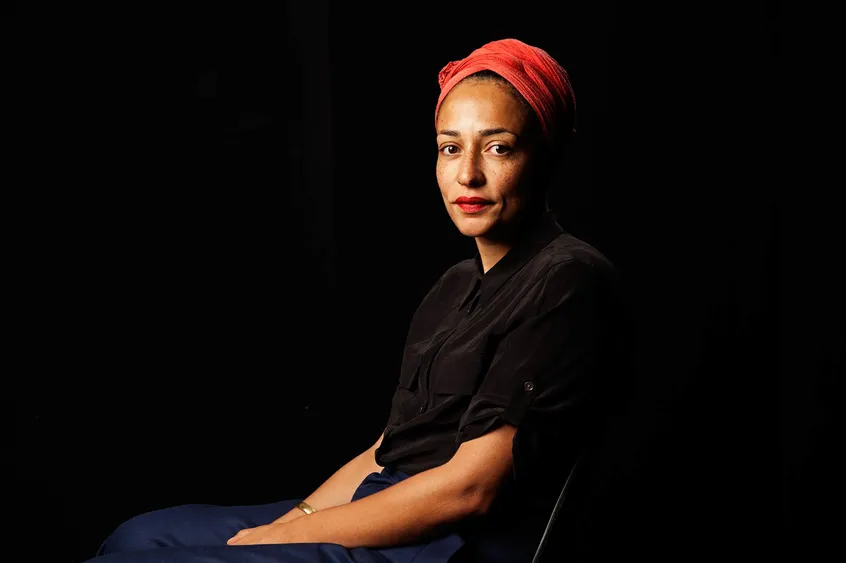
Zadie Smith is one of my favourite living novelists. Her latest, The Fraud (2023), takes up the real-life Tichborne case, which captivated the British public in the 1860s-70s.
This historical setting allows Zadie to articulate all kinds of contemporary anxieties around truth in a post-truth world, and about the possibility of justice when a court case becomes a spectacle, or even a piece of theatre.
Although these parallels with the present day were sometimes drawn a little heavy-handedly, Smith’s characteristic warmth in developing her protagonist, Eliza Touchet, more than made up for it. Smith gives voice to feelings, questions and griefs with a depth only a skilled writer can — and with an empathy and a wisdom that suggests she is deeply concerned with, and thoughtful about, the human condition.

A person who has 'never known God'
In an essay, Smith once described herself as ‘a person…who has never known God (who has only read and written a lot of words about other people who have known God)’. This description is really a disclaimer, right down to the brackets, in which her own fascination with faith is tucked away even as it is acknowledged. But it is on display in Eliza Touchet, whose faith Smith writes with sincerity. And it is as Smith sees out of Eliza’s Christian perspective that The Fraud affords us glimpses of grace.
In one exchange, Touchet commends the striking workers of Manchester, who refuse to work with cotton produced by slave labour. Attempting to convince her friend — for whom such a cost of such an embargo is too high — she says, ‘from the perspective of a vision further and deeper than yours or mine or any on this earth, such sacrifices may prove to be the very least we can do.’ Smith, who has never known God, nonetheless writes with a yearning for a perspective only He can provide: the kind which sees through and beyond strictly economic calculus and mere financial concerns, which prizes justice even when it is costly.
'[She represents] a culture that longs to affirm our dignity, but, having turned away from God, is deprived of the ability to do that in a truly meaningful way.'
One section of the novel follows Andrew Bogle, another figure from the real-life Tichborne case, fictionalised by Smith with seriousness and care. Touchet listens at length to Bogle as he recounts where his life has taken him, from slavery on a plantation in Jamaica to service in the Tichborne household. Having heard his life story, Touchet sees Bogle speaking in public, and realises, ‘A person is a bottomless thing!’ There is an awesome reality to every human being — and yet, ‘We mistake each other. Our whole social arrangement a series of mistakes and compromises. Shorthand for a mystery too large to be seen.’
Is there really ‘a vision further and deeper than yours or mine or any on this earth’? Is a person really ‘a bottomless thing’? What would have to be true for us to answer ‘yes’ to both questions? One senses Smith wishes she could say ‘yes’, but these are glimpses of grace. They’re available to Smith as she sees the world through the eyes of a Christian, and as she takes that faith seriously.
Reading The Fraud made me grateful for Zadie Smith’s sense of how very precious, how bottomlessly deep a human being is. She is an insightful, humane and articulate representative of a culture that longs to affirm our dignity, but, having turned away from God, is deprived of the ability to do that in a truly meaningful way. Reading it made me pray that she, and many others with her, would find in the gospel the truth that makes sense of that longing.
Truth, shame & the search for blame
There was a stream of articles and commentary in the weeks leading up to Jason Arday’s resignation as Professor of …