Netflix’s latest dark but glossy psychological thriller Unchosen starts with the staggering statement that “over two thousand cults exist in the United Kingdom”.
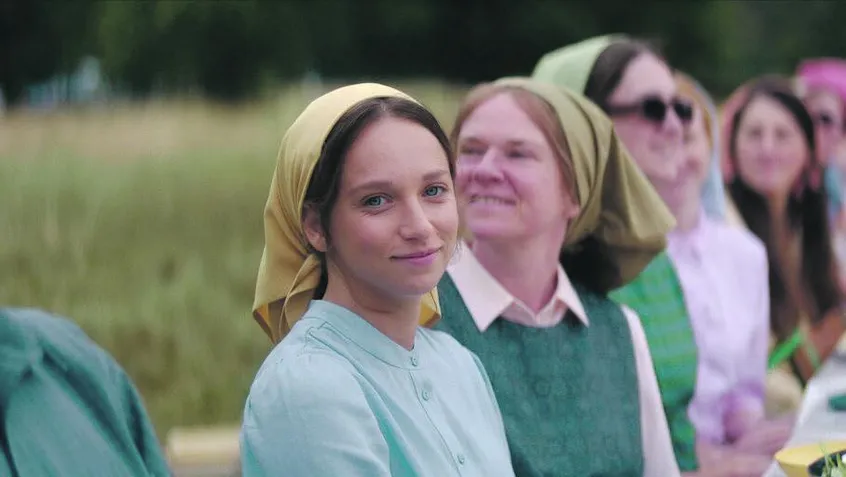
It appears on-screen over some stunning pastoral shots of England looking serene. The series unfolds, with a star-studded cast including Asa Butterfield as Adam – the husband and burgeoning church leader; Molly Windsor as his wife Rosie – the protagonist; Christopher Ecclestone as cult leader Mr Phillips; and Fra Fee as Sam – the “unchosen”, who finds himself drawn into the world of this fictional sect and forms an attachment to Rosie, who finds herself yearning for freedom.
The Daily Express called it “possibly Netflix’s most distressing drama of 2026”. It feels a bit like an attempt to take the grimmest element of as many cults as possible and create a mega-mashup of misogyny and abuse, but beautifully filmed. Brothers are set against brothers, tiny sons weaponised against fathers. The Netflix show Adolescence was released while Unchosen was being filmed, and the cast were aware of the effects of childhood trauma, on men especially.
However, in a world where men lead, it is interesting to hear how the voices of older women are heard. Rosie’s mum reminds her that “our suffering brings us closer to God”. Mrs Phillips, the cult leader’s wife, instructs “put your trust in the Lord and the men who follow his instructions … regulations are the world of God. Even when the heart says otherwise.” Meanwhile, the children think a storm is the rapture, and are taught that The Beano is from the devil.
This isn’t a quick-moving series, though when it warms up things do get quite heated and there is some violence. With two of the lead protagonists as a perceived “prisoner” to a cult, and an escaped prisoner, the narrative perhaps isn’t super-nuanced, but no less impactful for that. We are shown the darker side of a faith community, alongside the complexity of human nature in our struggle for identity and the need for human connection. And of course, questions about the nature of repentance are never far away.
The community meeting hall scenes are a dead ringer for the Plymouth Brethren Christian Church – from their distinctive sliding doors to the coat hooks outside the chamber, and even down to the headscarves the members wear. There might be moments where this series feels reminiscent of The Handmaid’s Tale, but the mis-en-scene is distinctively English, from the village setting to the Dettol characters use.
The Testaments
Over on Disney+ there is now a young adult-style sequel to The Handmaid’s Tale, called The Testaments. This gives off Mean Girls vibes, a dystopian drama set in an elite prep school, with a sparky script and soundtrack – and a coming-of-age narrative. Like the original Handmaid’s book published in 1985, the 1990 film, 2000 opera, and then the popular TV series, this again shows a patriarchal society where women exist only to serve men. Power is survival. Like The Unchosen we see the drama through the eyes of a young women growing up in a fundamentalist dictatorship. This is their normal. Another world where unquestioning obedience is called for.
The cult-like religious language is as ubiquitous here as the popping bright colours denoting the girls roles. “Praise be” or “Under his eye” are peppered throughout. One of the main characters has supposedly come from outside Gilead to learn its godly ways. The other teenager girls are not convinced – “the passion of the convert, what a pain in the backside”. Here we see how power and corruption creep into even the most mundane of contexts. How ordinary girls normalise and acquiesce to evil, even to join in: “for there is nothing new under the sun”, says Ecclesiastes.
The concept of cults is nothing new. But we do need reminders about regarding our pastors as the ultimate source of spiritual authority. Andrew Graystone’s recently for revised book Bleeding Jesus had the subtitle John Smyth and the Cult of the Iwerne Camps. The most wholehearted of believers submitted themselves to an abusive leader, who Andrew argues was leading a cult. We are all prone to putting our leaders onto pedestals, to varying degrees. This is an unsettling thought – and Unchosen and The Testaments are unsettling shows. One is set in a very real (and hyper-English) world, the other a dystopian one.
Whatever our church context, there are questions we can ask ourselves about how contributions to our faith community, our church family, are worked out – and how this happens without control or coercion becoming an issue. We have been made in the image of God – made to be in community, and our desire to belong can be alluring, even when it is focused on harmful cultures. God calls us to be in communion with Him – and with each other. But he has also made us capable of critical thinking. Such unsettling shows remind us of this. In a world where we are surrounded by endless data, and countless opinions, they remind us that we are called to test everything, and to hold fast what is good. And however godly our pastors, it is better to take refuge in the Lord than to trust in man – and to teach our young people that it’s okay to question and critically reflect, whatever the culture and context they are growing up in.