
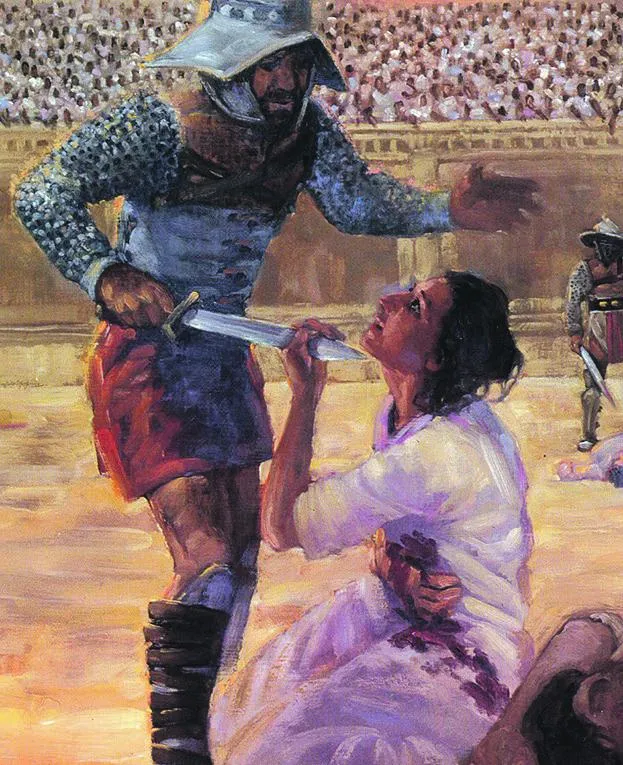
In the year 201 the Roman Emperor, Septimius Severus, who had become the head of the empire in 197, issued an edict forbidding anyone to become a Jew or a Christian. The Roman governor in Carthage in North Africa, Publius Aelius Hilarianus, a man who was steeped in Roman idolatry and paganism, was eager to enforce the edict.
And so, immediately prior to some gladiatorial games celebrating the birthday of Septimius Severus’ son Geta, in March 203, he had a number of Christians arrested. Eventually six were put on trial: four men – Saturninus and Secundulus, who were slaves, Revocatus, and their teacher, Saturus – and two women – Felicitas (or Felicity) and Vibia Perpetua, a noble-born Roman matron who was 22 years old with a newborn son.
In typical Roman fashion, they were asked to offer a sacrifice to the gods for the safety of the emperor or face death. They all refused and on 7 March 203, five of them – Secundulus had died in prison – were martyred in the Roman amphitheatre in Carthage, the ruins of which can be seen to this day as a UNESCO World Heritage site in Tunis, Tunisia.





'An angular Messiah is our only hope'
Having devoured Jonathan Freedland’s The Escape Artist (2022) with fascination, I wasn’t going to miss reading his latest, The Traitors …