Archaeological excavation has been fairly muted in the Middle East during the present crisis there. However, a number of discoveries have been made in Egypt over the last year that have been in the news. One in particular may have significant bearing on how we read the Bible.
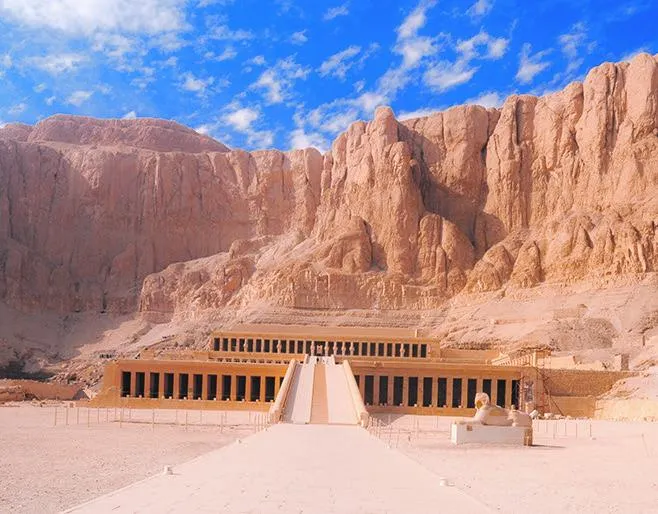
Any visitor to Egypt will have been awestruck by the stunning ruins of tombs, temples and pyramids. Among those memorable sights will probably be the mortuary temple of Hatshepsut in Luxor. Built as three terraces into the sides of a cliff it remains remarkably intact having been used and reused for different purposes over 3,000 years.
A female Pharaoh
Hatshepsut was one of the few female Pharaohs in Egyptian history. Soon after her death an attempt was made to erase her memory. Her name was hacked away from stone inscriptions. An effort began to remove her name from the temple, though this was never completed. While she was not unique as a female Pharaoh, Hatshepsut was the most powerful of those women and the grand building works of her Luxor temple showed just how prosperous Egypt was at that time. It is a mystery why her successor sought to obliterate her memory.
Archaeologists have recently uncovered 1,500 decorated stone blocks that had once been part of the Luxor temple. They also found building tools from the time and a tablet that records the name of the chief architect, Senmut, who oversaw the building work. These artefacts are still being interpreted, but will cast light on this enigmatic time in Egyptian history.
The Moses connection?
Hatshepsut reigned c.1473–1458 BC, a period which overlaps with the traditional date for the time of Moses. While this is one of the more controversial areas of Biblical archaeology, it is generally accepted that if you take dates given in the Bible at face value you arrive at something like 1446 BC for the time of the Exodus. If that date is accurate then Hatshepsut was the daughter of the Pharaoh at the time of the oppression. She would have died some time before Moses returned from the wilderness to demand the freedom of the Hebrew slaves. Many great Biblical scholars, such as the late Kenneth A. Kitchen, believe that the Exodus belongs to a later period of Egyptian history, in which case Hatshepsut could not possibly be connected to Moses. However, following the traditional dates some interesting parallels emerge.
We know of one remarkable daughter of a Pharaoh in the Bible (Ex. 2v5). We don’t know her name but we do know she was able to adopt a Hebrew child, name him Moses (possibly an Egyptian name), and bring him up in the palace of Egypt (Acts 7v22). Is it possible that this is the member of the royal household who had favoured Moses and been in a position to give him the privileges of the Egyptian court despite his Hebrew background?
Forget me not
Scholarship continues to focus on the subsequent attempt to destroy Hatshepsut’s memory. It was her stepson, Thutmose III, who decreed that her statues be destroyed and her name removed from official records. Many Egyptologists think something had angered Thutmose and caused him to smash her statues. In contrast, Jun Yi Wong, of University of Toronto, points out how clinical the process was, and suggests not rage but “pragmatic and ritualistic reasons”. All the evidence suggests that the attempt to destroy Hatshepsut’s memory happened many years later in Thutmose III’s reign and not immediately after her death.
What could explain this? What event may have happened a decade or two after Hatshepsut’s death that would have turned her legacy from one of the most prosperous and successful leaders of Egypt to being reviled and rejected? What associations might Hatshepsut have had that may have brought a later generation to despise her? We can’t be sure of the dates and connections so we can’t be dogmatic, but it does seem that the Book of Exodus offers explanations that could fit neatly with new archaeological discoveries. Only now is the material evidence for the life and times of Hatshepsut emerging in such detail. Whether the Moses connection finds direct corroboration or not, this ancient woman will have interesting stories to tell.