Why is the world not destroyed by cataclysmic natural disasters? Why is God’s purpose of salvation for His people secure? Two very different questions, with one answer.
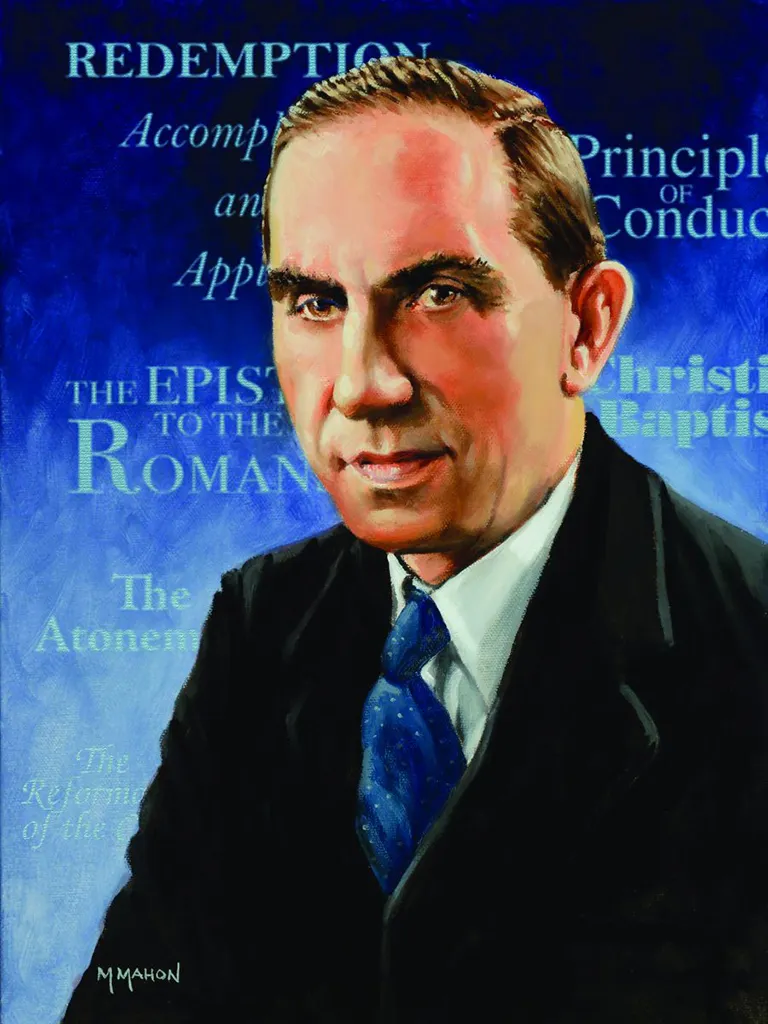
And that answer was once one of the hallmarks of historic Reformed and Evangelical thought – the idea of covenant. Professor John Murray (1898–1975), of Westminster Theological Seminary in Philadelphia, wrote: ‘Covenant theology is … a distinguishing feature of the Reformed Tradition … the idea of covenant came to be an organising principle in terms of which the relations of men to God were construed.’ The theology that came from the Reformation was emphatically a covenant theology.
But does covenant theology deserve that central place? Does it really answer the two questions at the start of this article? Well, yes, because at every pivotal event in the history of divine revelation a covenant initiated by God appears.

Covenants and creation
We first see a divinely initiated covenant in aftermath of the flood. The old world was destroyed, and the new world emerges with a covenant promise. It is a covenant that provides the certainty that God will not again destroy the world by water. This is detailed in Genesis 9:8-17 where, in an act of divine initiative, God says: ‘I establish my covenant’ (v.9). God brings an unconditional promise: ‘I establish my covenant with you, that never again shall all flesh be cut off by the waters of the flood, and never again shall there be a flood to destroy the earth’ (v.11). He assures Noah that all covenant blessings are dependent on God’s faithfulness (v.15) and He gives Noah a covenant sign of that rainbow (v.13), to assure Noah that: ‘When the bow is in the clouds, I will see it and remember the everlasting covenant between God and every living creature of all flesh that is on the earth’ (v.16).
So, if we pose questions as basic as why is there order in the world, why does humanity continue to exist, and why will humanity exist until the Lord returns, the answer is a divinely initiated covenant.
Moving more specifically to the arena of redemption. The first great advance in redemptive history was the calling of Abraham out of idolatry to faith in the one true and living God, and promising that through him the Saviour of the world would be born.
In Genesis 12, God calls Abraham (or Abram) to follow Him, and arms him with great promises. Then in Genesis 15 we have God reiterating these promises to Abram, for example: ‘And he brought him outside and said, look toward heaven, and number the stars, if you are able to number them. Then he said to him, So shall your offspring be’ (v.5). But Abram has a problem. He has had these promises for some time now, and they do not appear to being fulfilled. So, Abram asks: ‘O Lord God, how am I to know that I shall possess it?’ How am I to know all your promises will come true? (v.8).
And the answer God gives to Abraham in Genesis 15 is covenant. God’s promises will certainly be fulfilled because God pledges in covenant that they will be. Abraham is told to gather animals and they are sacrificed. Then Abraham falls into a sleep and: ‘When the sun had gone down and it was dark, behold, a smoking fire pot and a flaming torch passed between these pieces. On that day the Lord made a covenant with Abram, saying, To your offspring I give this land’ (v.17-20).
Here God speaks into the life of a believer needing assurance. And He does so by confirming His promises in a covenant – bringing an oath of self-malediction on himself. As God passes through the dead animals, in effect He says: ‘May I be like them if I do not fulfil my promises’. And the promise, now bound in covenant blood, is repeated and reaffirmed to Abram.
This covenant is renewed in Genesis 17 with the central promise in v.7: ‘I will establish my covenant between me and you and your offspring after you throughout their generations for an everlasting covenant, to be God to you and to your offspring after you.’ As John Murray notes, this is a promise of mutual union and communion with God. God’s great initiative in making covenant promises does not undermine, it encourages human agency: ‘Where there is religious relationship there is mutuality … The keeping of the covenant, therefore … is a necessity arising from the intimacy and spirituality of the religious relation involved.’ As a recognition of this mutuality, there is a covenant sign and seal, the sign of circumcision, and the significant renaming of Abram and Sarai to Abraham and Sarah.
Covenants and law
The next great advance in redemptive history is the establishment of the nation of Israel under the Mosaic covenant. The nature of the Mosaic covenant is often disputed and debated, but its significance cannot be ignored.
It is important to highlight that this covenant is a fruit and advancement of the Abrahamic promise. The whole basis of the Mosaic covenant is the prior Abrahamic covenant: ‘I have remembered my covenant … I will take you to be my people, and I will be your God … I will bring you into the land that I swore to give to Abraham, to Isaac, and to Jacob’ (Ex. 6:5-8).
This similarity of the Mosaic and Abrahamic covenants is seen in the same great covenant promise being embedded in them. The centre point of the Abrahamic covenant is also in the Mosaic covenant: ‘I will dwell among the people of Israel and will be their God’ (Ex. 29:45). ‘I will walk among you and will be your God, and you shall be my people’ (Lev. 26:12). In one sense that had to be the case, for, as Paul argues, the Mosaic covenant could not contradict the principles of the Abrahamic covenant (Gal. 3:17-18). This similarity is also seen in what Michael Morales identifies as the ‘literary and theological centre’ of the Pentateuch, namely the day of atonement in Leviticus 16. This day is all about how a holy God can have a relationship with a sinful people; a holy God can truly say ‘I will be your God’ to sinners.
Another continuity, often strangely presented as a difference, are the conditional elements, or the demands for obedience in the Mosaic covenant. However, Abraham, no less than Israel, had to obey God and walk in his ways (Gen. 17:1).
But there are also real areas of advancement in the Mosaic covenant. The giving of the law is an obvious area. The sheer amount of revelation surrounding the Mosaic covenant is vast. Exodus 19–40; Leviticus; Numbers 3–6, 9, 15, 18–19, 27–30, 35–36; Deuteronomy. And this whole system is ‘burdensome’ (Gal. 3:23-24). Additionally, the law, while in no sense teaching ‘salvation by works’, did make a clear statement of the ‘works principle’. As Paul says: ‘Moses writes about the righteousness that is based on the law, that the person who does the commandments shall live by them’ (Rom.10:5). This inevitably accented the condemning power of God’s law towards sinners: ‘For by works of the law no human being will be justified in his sight, since through the law comes knowledge of sin.’ (Rom. 3:20, see also 4:15, 5:20, Gal. 3:10, James 2:10). The law also marked out Israel from the surrounding nations in tangible ways (Eph. 2:14-15, Acts 10:28).
More positively, the whole Mosaic system also revealed and pictured the coming Saviour in greater ways. The exodus of Israel from Egypt, pointing to ultimate redemption from captivity to sin. The Passover lamb, pointing to the lamb of God who would take away the sin of the world (1 Cor. 5:7). The Aaronic priesthood, foreshadowing the Great High Priest. The tabernacle, pointing to the dwelling of God being with humanity. Moses himself, pointing to the greater Prophet to come, Jesus Christ (Acts 3:22). The sabbaths, and festival days and years, typifying rest from our works and eternal salvation in Christ. The separation of Israel as a nation pointing to the holy people of God, sanctified by the Spirit.
So the Mosaic covenant marked the formation of Israel as a nation. It was of profound significant for the nation of Israel and its future. But it left one question open – who ultimately would lead the nation?
Covenants and kingship
This leads on to the next great advance in redemptive history. The line of kings in Israel, from whom ultimately would come the King of Kings and Lord of Lords. Again, the giving of the royal Davidic line to Israel was marked by covenant. We see great promises given to David in 2 Samuel 7:12-17. As an example: ‘Your house and your kingdom shall be made sure forever before me. Your throne shall be established forever’ (v.16). We know this is a covenant from Psalm 89:3-4: ‘I have made a covenant with my chosen one; I have sworn to David my servant: I will establish your offspring forever, and build your throne for all generations.’ And again, v.28-29, 33-34: ‘… my covenant will stand firm for him. I will establish his offspring forever and his throne as the days of the heavens … I will not violate my covenant or alter the word that went forth from my lips’. David himself found his security in the covenant: ‘For does not my house stand so with God? For he has made with me an everlasting covenant, ordered in all things and secure. For will he not cause to prosper all my help and my desire? (2 Sam. 23:5).
It would be hard to overstate the importance of kingship for the future of Israel after David, and for the hopes and expectations of who the Messiah would be. Consistent with earlier patterns, this new advance in the life of God’s people is marked by covenant.
The new covenant
Whilst Noah, Abraham, Moses and David are important, the central figure of redemptive history is obviously the Lord Jesus Christ. And in His life and work, the importance of covenant is not diminished, but heightened.
Indeed, the promises of the prior covenants all pointed to and built towards Christ. The Abrahamic covenant promised Christ: ‘Now the promises were made to Abraham and to his offspring. It does not say, And to offsprings, referring to many, but referring to one, And to your offspring, who is Christ’ (Gal. 3:15-17). The Mosaic covenant promised a prophet like Moses (Acts 3:22). The Davidic covenant was ultimately a promise of King Jesus: ‘For to us a child is born, to us a son is given … Of the increase of his government and of peace there will be no end, on the throne of David and over his kingdom, to establish it and to uphold it with justice and with righteousness from this time forth and for evermore’ (Isa. 9:6-7). More generally in the Old Testament, the servant songs in Isaiah spoke of the coming servant as the covenant head of a new people: ‘I will give you as a covenant for the people, a light for the nations’ (Isa. 42:6).
Jesus himself speaks of His death in overtly covenantal terms: ‘… for this is my blood of the covenant, which is poured out for many for the forgiveness of sins’ (Matt. 26:28). Hebrews also placed Jesus’ death within a covenant framework, speaking of ‘the blood of the eternal covenant’ (Heb. 13:20-21). It would be no exaggeration to say it is impossible to rightly understand the work of Christ, and particularly the atonement, without a robust doctrine of covenant. Embracing that covenantal understanding of Christ’s death, John Murray wonderfully notes: ‘When our Lord said that His blood was the blood of the covenant … we cannot but regard the covenant as a designation of the sum-total of grace, blessing, truth, and relationship comprised in that redemption which His blood has secured. Covenant must refer to … the fulness of grace purchased by His blood and conveyed by it.’
The death of Christ, though, is not just a covenantal death, but a death that is ‘the new covenant in my blood’ (1 Cor. 11:25). Whilst Christ is the sum and substance of all prior covenants (and they are all united in one promise of grace, ‘I will be your God’) there is a newness to the covenant of which Jesus is the head. This is clearly brought out in the citations of Jeremiah 31:31-34 in Hebrews 8:8-12, 10:15-17. There we are told: ‘I will establish a new covenant with the house of Israel and with the house of Judah … this is the covenant that I will make with the house of Israel after those days’.
But what is new about the new covenant? On the face of it we are told four things: the law will be written on the heart; God will be their God and they will be His people; there will be no need to teach anyone ‘know the Lord’; and forgiveness of sins (Heb. 8:8-12). But if we carefully consider these things, they are not really that new. That covenant promise ‘I will be your God’ is the promise of every redemptive covenant. The forgiveness of sins was celebrated, for example in Psalm 32:1, ‘Blessed is the one whose transgression is forgiven, whose sin is covered.’ And even the promise of internal transformation is found in the Mosaic covenant, for following exile the promise is, Deut. 30:6, ‘the Lord your God will circumcise your heart and the heart of your offspring, so that you will love the Lord your God with all your heart and with all your soul, that you may live.’
What then is new? Well, the author tells us, these things are all new in their permanence and their finality. Heb. 8:13, ‘In speaking of a new covenant, he makes the first one obsolete. And what is becoming obsolete and growing old is ready to vanish away.’ All the prior covenants were never designed to be permanent. They were temporary, for their time, and so subject to becoming obsolete. They could not, in themselves, deliver what they promised. Not so the new covenant. The last Adam, the second man, has come, fulfilling His covenant obligations for His people, while Adam failed his (1 Cor. 15:22, 45-49). There is nothing more after this, no other covenant to come.
The new covenant is also new in its finality. After citing Jeremiah 31 in Hebrews 10, the author says: ‘Where there is forgiveness of these [sins], there is no longer any offering for sin’ (Heb. 10:18). His meaning is: animal sacrifices could never truly atone for sin, that is why they were offered over and over as pointers to the one true sacrifice to come. But the death of Jesus, that is the once for all atonement of sin. Sin is truly forgiven; the final sacrifice has been offered.
This is the newness of the new covenant – permanence and finality. And it is glorious. We have the Spirit of the risen and ascended Christ to aid us as the world is convicted of sin, righteousness and judgment (John 16:8). We have a fuller revelation of the grace of God (John 1:17). We have the reality, not the types and shadows. We do not come to the terror of Mount Sinai, we come to Mount Zion (Heb. 12:18-24). In all things we have ‘better promises’ (Heb. 8:6). And week by week are led by elders who are ‘ministers of a new covenant, not of the letter but of the Spirit. For the letter kills, but the Spirit gives life’ (2 Cor. 3:6).
Covenant and heaven
But, while the new covenant is final, there remains a fullness that we do not yet possess. It is only in the new heaven and new earth that we know the final fulfilment of the great covenant goal, ‘I will be his God and he will be my son’ (Rev. 21:7). The beautiful new covenant reality described in Hebrews 8 awaits full realisation on that day when all things will be made new. And for all who are in Christ that glorious day is certain: ‘… he is the mediator of a new covenant, so that those who are called may receive the promised eternal inheritance, since a death has occurred that redeems them from the transgressions committed under the first covenant’ (Heb. 9:15).
Conclusion
Covenant secures the stability of this world. It also secures the stability of God’s redemptive promises. Because of all this, where there is the neglect of covenant, there is the neglect of a truly Scriptural theology. The words of the great Scottish theologian Hugh Martin (1822–1885) are truer now than when he penned them nearly 150 years ago: ‘It has come to pass, we fear, that the federal theology is at present suffering a measure of neglect which does not bode well for the immediate future of the church amongst us.’ Conversely, renewed attention to covenant will strengthen the church, give certainty to troubled believers and bring joy to our hearts. Covenant theology is not ‘rigid’ or ‘legal’. No, it is a relational marriage covenant – living, dynamic, loving, just as marriage is. Exploring this beautiful theological framework of Scripture will leave our theology enriched and filled with thankfulness that, as Joel Beeke says: ‘Jesus Christ’s saving work was promised in a covenant, His death established the covenant, His office is to mediate the covenant, His servants are ministers of the covenant, and His people receive the blessings of the covenant.’
FOR FURTHER READING:
Jonty Rhodes, Covenants Made Simple: Understanding God’s Unfolding Promises to His People (Phillipsburgh: P&R, 2014) Guy P. Waters, J. Nicholas Reid, John R. Muether (eds.), Covenant Theology: Biblical, Theological, and Historical Perspectives (Wheaton: Crossway, 2000)