
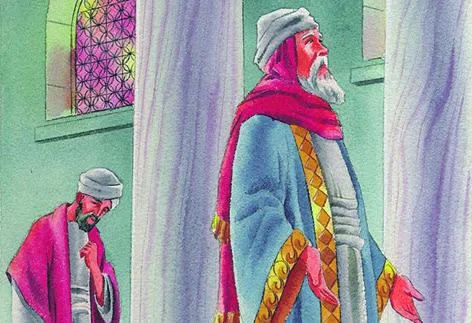
Two men went up into the temple to pray, one a Pharisee and the other a tax collector.
The Pharisee, standing by himself, prayed thus: ‘God, I thank you that I am not like other men, extortioners, unjust, adulterers, or even like this tax collector. I fast twice a week; I give tithes of all that I get.’
But the tax collector, standing far off, would not even lift up his eyes to heaven, but beat his breast, saying, ‘God, be merciful to me, a sinner!’ I tell you, this man went down to his house justified, rather than the other. For everyone who exalts himself will be humbled, but the one who humbles himself will be exalted. (Luke 18:9-14)
Jesus’s parable of the Pharisee and the tax collector presents us with two kinds of righteousness: an impressive parade of sham righteousness, performed for the world and admired by the world; and true righteousness, unrecognised by the world. We then hear two strange sentences of judgment, condemning the apparent saint, and commending the poor sinner.
It’s all so familiar. We know the story, we know the punchline, and we know the Pharisee as the caricature super-villain. There seems no obvious temptation to be like him. But we forget just how genuinely admirable the Pharisee was. Taken out of the parable and into our churches, he would be applauded as a model church elder, a pious paragon of godliness. Wouldn’t the world be a lovely place with more such people?
'We forget just how admirable the Pharisee was. Taken out of the parable and into our churches, he would be applauded as a model church elder...'
Yet we are too easily impressed by ourselves. The Pharisee certainly was. Scrupulous in all the wrong ways, he did not know his own heart. In reality, this disciplined and outwardly upright man was a gross transgressor against the very Law he claimed to uphold. He was a seeker of his own glory: he did not fear God or love Him or trust Him. Presuming to stand righteous before God, he did not seek forgiveness or redemption. He was false about himself and false about God, taking the name of the Lord in vain as he pretended with his prayers while worshipping himself.
In his treatment of his neighbour, the tax collector, he also offended against the second table of the Law. Seeing this sinner nearby, he had no mercy or sympathy for him. Instead, he contemptuously dismissed him, using him as a ladder for his own exaltation in his boast that he was ‘not like other men … or even like this tax collector.’
This pious Pharisee is self-reliance incarnate. With all his religious rigour and diligence, he is the model for all who want to be seen as holy and better than others, who reject their need for redemption, who think discipleship is about becoming better versions of ourselves.
In contrast, the tax collector saw clearly what the Pharisee did not. He appreciated the darkness within himself and how he continually offended God. Therefore, he could not comfort himself with his performance or trust in himself for any hope of heaven. Feeling his sin, he could only cry out for an undeserved mercy from God.
Yet as well as seeing himself more clearly than the Pharisee, he also seemed to detect something in God’s Word that the Pharisee did not. Where the Pharisee registered only God’s commandments (and them in a superficial way), the tax collector saw God’s promises. How else could he call for mercy unless he saw in God’s Word that the Lord is a ‘God merciful and gracious, slow to anger, and abounding in steadfast love and faithfulness, keeping steadfast love for thousands, forgiving iniquity and transgression and sin’ (Exodus 34:6-7)?
In the tax collector, we see a strange wonder: through grace, he knows himself to be a sinner – and then he clings only to grace! Yet then, because of that grace, he can no longer imagine that God could be unmerciful to him and so gives honour and praise to God alone. Having prayed for forgiveness, he is a changed man who could not want to continue in sin. And so the tax collector comes to fulfil the law as the Pharisee did not: he offers true worship to God as a merciful Saviour; he rests in Him, observing the true sabbath; and he now walks in His ways.
While the Pharisee is easily copied, the tax collector is less straightforward. For it is not a simple matter of the words he used. God is not merciful to those who copy his lowered head and mouth his words. The reason ‘this man went down to his house justified, rather than the other’ is that he humbled himself. Not that his humility itself saved him, but that in God’s kindness he saw himself for what he was – a sinner – and so cried out for mercy. In the tax collector we see heartfelt repentance.
We do not avoid the sin of the Pharisee merely by praising the gospel and God’s grace, or even by confessing that we are sinners. We can loudly assent to all that without true repentance, wishing instead like the Pharisee to be seen as holy and better than others. We can comfort ourselves with the thought that God is merciful to sinners and eagerly apply the Word of God when it rebukes sin in others, yet bristle with offence at any suggestion that we are less than perfect. So how can we be like the man justified? Luther, (in his ‘Second Sermon on Luke 18:9-14’, recorded in The Precious and Sacred Writings of Martin Luther) advised:
‘Be not a false but a real sinner; not only in words but in reality and from the heart acknowledge yourself worthy before God of His wrath and eternal punishment, and bring before Him in truth these words, “me, a poor sinner”; but in the same flight lay hold of the other words: “Be thou merciful to me.” ’
Are we willing to continually humble ourselves before our merciful and loving God?








Does Jesus hate people because of their ancestry?
I have been involved in reaching out to Muslim people for over 35 years and, surprisingly often, I hear Christians …