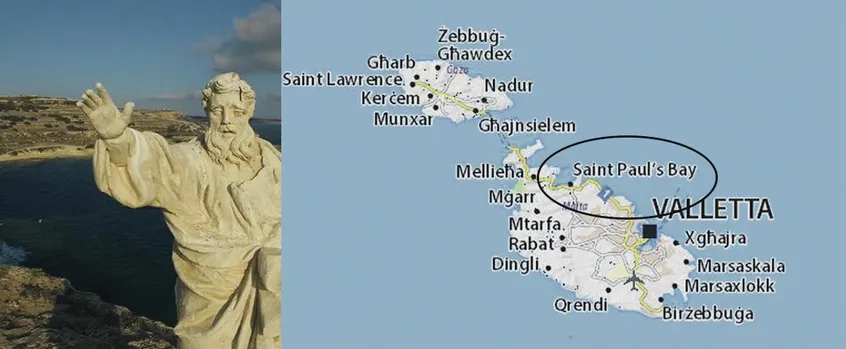
The question came to me as I woke this morning and pulled back the curtains in my hotel.
I was looking across the sea to a monument on a small island which is said to be the location where the apostle Paul was swept ashore, together with his two travelling companions, Dr Luke and Aristarchus. In all 276 people were miraculously saved. The graphic account of the perilous sea journey is detailed in Acts 27, where Luke gives a first-person account of the voyage.
Back in 1848, James Smith published a book The Voyage and Shipwreck of St Paul. He was a Scot, a soldier and keen yachtsman who was a Fellow of the Royal Society. He spent some time in Malta researching the authenticity of the Acts account, concluding it was an authentic eyewitness account, written by a landlubber not a professional sailor.
‘….no sailor would have written in a style so little like that of a sailor; no man not a sailor could have written a narrative of a sea voyage so consistent in all its parts, apart from actual observation.’
So Luke gets the vote of a professional for describing what must have been the most terrifying experience of his life. Battered by the infamous northeaster, and having not eaten for a fortnight, the travellers had given up all hope of being saved.
As I looked across the Mediterranean at the monument commemorating the miraculous landing and the way in which an unplanned detour brought the gospel to this community (see Acts 28:1-10 for the account), something else came to mind. Paul includes the event in his apostolic CV.
There were some who opposed his ministry and claimed he was unimpressive. They set themselves up as ‘super-apostles’ boasting in their eloquence and knowledge. Paul lists the many sufferings he had undergone for the sake of the Lord he loved. Read this list in 2 Corinthians 11:23-28:
‘I have worked much harder, been in prison more frequently, been flogged more severely, and been exposed to death again and again. Five times I received from the Jews the forty lashes minus one. Three times I was beaten with rods, once I was pelted with stones, three times I was shipwrecked, I spent a night and a day in the open sea, I have been constantly on the move. I have been in danger from rivers, in danger from bandits, in danger from my fellow Jews, in danger from Gentiles; in danger in the city, in danger in the country, in danger at sea; and in danger from false believers. I have laboured and toiled and have often gone without sleep; I have known hunger and thirst and have often gone without food; I have been cold and naked. Besides everything else, I face daily the pressure of my concern for all the churches.’
Paul mentions being shipwrecked not once but three times, and includes a night and a day in open sea. He insists these are his credentials as a preacher of the good news of Jesus. They are his marks of authenticity.
My early morning reflection reminded me that spiritual authority is not found in a leader’s designer wardrobe, private jet and fabulous wealth. These ‘credentials’ will one day be shown up for what they really are. We must never lose sight of this in Bible college training for ministry.
Real authority is seen in an individual’s capacity to serve selflessly and ‘throw themselves away’ for the sake of the gospel. Bible college training for ministry should produce such servant leaders rather than celebrity leaders. How do you spot a fake? By looking at the fruit. If it looks like selfless service it’s the real thing. If it is more about self-service, it’s a dud.






Get your church used to change – before it's too late
What if you’re a leader and you’ve run out of ideas?Amongst the many leaders I coach, this is a …