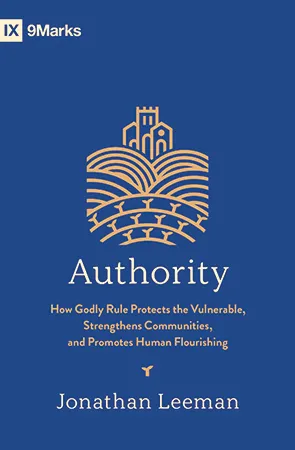
AUTHORITY:
How Godly Rule Protects the
Vulnerable, Strengthens Communities,
and Promotes Human Flourishing.
By Jonathan Leeman
Crossway. 304 pages. £16.99
ISBN 978 1 433 587 634
We live in a culture that is deeply suspicious of authority. Scandals in all our major public institutions have, for many, served to reinforce a profound post-enlightenment suspicion of anyone wielding power.
You see it everywhere: the stories we tell (every hero is the one who resists the powers that be); the prevailing attitudes to parenting, politics, and pastoral ministry (to name a few); the paralysis that many leaders feel when needing to act, for fear of being accused of abuse.
But we also instinctively recognise that, as Leeman puts it, ‘the solution to bad authority is seldom no authority, but almost always good authority’. There is something innate in us that desires to be under good authority – the inspirational coach, the loving parent, or the scrupulously fair judge.
That is why I think Leeman’s positive contribution is so timely and helpful. We want to know what good, ‘life-giving’ authority looks like, as well as to be able to spot the misuse of authority that steals and destroys.
Firstly, Leeman gets to the heart of the issue by defining what good authority is. He argues that it’s God’s good creation gift for sharing His rule and glory, and that having ‘authored’ life, God delegates authority to us to rule under Him for the good of others. Sin, of course, is the misuse of this authority, but Christ came to rescue and redeem, showing us that the purpose of authority is the service of others, and the right posture of authority is humility under God.
Secondly, Leeman argues that submission is the path to growth, authority, and likeness to Christ. It is deferring by moral constraint to another person’s judgment and deploying your sources for the sake of fulfilling that person’s judgment. As such, submitting to others (e.g. our parents) is how we grow, how we’re trained to make better judgments ourselves, and ultimately how we’re prepared to take on authority ourselves. Far from being dehumanising, it is the God-appointed means by which we grow to rule under Him. It’s never absolute, and always has limits, but submitting to (even imperfect) authority is designed to be life-giving. As with Christ, so with us.
Thirdly, Leeman gives five principles for how good authority works. It is not unaccountable, but submits to a higher authority. It doesn’t steal life, but ‘creates’ it by seeking to strengthen and grow those under it. It isn’t unteachable, but seeks wisdom (compare Joseph’s Pharaoh to Moses’s). It is neither permissive nor authoritarian, but administers discipline. This was a particularly helpful chapter, as permissive authority (failing to discipline when we should) is equally wrong and yet much more publicly acceptable. Finally, good authority is not self-protective, but bears the costs. In all of these, Christ is our example!
Fourthly, Leeman spends 150 pages helping us to think through what good authority looks like in practice, distinguishing between the authority of command (which can be enforced by force or discipline) and counsel (which cannot). In six incredibly helpful chapters, he teases out what this means for the former group (the parent, the state, the manager, and the church) and the latter (the husband, and the elder), teasing out what submission looks like in each case. These chapters are worth the price of the book alone.
Even if you don’t agree with every word (as I didn’t), I think most will greatly benefit from reading this. Whilst I imagine it will mainly be read by pastors, its conversational style and clear structure make it ideal for most book groups to work through. Buy it and read it – those who you lead will thank you for it!






Get your church used to change – before it's too late
What if you’re a leader and you’ve run out of ideas?Amongst the many leaders I coach, this is a …